(Almost) Every Rock Poster, Sticker, Reference, and List in “School of Rock”

School of Rock promotional poster

School of Rock promotional poster

School of Rock (2003) is one of my favorite music movies, and was on my previously published list of 30 Music Movies You Need to See Right Now. It contains a staggering amount of references to well-known rock bands through the decades. But it also contains a surprising amount of small nods to lesser known artists—the kind you would only catch if you already loved those bands. So I did my best to catalogue what we have going on in the movie. Most of the references have some pretty interesting explanations, and the stickers that show up throughout the film span now only the decades, but numerous genres as well.

As it’s called the School of Rock, I only put time into doing my best to catalogue the rock artists and references, though during the “backboard scene,” labels like “R&B,” “Blues,” and “Hip-Hop” are clearly visible. I highly recommend checking out some (all) of these artists. I might be slightly obsessive, but I just like to think of myself as a music addict ;D I wanted to include as many pictures as I could, but since there are so many, I had to choose just a few. I left out album covers since those are easily recognizable, but grabbed a few screenshots of the awesome blackboard tree and a bunch of the stickers. Enjoy!

Posters:

Poster Collage

Posters from Dewey’s room; clockwise: Sex Pistols, The Who, Ramones


Stickers:

sticker collage

Stickers from Dewey’s room and public telephone; clockwise: (First panel) AC/DC, Lunachicks, Nine Inch Nails, Beastie Boys, White Zombie, Voivod, Red Hot Cili Peppers, L.A. Guns; (Second panel) Ratt, Fugazi, Cannibal Corpse, The Chemical Brothers; (Third panel) Godflesh, M.O.D.

Albums:

References:

  • Jimi Hendrix – (when Dewey is trying to sell his guitar)
  • Led Zeppelin – (when Dewey references bands that rock!)
  • Black Sabbath – (when Dewey references bands that rock!)
  • AC/DC – (when Dewey references bands that rock!)
  • Motörhead – (when Dewey references bands that rock!)
  • Spice Girls – (Dewey refers to Katie as “Posh Spice” when assigning band positions)
  • Blondie – (Dewey refers to blonde girl Marta as Blondie when assigning band positions)
  • Neil Peart (Rush – drummer) – (Dewey refers to Peart when handing Freddie the album 2112)
  • The White Stripes/Meg White – (Freddie refers to White when discussing “great chick drummers”)
  • Glam rock/metal – (Billy refers to glam fashion when making the band’s costumes)
  • Kurt Cobain (Nirvana – vocalist/guitarist) – (Dewey calls Zack Kurt Cobain when asking to hear the song he wrote)
  • “For Those About to Rock (We Salute You)” by AC/DC – (lyrics recited by Dewey in his speech to class the night before the Battle of the Bands performance
  • AC/DC – (No Vacancy bassist’s shirt during Battle of the Bands)
  • Angus Young (AC/DC – lead guitarist) – (Dewey’s schoolboy uniform during the final Battle of the Bands performance is a direct reference to the schoolboy uniform Young is famous for wearing onstage; his burgundy Gibson SG model guitar is also the same model as Young plays)
  • Sex Pistols – (referenced by Freddie when he notes “Sex Pistols never won anything” after the Battle of the Bands show)
  • Ramones – (Zack wears a Ramones shirt during the credits scene)
  • Green Day – (Freddie wears a Warning shirt during the credits scene)
  • “Another Brick in the Wall (Part II)” by Pink Floyd (lyrics referenced on video/DVD release cover)
  • “Cum on Feel the Noize” by Quiet Riot (covering Slade) (lyrics referenced on video/DVD release cover)

Video:

Video collage; clockwise: Pete Townshend (The Who), Angus Young (AC/DC), Jimi Hendrix

Video collage; clockwise: Pete Townshend (The Who), Angus Young (AC/DC), Jimi Hendrix

Slideshow:

Slideshow of artists; clockwise: Iggy Pop, Kurt Cobain (Nirvana), The Clash

Slideshow of artists; clockwise: Iggy Pop, Kurt Cobain (Nirvana), The Clash

Riffs Played by Students:

  • “Iron Man” by Black Sabbath (played by Zack on guitar)
  • “Smoke on the Water” by Deep Purple (played by Zack on guitar)
  • “Highway to Hell” by AC/DC (played by Zack on guitar)
  • “Tough Me” by The Doors (played by Lawrence on keyboard)

Blackboard:


Collage of artists and music movements, part 1

Collage of artists and music movements, part 1

Collage of artists and music movements, part 2

Collage of artists and music movements, part 2

Soundtrack (songs from well-known artists, not songs only in the movie):

  • “Substitute” by The Who
  • “Sunshine of Your Love” by Cream
  • “Immigrant Song” by Led Zeppelin (this track is surprising since Led Zeppelin is famous for never letting any of their songs appear in film or on television)
  • “Set You Free” by The Black Keys
  • “Edge of Seventeen” by Stevie Nicks
  • “My Brain Is Hanging Upside Down (Bonzo Goes to Bitburg)” by Ramones
  • “Growing on Me” by The Darkness
  • “Ballrooms of Mars” by T. Rex
  • “It’s a Long Way to the Top (If You Wanna Rock ‘n’ Roll) by AC/DC – (played by students at the end of the movie as the credits start)

Featured Songs Not on Soundtrack (songs from well-known artists, not songs only in the movie):

Two Stories of Sexism in the Music Industry

The kind of BS sexism we need to eliminate

The kind of BS sexism we need to eliminate

The Scourge of Sexism

With the issue of gender equality fast becoming one of the central topics in Silicon Valley (and by extension, the tech and startups industries) at the moment, I can’t say I’m anything but pleased. The problem of gender discrimination and the glass ceiling is long overdue for a solution. While I harbor no fantasies that such a solution will be found overnight, I am nonetheless pleased to see that there is a major effort being made to reform these shortcomings in the tech industry.

As a male, I can confidently say that gender discrimination hits very close to home for me; my parents both practice civil rights litigation, with a focus in employment discrimination and sexual harassment. I grew up seeing cases of blatant discrimination (and unfortunately it makes me angry to say I still do), where the the ugly beasts of intolerance and sexism were clearly visible. The latter, in particular, surprises me again and again because we are taught to believe that we’re moving forward in eradicating sexism—but not fast enough in my opinion. We still have a lot of work to do.

While the tech industry is starting to really spotlight and root out sexism within its ranks (as well it should), other industries are lagging too far behind in my opinion. The music industry, for example, is still too hampered by outright sexism for my taste, even after movements like third-wave feminism and Riot grrrl punk began to shatter the mold. It’s not a foregone conclusion by any means, and there are many within the music trenches who are trying very hard to change it for the better—to level the playing field so that gender becomes irrelevant—so that talent is acknowledged and validated by its inherent existence, regardless of the artist’s gender.

But let me provide two examples of what can be changed, and how people can step in to make the music arena more tolerant and progressive. Neither example makes me happy to share (less happy to have experienced), but perhaps that underscores their importance.

The Sleazy Promoter

The first example happened a couple of years ago, in the spring of 2013, and goes like this: I am good friends with a band whose members included a female element (the singer and drummer). The group was set to work with a promoter to book shows in their home state (which, though eliminated by name, I can say is quite a big market for independent music). The promoter made inappropriate and unwelcome advances towards the female band member(s) and the group cut ties, not wanting to work professionally with someone of such poor character quality. The promoter then retaliated by threatening to call every promoter within the state, seeking to destroy the group’s reputation, thus effectively cutting out their feet from under them. (In this particular state, I can say with confidence that there are at least seven major cities and/or scenes that they most likely split their time between).

I was in Amsterdam at the time, on my study abroad program. I woke up one day to a frantic “what do we do?? we’re going to get totally screwed by this person!” email from the singer. Even through text it wasn’t hard to clearly read her fear and anger over the situation. So her solution? Reach out to me in search of some advice.

The response I sent her was simple: I explained to her that I was behind her, and would throw the entire weight of my blog and radio show behind her and the band (and would bring in other artists I knew for support if need be). I even offered to write a letter as a professional contact (DJ and journalist) attesting to their quality as a band and professionalism as people, which they might use to send to anyone to rebuke the slanderous threats of this sleazy promoter. She seemed calmed by that offer (and most thankful, as you can imagine!) and we decided to see just how events would proceed.

In the end, the promoter never made good on his threats, and the whole situation seemed to blow over. But I never forgot that frantic email (I’m sure she hasn’t either), and to this day I’m still good friends with her and the band. The point is this: such a situation should never have occurred, and it very quickly seemed to spin out of control. But in situations like these, one needs to have the wherewithal to step up for what’s right. I didn’t do anything I didn’t think others wouldn’t do in the same situation. You don’t do it for pats on the back—you do it because it’s right.

The Sexist Tweeter

The second example happened more recently, during the Super Bowl this year. One of the Super Bowl commercials was to promote the hashtag #LikeAGirl to promote gender equality. This is one commercial I loved and supported, and I made so known on Twitter. This was the result:

The sexism problem that needs to be solved

The sexism problem that needs to be solved

I was actually staggered by the sheer sexism of the comment that I saw on my post. Someone telling me that I was sure to “get laid” for supporting “those feminists.” I was angry—actually I was seething. Not only had this person insulted the women that my comment was meant to support, but had dragged my name down too by insinuating that my motive was “to get laid.” I work with numerous artists—many of them with a female element—and I was pissed that this person had seen fit to insult not only people I work with, but people who are my friends.

The music industry is like the tech/startup industry in this respect—not perfect by any stretch of the imagination, but trying very hard to get better. And here was someone dragging us back to the dark ages. This is exactly the sort of thing that people in both industries (or any industry) need to find and root out. The people who make these comments and hold these views are toxic. It’s not (and won’t be) easy, but it has to be done. And it will be.

I for one will be on the lookout for it in the music industry, and will call anyone on it. I encourage other to take aim at sexism and gender discrimination in their respective industries which they know best. Music is my world, and I will not have it polluted with this sort of poison. Don’t step into my house and disrespect my business contacts and friends, it’s as simple as that.

Studies on Van Gogh’s “Ravine”

The Setting

Vincent Van Gogh’s Ravine (1889) sits in the Impressionist Room of the Boston MFA, a breathtaking work of cool, subdued colors and broad-brushstroke technique. Set in a bright room under light cascading and reflecting off the other Impressionist works, Van Gogh’s Ravine is not immediately eye-catching. In contrast to the other works in the room by Signac, Renoir, and Monet, Van Gogh’s piece, though painted in the same Impressionist style, is not done in bright fluttering colors, but in cool tones of grays and blues that provide a more subtle feeling upon viewing. While the Renoir pieces to its right and left rely on heavy pinks, oranges, reds, and yellows, Van Gogh’s Ravine seems almost to hide from the eye at first, rather drawing its power from its simple and subdued cool impressions.

Van Gogh's "Ravine"; 1889; image courtesy of the MFA

Van Gogh’s “Ravine”; 1889; image courtesy of the MFA, Boston, MA

Utilizing the full spectrum of cool tones to paint the ravine walls, Van Gogh creates an undersea aura as he decorates the gray ravine walls with splashes of green, blue, and white. As the charcoal-gray tones set the backdrop for the ravine, Van Gogh’s introduction of the blues over it breathes into the work a sense of depth without which it would seem plain and flat.

A Clever Eye-Line and Clearly Cut Contours

Van Gogh illustrates for the viewer an eye-line looking directly along the ravine’s bottom, as if one were standing in the ravine itself. With his use of gray and black to sketch the cuts of the ravine walls, Van Gogh starts to depict for the viewer the illusion of a three-dimensional landscape. Yet if Van Gogh were to have used his blacks and grays exclusively, his illusion of a three-dimensional scape would not have been as effective as it is. By introducing blues and whites, Van Gogh takes his three-dimensional construction steps further. The navy coloring along the edges of the river carves out the path the flowing water takes as it winds its way through the canyon, and his use of grungier and brighter whites along the ravine walls creates for the viewer a sense of movement in the water.

Curvature of the river's cared out path

Curvature of the river’s cared out path


Movement Through Color

With the water movement outlined through his masterful use of blues and whites, Van Gogh then turns his brush towards giving the rushing body a depth for the viewer’s eye. Contributing sea-greens to the rushing bend of the water in the foreground of the painting, Van Gogh succeeds in creating for the viewer the illusions of depths of water flowing over one another, as the surface rushes and crash into bursts of white and light gray along the sides of the ravine. Indeed, Van Gogh uses particular colors to cut contours as well; his use of black (rather than a use of navy or gray) to cut out the small recess in the foreground of the painting makes the recess all the more stark and powerful, contributing to the overall movement-aesthetic of the work.

But perhaps Van Gogh’s greatest triumph in his color-usage in Ravine is the way he uses his colors to create movement and power in other areas besides the river. In the top recesses of the painting, Van Gogh uses lighter blues over grungier whites and splashes of navy to create the same moving sky as in many of his paintings. Indeed, the movement in the sky seems to mimic that seen in The Starry Night (1889). More than that, though, the sky seems to mimic the water of the river: the light sky-blues laid over the navy’s and whites create a rippling effect evocative of light on water.

The light-blue rippling sky above the ravine

The light-blue rippling sky above the ravine

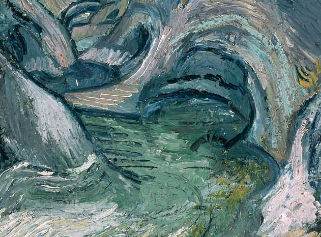
With the sky rippling above, Van Gogh sets about creating the walls of the ravine. There, sharp contours of black cut in mismatched and jagged patterns alongside gray rock-faces and navy shadows. The most striking thing about the way that Van Gogh paints the ravine walls is the strokes with which he does it; rather than straight lines intersecting at random points, Van Gogh uses swirling brushstrokes to create a flowing downward motion and feeling, opting only to create a few jagged protrusions toward the ravine’s bottom. In doing so, Van Gogh presents the walls of the ravine not as entities separate from the river and sky, but as similar parts of the same whole.

Screen Shot 2015-03-26 at 6.50.29 PM

The flowing sea-like plants on the ravine’s wall, right side


The flowing sea-like plants on the ravine's wall

The flowing sea-like plants on the ravine’s wall, left side

Upon the ravine walls, Van Gogh paints flowing canyon plants in red-oranges and sea-greens, with the plants having the added effect of resembling sea anemones and underwater seaweed. By adding such unique plants to the sides of the already flowing walls of the ravine, Van Gogh completes his creation of a marine world within the walls of the ravine. As if mirroring the flowing currents of an ocean or river, the waving plants dot the upper sides of the canyon walls, creating a “pop” for the viewer with their bright colors against the backdrop of the gray-blue-white walls.

Little Eddies of Stillness

Perhaps the greatest expression of movement with color in the painting, though, is Van Gogh’s use of dark grays and white to create boulders in the bottom portions of the work. In using such colors coupled with his curved brushstrokes, Van Gogh creates portions of the painting that act as metaphorical voids of movement; these voids are perhaps the only “stable” parts of the work, and in turn starkly contrast with the portions of the painting where real movement flows. For example, the boulders in the lower left-hand corner of the painting exhibit a very different type of brushstroke than that used to depict the plants and river around them. With their curved, almost subdued brushstrokes, the boulders create a break in the movement of the brushstrokes around them. Like an eddy in a river disrupting the initial inertia of the river’s flow, the boulders serve as barriers against which the movements of Van Gogh’s other brushstrokes crash.

The boulders in the lower left corner, providing a stillness

The boulders in the lower left corner, providing a stillness

With his brushstrokes long, loose, and flowing and his paint thickly applied, Van Gogh adds to Ravine the same feeling and effect as exhibited in his more famous works such as The Starry Night and Bedroom in Arles (1888). As in his painting The Starry Night, Van Gogh utilizes the technique of dividing the painting into sections, with each ravine wall making up a triangular section and the sky completing the final area.

Black and White

Still, though, one of the most intriguing aspects of the painting is not Van Gogh’s usage of marine and tropical colors, but his use of black and white. Indeed, Van Gogh uses white as a true color rather than a place holder, making use of different shades, with bright white “popping” off the walls of the ravine and the surf in the middle of the work, and a more subdued white blending with the blues in the sky. Van Gogh addressed this notion of black and white color usage in a letter to Émile Bernard in June 1888, stating, “I am going to put the black and the white, just as the color merchant sells them to us, boldly on my palette and use them just as they are” (Chipp, Theories of Modern Art, 1968, p. 32).

Black strokes blended with the greens and blues

Black strokes blended with the greens and blues

True to his declaration in his letter, Van Gogh uses the colors black and white as real colors in the work, not simply as backdrop colors to make the other colors of the painting appear more vivid. Rather than using black simply to define the lines and contours, Van Gogh blends black strokes in the with green plants, using it to add shadow and depth to the motion and flow of the plants along the ravine walls. Similarly, rather than using white to create a simple void on the canvas where other colored paint colors do not appear, Van Gogh blends in in the with river movements and the along the lower cliff faces, creating the rush of the surf crashing along the canyon walls.

Marine World

With his usage of broad brushstrokes, thickly applied paint, subdued colors mixed with brighter “popping” ones, compartmentalization within the painting, and rippling movement, Van Gogh’s Ravine is a brilliant tapestry of masterful techniques. Creating an almost marine-like world in the middle of a ravine, Van Gogh plays with something as basic as the setting of the painting, while at the same time still delivering strong movement through broad strokes (the river and the canyon walls) around areas of rest (the boulders). In pulling all of these aspects together, Van Gogh experiments not only with the nature of flow and movement, but also with the effects of particular colors upon those very motions.

Why Isn’t the Music Business Fully Crowdfunded?

Last week, I posted an article detailing VC Fred Wilson’s thoughts on investing, in which I drew on a few things he’d stated during his interview with Jason Calacanis at LAUNCH. This time around I want to explore another statement Wilson made during his time on stage which I thought received way too little attention at the time. In fact, I’m quite shocked that more people haven’t really latched onto this sooner.

At one point during the conversation, Wilson mused, “I don’t understand why the music business isn’t fully on Kickstarter,” to which there was some murmuring (I heard sitting in the audience), but no real discussion thereafter of that particular comment. While I was just as interested in the next point that Wilson discussed with Calacanis (the subject of my previous post), I couldn’t (still can’t) get my arms around how something so stark to many people seems to fly under the radar. But before I get too incoherent, let me back up and explain my exasperation.

The wonderful thing about Kickstarter (or any of the other crowdfunding platforms) is the freedom that they give to artists. In the case of the music industry, the freedom I’m referring to is the ability to not have to sign to a major record label in order to have money to finance an album, tour, video, etc. Instead, artists can go directly to their own fanbases and raise the required capital from them, thereby side-stepping the very real consequence of having to sign away some amount of creative control (ever hear of master tapes?) to the major label. As a result of this, artists consequently side-step the dynamic of accruing a similar sort of debt with the label itself. (I will explain the deeper economics at play here in a later post).

The dynamic of crowdfunding has changed the entire paradigm of the music industry. Wilson’s comments struck me so much because of how true they really are. He doesn’t need to be a guitarist in a band to understand that the freedom that services like Kickstarter give content-producing artists is invaluable (clearly the reason he invested in Kickstarter in the first place). His own “I don’t understand why” comment exhibits his understanding of the services that used to be out of reach of artists, which are now readily available thanks to crowdfunding dynamics.

Of course, crowdfunding alone can’t and won’t control an entire vertical like, say, the music industry. It’s one part of a larger mechanism. But it’s nonetheless a shift in the paradigm of music production, distribution and consumption that was previously unavailable. Where crowdfunding really comes into play is when it totally disrupts the age-old adage “live won’t save music” (but that’s an argument for a later post).

Here’s the real point: Fred Wilson is an investor, not a guitarist or aspiring singer. Yet he sees the value of crowdfunding so much (investment interest aside) that he doesn’t understand why any artist would forgo the opportunities presented by these new services. And I’m inclined to agree with him (and I’ve been in the music industry now for years). So here’s the real question: if he gets it, and I get it, don’t you think that all the new artists out there get it too?

It just might be a very short time until the music business is fully (or mostly) crowdfunded.

30 Music Movies You Need to See Right Now

While racing my brain today for a topic to blog about, I found my mind wandering to the music-centered movies that I wanted to watch this weekend. After some listing in my head, that seemed like a cool topic in and of itself, since I find that so many of my favorite music movies go under the radar. As it’s been a while since I last posted a list at all, I figured that today seemed an ideal time to put up a new one. So here are some of the best music movies in my opinion—docu-/rockumentaries, mockumentaries, and just plain good flicks. These are just some of my favorites based on my taste—there are a ton of other amazing music-centered movies out there (in no particular order). Check ’em out:

Mockumentaries

  1. This Is Spinal Tap – 1984

Rockumentaries

  1. About a Son – 2006
  2. 1991: The Year Punk Broke – 1992
  3. Hype! – 1996
  4. PJ20 -2011
  5. LoudQuietLoud: A Film About The Pixies – 2006
  6. The Decline of Western Civilization – 1981
  7. The Decline of Western Civilization Part II: The Metal Years – 1988
  8. The Decline of Western Civilization III – 1998
  9. The White Stripes: Under Great White Northern Lights – 2009
  10. Some Kind of Monster – 2004
  11. Anvil: The Story of Anvil -2008
  12. A Band Called Death – 2012
  13. Rush: Beyond the Lighted Stage – 2010
  14. It Might Get Loud – 2008
  15. Metal: A Headbanger’s Journey – 2005

Biopics

  1. 8 Mile – 2002
  2. Walk the Line – 2005
  3. Ray – 2004
  4. The Runaways – 2010
  5. Hysteria: The Def Leppard Story – 2001
  6. What We Do Is Secret – 2008

Fictional

  1. School of Rock – 2003
  2. Rock Star – 2001
  3. Empire Records – 1995
  4. That Thing You Do! – 1996
  5. The Blues Brothers – 1980
  6. High Fidelity – 2000
  7. Almost Famous – 2000
  8. Tommy – 1975

Fred Wilson Believes in Things That Everyone Else Thinks Are Wrong (But Are Actually Right)

A couple of weeks ago I attended the LAUNCH Festival in San Francisco, where I saw a number of amazing speakers over a three-day period. Needless to say the cross-country trip from Atlanta was worth it. However, despite the fact that there were numerous speakers whose points have stuck in my head since then (particular favorites of mine were Yancey Strickler (Kickstarter), Jeff Weiner (LinkedIn), Chris Sacca (VC) and Tony Hawk (yes I’m a huge fan of skating and the Brown Brigade)), the speaker whose comments were most easily accessible to me was Fred Wilson (Union Square Ventures).

Since the wrap-up of the festival, Jason Calacanis has published a couple of posts and tweets noting the fact that his fireside chat with Wilson was one of the most popular interviews of the whole event. This I readily believe, as I sat with rapt attention as Wilson discussed a number of topics. Actually, Wilson made so many good points during his chat that I need to dissect it through a number of posts rather than in just one.

Of particular interest to me though was one thing that Wilson said. It clearly demonstrated to me his line of thinking when it came to identifying new companies that he liked to become (or was likely to become) involved in: “Believe in something that everyone thinks is wrong (but actually turns out to be right).”

That terse statement, which Wilson actually attributes as something Bill Gurley once wrote, underscored his thinking when it comes to herd-mentality and how he identifies opportunities. While I’m sure there are certainly other factors at play, the qualifier word “wrong” is an interesting choice for his (Gurley’s) adage; it implies quite clearly that he identifies opportunities not only in areas or with companies that might be viewed as rare or unconventional, but ones which may be entirely against the grain of “logical” thinking at the time. This by extension highlights the fact that one can expect Wilson’s current and future investments to be in areas or companies wherein others might not dare even entertain the notion of involvement. He benefits from the fear factor that clears the road in front of him to make it an open highway while others see the words “do not enter.” [1]

Though I’ve followed Wilson’s blog for some time now, since LAUNCH I’ve been reading his posts with this new thought in mind. With each new post I read, there’s now that nagging question in the back of my mind: “what’s the thing in this post that Wilson has identified that others think is flat-out wrong (but is actually right)?” There isn’t always a phrase with a blinking sign screaming “it’s me!” but the point remains that with each subsequent post comes a learning opportunity to go back and reexamine a possibility that I might have dismissed earlier as a “do not enter” sign.

I’m interested to see Wilson’s posts over the next month or so. I’m curious to see what piques his interest enough to blog about it that others may have already dismissed or avoided. I suspect that Wilson’s thought process might very well be as alternative as his Egon Schiele-esque Twitter profile pic (by the way Fred, kudos on that; art-history nerds like me rejoice in the fact that so many within the tech industry use so much modern art imagery). I believe that’s precisely how he’s able to identify opportunities that others miss, or dismiss altogether.


Thanks to Dad for reading drafts of this.


Notes


[1] Wilson also stated that he had been on the board of a non-profit called DonorsChoose for a few years, which, as he put it, “does exactly, exactly what Kickstarter does” for teachers and public schools. As a result of his involvement with this previous venture, which was raising between $30-40M at the time, Wilson notes that he had a bit of an inside look at the very sort of mechanism upon which Kickstarter was building.

Why Music Journalism Bias Works

A Shopworn Adage

When I began music blogging, one of the first things I heard repeated over and over was the phrase, “you need to be unbiased in your journalism.” I heard it even more when I shifted my focus from writing about artists that everyone already knew about to ones that people should know about. As I retuned my radar (under the moniker Underground Takeover) to scan for artists that were up and coming, I noticed that the skepticism became more palpable; it seemed that writing a post slamming a new artists—being “unbiased”—was somehow a badge of honor that marked one as “a real journalist.” Yet something didn’t fit.

Me with Those Mockingbirds at The Middle East in Cambridge, MA, 3/9/14

Me with Those Mockingbirds at The Middle East in Cambridge, MA, 3/9/14

The shopworn adage that music journalists should be and need to be unbiased when reviewing music doesn’t work in practice simply because it’s based upon a flawed premise. Non-bias works well in coverage of politics and economics—however, it does not work well within the realm of music and art. Music is an individualized, subjective response to the world or to life by each respective artist. It is a contradiction in terms to try to judge that individualized, subjective response by an impersonal, objective standard, even assuming that we could agree on what that standard is. In addition to that internal contradiction, the fact is that so-called “objective” music journalism is unenjoyable to read either by the music fan or by the artist. Indeed, I didn’t—and still don’t—like writing negative music journalism. Concluding that a work of music is either “great” or “terrible,” or somewhere in between, fails to provide the reader with an understanding of the artist’s intent, or worldview, or what the artist was seeking to express by his or her creation.

Music At Its Core

At its very core, music is simply another form of art; an expression by one or more creative minds of how they see and interact with the world. As with all forms of art, you either like something or you don’t. You may like it somewhat, or it may grow on you after a period of time. All of these possibilities have nothing to do with how “good” or “bad” something is. Within the context of art, concepts of “good” and “bad” don’t exist. How can they? I’m not much of a Rolling Stones fan, but there are a ton of people who are. I’d prefer to listen to a Wipers album (if you know who the Wipers are, then I’m impressed), but my preference doesn’t make me right or wrong.

What I learned from my days in music journalism is that, regardless of what one might glean from watching Almost Famous or reading Rolling Stone, today’s world with the internet and plethora of music blogs and journalists has brought about the democratization of music journalism. This has created a new view of music journalists within the music community, both by artists and by journalists as well. This new perspective is that if you write negative pieces, you’re just some fool with a laptop and internet connection; but if you write positive pieces, then you become a credible news source. And amazingly, this new understanding of music journalism is held as much by music fans as by the artists themselves. After all, when someone attacks an artist I love as “derivative” and “overdriven,” then that journalist attacks me by extension, an action which does not engender a positive feeling in me for the writer.

Me with Sunshine & Bullets at Smith's Olde Bar in Atlanta, GA, 7/5/14

Me with Sunshine & Bullets at Smith’s Olde Bar in Atlanta, GA, 7/5/14

I expect that the established music journalism world will say that without articles ripping new album releases, music fans will be unable to know what’s “good” and what’s not. But as demonstrated already, that line of thinking is flawed in itself since the notions of “good” and “bad” don’t exist within the confines of art at all. You either like something or you don’t—”good” or “bad” simply don’t enter into the equation. (Outside the scope of music journalism, interestingly enough, Marc Andreessen makes a similar point about journalism in general in the new age here, when he spoke last year at Stanford).

I do not advocate for writing positive pieces about music one doesn’t like. If you don’t like a piece of music, it’s impossible to fake a positive review written well enough to fool a reader. Thus it becomes clear that one should write about the music that really resonates with one’s personal tastes. Don’t write rap music journalism if you’re a punk fan. But the flip side is also true: when you’re writing about something you absolutely love and can barely contain yourself long enough to lay the words down on paper because you’re dying to get back to that song again—well your audience can also tell that, and from my experience, that’s when you have them hooked.

Don’t Be “The Enemy”

The added benefit to writing positive pieces about music you like is that you very quickly begin to develop relationships with those very artists. You will no longer be held at arm’s length—as “the enemy” portrayed in Almost Famous. Instead, as you become as much of a fan as those who attend the artists’ shows, you will benefit from reciprocal artist loyalty in most cases that becomes indispensable to you as a writer. I could never have imagined how much reputation is tied to what and how you write until I started getting emails from friends of friends of artists I’d reviewed, asking me to review or interview bands they knew, or their own bands. This opened me up to opportunities I’d never even considered but retrospectively was so lucky to be able to be exposed to (something that Steven Sinofsky talked about here, when he spoke at UC Berkley last year).

Me with June Divided at Warped Tour Atlanta, 2012

Me with June Divided at Warped Tour Atlanta, 2012

Within my own universe I began to do things I’d never thought of. Writing music articles turned into artists seeking me out to do interviews (and making themselves readily available to do so), artists sharing demo mixes with me weeks or even months before final products were released, and artists asking for my opinion, initially just as a fan and eventually as a friend. It’s a wonderful feeling to see your name in the liner notes of an album by an artist you so doggedly support.

Through all of these experiences, I became privy to things that I never could have, had I been shut out as the “enemy journalist.” Having a reputation as an “album killer” may be good for climbing the corporate ladder at an established music magazine, but it’s counterproductive in the real world of music. If you want to sit behind a desk all day and write reviews that will garner views because of how ruthless they are, by all means do that. But if you got into music journalism to talk to artists (which I do daily), to go to shows and (very possibly) get waved past security backstage (which I have been often), to get press access to festivals like Warped Tour (draw your own conclusions here), and grow a reputation as someone to be in contact with within your industry (draw your own conclusions here too), then I highly suggest reaching out with a positive keyboard to this industry.


Thanks to Dad, Charles Jo, Scott Menor, and Terrence Yang for reading drafts of this.

Taylor Swift Can’t Sue Me Yet

Last week, I posted an article detailing Taylor Swift’s statement that she intends on trademarking phrases from her most recent album 1989 like “this sick beat” and “party like it’s 1989.” I found the statement equally outrageous and unsurprising, as Swift seems intent on continuing to provide headlines in the wake of Swiftgate. [1] My disdain for this sort of play by Swift is fairly apparent.

Taylor Swift; Image courtesy: Getty Images for Moet & Chandon Astrid Stawlarz

Taylor Swift; Image courtesy: Getty Images for Moet & Chandon Astrid Stawlarz

But let’s back up for a moment. My disdain is not brought on by some anti-business philosophy or pro-starving-artist sentiments. That would make it super convoluted and essentially amorphous in meaning. It’s actually a lot simpler than that: my disdain is driven by how Swift’s actions are affecting her fans, and the subsequent results that may (and most likely will) occur. While I applaud Swift, and artists like her, for taking their business futures by the horns and seeking to transform themselves from solely artists into artists/business people, I do not agree with the way in which Swift is going about it. And apparently, neither do some of her fans.

Today, Buzzfeed reported that Swift’s lawyers began threatening Etsy sellers with legal action (which we all know is code for “we’re going to sue you the minute the ink dries”) if they didn’t take down products they were selling which referenced either Swift’s lyrics or music. Normally this would be a completely reasonable thing to request (though in this case, the “request” is actually a demand), except for 3 things:

  1. The respective Etsy sellers were selling one-off items, or just cobbled-together fan paraphernalia; hardly enough to either cause Swift any sort of economic hardship or make her any real money anyway
  2. Swift doesn’t own the trademarks yet
  3. Swift is biting the hand that feeds her (her fans), and appears happy to keep doing it

So let’s take these one at a time. Regarding point number one, we’re talking about little pieces of jewelry or candles with bits of Swift’s lyrics referenced—hardly enough to be of any real threat (or benefit) to her “empire.”

Number two, as is clearly spelled out in this Time article, in 2014 Swift merely applied for the trademarks she’s already aggressively protecting. That means she actually has no right to be sending letters with threats of legal action right now; at least not until the USPTO awards her ownership over her prospective trademarks. So, from a strictly legal point of view, Swift is very clearly jumping the gun on threats of any sort of trademark infringement lawsuit. [2] That means that this great song by progressive-metal artist Peculate is not only awesome, but completely legal (at least for the time being):

Now the last point, and actually the most important of the three: Swift is actively alienating her fanbase and leaving a bitter taste in the mouths of (possibly former) fans. Swift is so focused on protecting her (as of yet un-granted) trademarks that she is biting the hands that feed her. Let’s see what some of the Etsy sellers/Swift fans have to say:

One Etsy owner/fan said:

When we got the email that the trademark infringement occurred [(which, by the way, it hasn’t yet)], we were shocked…We were scared. We didn’t even make enough money for a lawyer…That same day, we saw that Taylor was attempting to trademark a variety of phrases trying to get them blocked from being sold. After seeing that, we grew a little angry and felt targeted by her camp. It didn’t seem like much of a coincidence anymore.

Another wrote:

Obviously an artist has a right to their art and people should respect that. But at the same time most people, like us, are trying to be respectful and contribute to the excitement that the artists brings into our lives. When that is taken away, it leaves us with a bitter taste in our mouths. It feels as though we don’t matter [to her.]

Swift’s actions will cost her very much in the long run, I believe. While it’s true that Swift is entitled to a share of any money made through sale of products that reference her material, I wonder if alienating her fans could possibly be worth the $1.60 she might receive in a one-time royalty. One commenter on the Buzzfeed article pointed out the reality that there is a ton of fan-made Harry Potter stuff floating around out there for sale, but J.K. Rowling doesn’t go around sending cease-and-desist letters to all those sellers.

Ironically, so many times in the music business, artists encourage fan art and expression; it helps them to build their brand and following. In fact, I see daily posts on my Twitter feed by the artists of fans’ work that they love. I’ve seen drawings of band members, bracelets and jewelry with the band name, and shirts with artists’ logos and lyrics all submitted by fans to the artists as away of showing their support. And so many times I find the artists so grateful for the allegiance and passion that they repost the pictures and encourage other fans to send in pictures. This is how you build a bridge to your fans.

In the music industry, it’s all about reputation: reputation amongst peers and reputation amongst fans. Few other things matter as much as those realities because those are the two realities that one can count on, particularly when things get tough. It can be a hard market, but if you’re an artist with a great reputation amongst peers, other artists will continue to want to play shows with you, vouch for you, encourage their fans to go see you. And your own fans will take up your flag. But if your reputation sucks, frankly, you’re lessening your chances of having any of those things.

Maybe Taylor Swift doesn’t care—I can’t and won’t presume to know. Here’s what I do know: her reputation is taking a beating in the music trenches, even if her wallet isn’t. 1989 sold a ton of copies and that’s great, but selling album copies doesn’t automatically rehabilitate one’s image amongst one’s contemporaries. Ironic though it may seem, the way things are going, Swift’s own fans are going to be a major headache for her camp in the future. Many of them feel betrayed, targeted, taken for granted. And that’s rule number one in this industry: never ever take your fanbase for granted.


Thanks to Mom for reading drafts of this.


Notes

[1] My first article on Swiftgate can be found here, with the follow-up piece here.

[2] This means that the poem I wrote at the bottom of my post last week is completely legal. (Though one could also argue quite successfully that it would be anyway whether Swift has been granted the rights or not since it falls under a creative parody license).

Navigating Swift Currents

As we come to the end of 2014, things seem quiet in the music-tech arena—at least for now. Yet it wasn’t too long ago that things were blowing up between Spotify and a number of artists over royalty rates and compensation practices. No doubt the most famous of these disputes (this year) was between the streaming service and popstar Taylor Swift. In what has come to be known by some in the tech and music communities as SwiftGate, Taylor Swift abruptly pulled her entire catalogue from Spotify just around the same time that she released her new album 1989. The response was nearly biblical.

All I saw for weeks on end was a back-and-forth exchange of words, accusations, arguments, and media coverage between Swift and Spotify. Even the service’s CEO Daniel Ek took time to release a public statement responding to Swift’s qualms with the service. This was definitely a story with legs—it just didn’t seem to die down.

Yet what struck me the most were not the statements made by either side, or even the statistics each used to bolster their respective cases. I was more focused on the amazingly divided response that Swift’s actions and statements generated from her fans. Personally, I’m ambivalent—I enjoy some of Swift’s music, though not all, and would not call myself either a major fan or a hater. When Swift wrote her op-ed piece in the Wall Street Journal earlier this year, though, there were immediately a couple of things I didn’t agree with. Perhaps the most presumptuous statement I thought, though, was:

“Music is art, and art is important and rare. Important, rare things are valuable. Valuable things should be paid for. It’s my opinion that music should not be free, and my prediction is that individual artists and their labels will someday decide what an album’s price point is. I hope they don’t underestimate themselves or undervalue their art.”

This statement, though most likely made with the best of intentions, comes across to many within the music community as narrow-minded and out of touch. First, I readily agree with Swift that music is indeed art; art is subjective and highly personal to each person who experiences it. But art is not inherently rare. Nor should it be. This is an outdated concept that smacks more of a stuffy art-history academic than a modern musician. Art as a commodity, or even simply as a means of expression, should derive value from its inherent existence and experience; economic value is secondary to the very nature of what art is. In stating that art requires qualities of rarity and economic value in order to be valuable as art, Swift thus demonstrates a misunderstanding of what art functions as at its core. The concept of music as free is a notion that I will tackle in a later post (probably more than one), but what I will say with regard to Swift’s analysis is to point out how narrow its definition is. There are a great many artists who distribute their music for free, either online or as free giveaways at shows. By insinuating that these artists are devaluing their own art by making the decision to freely distribute, Swift does two things: 1) she demonstrates a worldview that is essentially narrow in its scope, and 2) she effectively succeeds in insulting these artists, more or less stating that they’re not smart enough to “know better.” It’s been a while since I performed as an artist in my own right, but even I still take offense to the above insinuations. Am I really to believe that Swift never played a pass-the-hat acoustic set at a Starbucks or diner somewhere when she was just starting out? [1]

But back to the response to Swift’s sparring with Spotify. If the goal was to generate a media response, then such a goal was certainly achieved. The responses from Swift’s fans in the general music community were far more diverse than even I would have thought. They ranged from those championing her decision and statements to those swearing they will never buy another Swift album from here on out (of course, the latter of those is hardly a statistic that can be confirmed at present). Yet what I focused on through this whole maelstrom of attention and biting back-and-forth comments was the way it could very conceivably (and most likely did) affect Swift’s fans on a psychological and emotional level.

Music, as stated, is emotional and highly personal. There’s a certain identification that one feels when one identifies with a particular artist, song or album. The psychology of wearing a shirt with an artist’s moniker on it effectively marks one as flying a flag for that artist—they become an extension of oneself—an extension of us. We use an artist’s music as a way to expand our sense of expression to the world. That makes our identification with that music highly volatile. Snap decisions like Swift’s have the opportunity to aggressively backfire (depending on one’s point of view, I suppose). Thus I question the long-term effect of Swift’s actions and statements. Yes, the immediate effect was fantastic for her: sales of her new album 1989 blew through the roof upon it’s release on Oct. 27, 2014. It opened at number one on the Billboard 200 and sold over 1 million copies. But I can’t help but focus on the gripes of those fans who felt personally betrayed by Swift’s removal of her catalogue from and subsequent sparring with Spotify. Are those fans going to go see her on tour? Buy a shirt? Tell their friends about her new album? Probably not. The way I see it, Swift has effectively traded long-term benefits for short-term gains. One thing I know about music and artist-loyalty is that it can be a fickle beast. The possible (probable?) effect of dividing her fanbase I think will constitute a major challenge for Swift to overcome in the future. She will have to spend time, energy, patience (and most likely money) trying to reconnect with those fans she might have alienated or even lost.

While it’s possible that the short-term gains may have been worth it to Swift and crew, I think the next currents will prove more difficult to navigate in the coming months. I think Swift has a lot of work ahead of her, and a lot of damage-control to partake in (ironically, not unlike the damage-control that Metallica faced in the wake of the whole Napster controversy). [2] I suppose only time will tell. We’ll reassess in the new year.


Thanks to Alyssa Shaffer, Charles Jo, Mom, and Dad for reading drafts of this. (And to Paul Graham for reminding me that thanks are as much in order for assistance as much as publication of the final product).


Notes

[1] Within the music community, the term “pass-the-hat” most readily refers to a (usually) acoustic set where no cover charge is required, and the artist relies mostly on the generosity of the audience to throw a few dollars in a hat or the guitar case to show their appreciation for and enjoyment of the performance.

[2] As many may remember, when Metallica waded into the thick of the Napster controversy in 2000 (most visibly driven by drummer Lars Ulrich), their rabid fanbase subsequently split into those who supported Metallica’s decision and those who vehemently opposed it. The alienation of a portion of their fanbase proved a challenge that took Metallica a number of years to surmount (and arguably one they are still surmounting). It affected both their sales of merchandise/tickets and their reputation within the music community.

Basquiat’s Prevalence in the Tech Space

As an art history student, Jean-Michel Basquiat spoke to me on a very cerebral level. He was (and is) art in its rawest form since perhaps the action paintings of Jackson Pollock, with half the amount of time lived, and probably a quarter (or none) of the experiences of Pollock. Basquiat’s death at 27 (yet another addition to the 27 Club) was tragic in more ways than one, but perhaps the greatest loss from an academic perspective is the loss of such a natural talent and artistic genius. It makes sense for Basquiat to command so much of my attention; I studied art history in college and find something calming about it. But what’s so intriguing to me is that prevalence of Basquiat’s work in the tech community, something I’m beginning to see more and more.

Jean-Michel Basquiat

Jean-Michel Basquiat

I’ve seen Basquiat paintings retweeted and made as backgrounds, and have come to question just how much Basquiat’s work connects with those outside the art community. Certainly works by one of his contemporaries, Keith Haring, are popular in society today. They grace shirts, backpacks and the sides of water-bottles. But comparatively, Haring’s work is understandably more mainstream-acceptable: there’s a unique sense of balance in it that appeals to the human emotion. As far as graffiti art goes, to the mainstream mind, it appears as doodles, almost child-like in its composure. And that’s exactly the way Haring wanted it–that was his style.

Crack Is Wack!; Keith Haring; 1986

Crack Is Wack!; Keith Haring; 1986

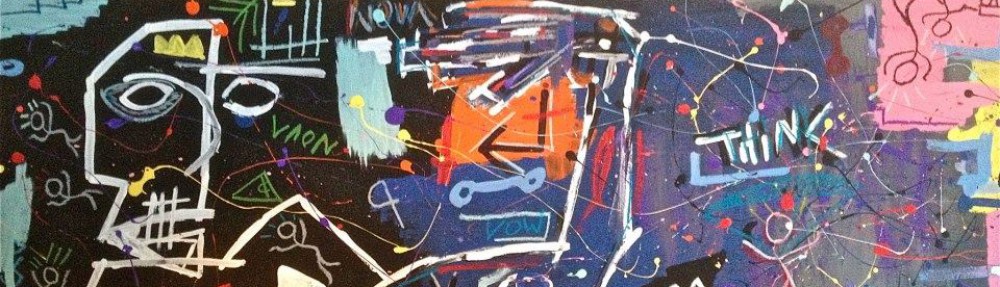
Basquit’s style, though, presents more of a bitter pill for a mainstream audience to swallow. It’s wild, rude, crass, raw, racial, emblematic, poetic, nonsensical, grungy, sloppy, brilliant. It’s not a pretty picture, nor a balanced composition, and thus presents the audience with an almost reversible set of emotions. It is at once both obsessive and nonchalant, as if Basquiat cares so much up until a certain point, then doesn’t at all beyond that. (More of the deep artistic undercurrents of Basquiat’s work later).

Boy and Dog in a Johnnypump; Jean-Michel Basquiat;1982

Boy and Dog in a Johnnypump; Jean-Michel Basquiat;1982

And through all this artistic rage and raw power, I’m intrigued by what I perceive of the minds of some in the tech community (though this, admittedly, is based on my own experience). Perhaps it makes sense that an industry and community so centered around creation would find such a riveting painter fascinating. Certainly it can be said that a good many within the tech sphere are driven by the desire to create and view the world from a continually evolving perspective. Would this, then, explain why I’ve seen Jean-Michel’s work pop up more than a few times in this intriguing community of tech enthusiasts? More research is necessary to find out.