An Artistic Analysis of Four Tech Investors

Seeing the World Through Artistic Eyes

Part of being an art student is that you inevitably see art everywhere, whether it’s meant to be noticed as art or not. This goes for anything—drawings, graffiti, cars, apps—and most recently for me, Twitter profile avatars.

Twitter avatar profile pictures of Fred Wilson (top left), Brad Feld (top right), Hunter Walk (bottom left), and Marc Andreessen (bottom right)

Twitter avatar profile pictures of Fred Wilson (top left), Brad Feld (top right), Hunter Walk (bottom left), and Marc Andreessen (bottom right)

As I was scrolling through my feed the other day, I saw a number of avatars go by, and my resulting thought process surprised even me—I thought wouldn’t it be cool to analyze those the way I used to analyze art pieces for my art history classes (well, cool is relative I suppose, but I’m an art nerd, so there). So that’s what today’s post is about: no talk of music, apps, or any major tech trends. Just an artistic analysis of the profile avatars of four tech investors. I wasn’t sure exactly how to order these, but I decided it would interesting to go according to an art history timeline, rather than simply by alphabetical order. Let the analyzing begin.

Fred Wilson

Fred Wilson‘s Twitter avatar is one of my favorites from an artistic perspective because of its striking power. I look at Wilson’s picture, which sets a large facial portrait against a lime-green background, and think immediately of the work of modern Austrian painter Egon Schiele (something which I’ve tweeted about numerous times). For those unfamiliar with Schiele’s work, he redefined the concept of portraiture in the early 20th century by daring to accentuate bodily features way outside their normal proportions. Some common aspects of Schiele’s work are overly-large eyes, and a strong, set jawline, usually defined by a sharp contour, which can clearly be seen in his pieces “Self Portrait” (1910) and “Self Portrait with Physalis” (1912).

Egon Schiele; left:

Egon Schiele; left: “Self Portrait” (1910); right: Self Portrait with Physalis” (1912)

Looking at Wilson’s picture, the enlarged eyes and clearly defined jawline fit the mold of Expressionism which Schiele helped to pioneer. The eyes are deep-set—almost sunken—but with a gleam that seems to burst from the canvas, made even brighter by the bold green that encapsulates the pupils. The cut jawline is mirrored at the top of the piece by raw, almost rugged strokes of brown making up Wilson’s hair. Yet while the zig-zag strokes chisel the top of the portrait in an almost sculpted way, the slight waviness of the hair on either side of Wilson’s heads help to capture a curved smoothness which bleeds out into the dynamism of the green background.

Fred Wilson Twitter avatar

Fred Wilson Twitter avatar

The life of the piece, though, is centered in the eyes, and the cheeks. The eyes swirl knowingly—disjointed only by the large space between them. The cheeks meanwhile, glow warmly with the only hot colors on the canvas: a roughly hewn pink which darkens towards the face’s edges. Even the the portions of the piece where the paint seems too thin are almost indicative of Schiele’s practice of leaving paintings unfinished. Collectively, Wilson’s avatar contains deep traces of Expressionism roots, though nodding to a lighter palette than was typically used in Europe at the time.

It’s also worth noting, however, that Schiele is not the only art master represented. Henri Matisse seems to make an appearance as well, mostly in the nose-area. While the nose seems almost too large for the face surrounding it, it nonetheless conjures up images of Matisse’s “Portrait of Madame Matisse (The green line)” (1905), or even his “Self-Portrait in a Striped T-shirt” (1906). Intentional or not, I nonetheless look at Wilson’s picture and see Schiele’s Expressionism and Matisse’s Fauvism and Modernism.

Henri Matisse; left:

Henri Matisse; left: “Portrait of Madame Matisse (The green line)” (1905); right: “Self-Portrait in a Striped T-shirt” (1906)

Brad Feld

Brad Feld‘s picture is similar to Wilson’s in that it’s a painted portrait. That, however, is where the artistic similarities end. Whereas Wilson’s piece drips of early 20th century Expressionism and Fauvism, Feld’s portrait exhibits a more mid-century style. The thinner mouth and quirky glasses add a Pop Art flavor to the portrait, a fact that’s exacerbated by the bright greens and purples that play through both the back and foreground.

Brad Feld Twitter avatar

Brad Feld Twitter avatar

While still set amid deeply defined contours, Feld’s jawline is nonetheless more curved and flowing than Wilson’s, and with the light stream of pink that follows the chin-line, Feld’s smile is captured perfectly. The curvature of the lower half of the portrait plays on the wavy strands of hair which sit at the top, floating in a controlled messiness which adds a sense of jubilance to the work.

The most striking feature, though, is Feld’s eyeline. Encased in straight-edged square glasses, the eyeline cleanly divides the portrait into two halves, thereby introducing a sense of order into an otherwise happy-go-lucky piece. The Andy Warhol-esque psychedelic color-scheme in the background is indicative of mid-’60s Pop, as is Feld’s mauve shirt collar. Seemingly taking direction from color-schemes like that in Warhol’s “Marilyn Monroe” (1962), Feld’s avatar bleeds with a real ’60s flavor.

Andy Warhol;

Andy Warhol; “Marilyn Monroe” (1962)

Of particular note, though, is Feld’s smile, which reminds me of pieces by a famous Pop artist, though not one the mainstream is too familiar with. James Rosenquist emerged separately from Warhol and Roy Lichtenstein, but is notable for his use of “the grin,” which can be clearly seen in the baby portion of “F-111” (1964-65) and in President Kennedy’s smile in “President Elect” (1960-61). The grin which plays through Rosenquist’s pieces finds a home in Feld’s piece as well, framing the portrait in visions of Pop from all styles of the decade.

James Rosenquist; top:

James Rosenquist; top: “President Elect” (1960-61); bottom: “F-111” (1964-65)

Hunter Walk

Hunter Walk‘s Twitter avatar isn’t hard to place; one look at it and the first thing any art student or aficionado would think is Roy Lichtenstein. The cartoonish quality of Walk’s picture is not only evident, but is the main focus of the piece itself. Whereas the previous pictures exhibited more subtle elements of the art movements which seem to be at play in them, here there is no question. The animated nature of the piece has a disarming effect on the viewer, making Walk’s smile seem all the more friendly.

Hunter Walk Twitter avatar

Hunter Walk Twitter avatar

Much like Lichtenstein’s “Drowning Girl” (1963), Hunter Walk is portrayed in a series of curves and flowing lines. Though obviously different subject matter than the aforementioned painting, there is nonetheless a similar ebb and flow that connects the two. Walk’s hairline is jagged only in certain spots, leaving the rest to create a circular movement around his head. The dynamism that this movement contributes to the piece cannot be understated because it is precisely mirrored by his shoulders and neck tilt.

Roy Lichtenstein;

Roy Lichtenstein; “Drowning Girl” (1963)

Rather than appearing stilted and set, Walk seems to lean into the movement, adding to its run through the picture. Even the shadowing of his beard and smile accentuate the flow of the centripetal movement. The darker shade of gray used for the beard moves along the face smoothly in some areas, and yet is cut sharply in others, much like the movement of waves splashing up against a cliff. The smile, meanwhile, is simple, but creates an eddie around which the flowing contours of the beard and facial lines must move.

Perhaps most interesting of all, though, is the way in which Walk’s beard in the piece seems to harken back to Lichtenstein’s common use of pointillism. While clearly one solid color throughout, Walk’s beard is nonetheless styled and colored in such as way as to appear to be more individualized than it really is. When compared to Lichtenstein’s oil piece “I Can see the Whole Room…and There’s Nobody in It!” (1963), Walk’s avatar seems to take on a different sense of shadow. As the man in Lichtenstein’s painting is lightly shadowed along his face to create a deeper perspective, so too does Walk’s beard in his avatar create for him.

Roy Lichtenstein;

Roy Lichtenstein; “I Can See the Whole Room…and There’s Nobody in It!” (1963)

Marc Andreessen

Perhaps the most post-modern piece of the four is Marc Andreessen‘s avatar, done in a way which most would describe as “South Park-ish” owing to its cut-and-paste style. While this is actually a good description based on South Park popularizing the cut-and-paste style in the last couple decades, it begs the question of what does that mean artistically? Is it just a cartoon? If so, why doesn’t it look like Hunter Walk’s Twitter avatar, which also exhibits a clear, cartoonish quality?

Andreessen’s avatar is a mix of post-modern, cut-and-paste qualities, but it also employs a sense of Pop which is prevalent in the other avatars. The sharp, clean lines cast the picture in brisk light, asserting that it’s so simple, there must not be anything under the surface. But there is.

Marc Andreessen Twitter avatar

Marc Andreessen Twitter avatar

The cartoonish Pop quality hides the other influences which dance through the piece. The basic oval-shaped hands, straight-line eyebrows and simple circular head harken back to the bare-bones approach towards geometry of Cubism, while the flat, cut-and-paste quality is indicative of the Superflat movement. As Cubists like Pablo Picasso and Juan Gris attempted to unravel the notions of geometry in art, so too did post-modern artists like Takashi Murakami desire to understand depth in a different way.

Right: Pablo Picasso;

Right: Pablo Picasso; “Girl Before a Mirror” (1932); left: Juan Gris; “Harlequin with Guitar” (1919)

The simple, circular curvature of Andreessen’s head in the avatar seem to mirror the circular head of the girl in Picasso’s “Girl Before a Mirror” (1932), while his egg-shaped eyes mirror those of the man in the Juan Gris painting, “Harlequin with Guitar” (1919). The flat quality of the avatar, however, jumps almost a hundred years forward, to the Superflat movement of the 2000s, pioneered by Murakami. As Murakami explored the flatness that depth could have in pieces like 2001’s “Tan Tan Bo,” so too does Andreessen’s avatar explore concepts of flatness and depth (perhaps without even knowing it). In its exploration of depth and geometry, Andreessen’s avatar is thus more artistic than it initially appears.

Takashi Murakami;

Takashi Murakami; “Tan Tan Bo” (2001)

Art and Tech Intertwined

Though these are just four analyses of four Twitter avatar’s it’s become clear that art and tech are more closely intertwined than perhaps initially thought. This might explain why I see pieces by Basquiat and other artists come up so often in the tech industry. But it may be even simpler than that—it may simply be that art resonates with people in the tech industry precisely because they are also in the business of creating as much as painters and sculptors are. Or maybe they just like how it looks, that’s a valid point too. In the end what matters is what you see when you look at pieces and avatars like this. For me, I see art that is deeper than what’s on the surface. What do you see?

Tidal Is Really Just a Ripple in a Larger Ocean

The Basic Background

Yesterday, Jay Z and company relaunched Tidal, the new music streaming company that they’re convinced is “the future of music.” After a $50+M purchase of Tidal (in the form of Aspiro) last year, Jay Z has been bending our ears with how the rerelease of the new service will be the best thing ever for artists, revolutionize the music industry, provide the best listening experience…blah, blah, blah. Only it likely won’t do any of those things.

Not the First Anything

In order to understand why Tidal likely won’t make good on any of the things Jay Z and his companions have promised, one needs to understand how the music industry works. First, let’s get something out of the way that’s been bugging me since I heard it during the launch party last night: “Tidal is the first ever artist-owned music service.”

No it’s not. NoiseTrade has been around since 2006, and was founded by singer/songwriter (that means artist) Derek Webb. So already it’s clear that the Tidal team needs to do a better job of researching their claims before making them.

No, It’s Really Not “Artist-Owned”

Next, the phrase “artist-owned service” is nice and poetic, but it’s frankly wholly untrue in this respect. Let’s examine the laundry list of artists now attached to the Tidal moniker and company:

  • Jay Z – Signed to Roc Nation (which he owns, and which had distribution deals with Sony Music (2009-2013) and Universal Music (2013-present)
  • Rihanna – Signed to Roc Nation (see above)
  • Beyoncé – Signed to Columbia (which is owned by Sony Music)
  • Alicia Keys – Signed to RCA (which is owned by Universal Music Group)
  • Daft Punk – Signed to Columbia (which is owned by Sony Music)
  • Madonna – Signed to Interscope (which is owned by Universal Music Group)
  • Kanye West – Signed to Def Jam (which is owned by Universal Music Group)

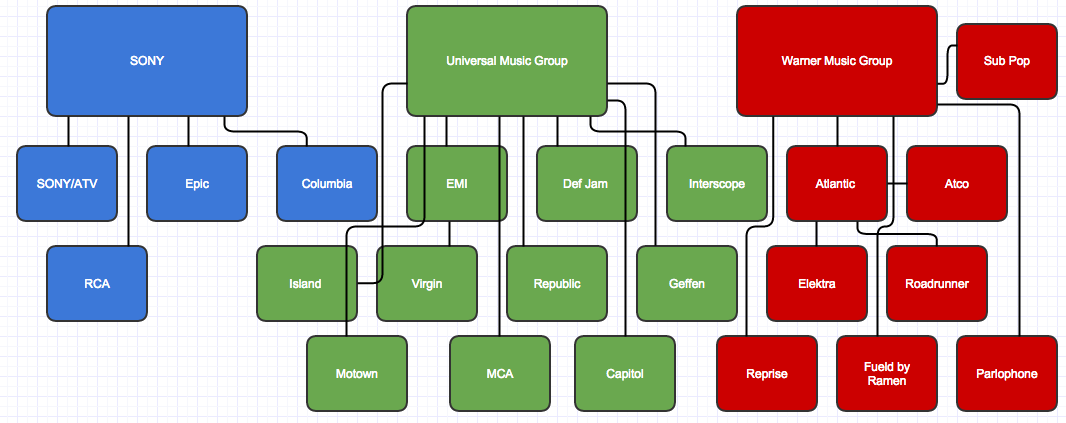
I could go on, but you get the point. This is not the “first ever artist-owned music service.” Frankly, it’s not really even “artist-owned;” it’s “label-owned by extension.” Let’s call it how it is, and pretending that these major label artists are independent operators is to fabricate an ideal (but false) reality. While it looks as if these artists belong to a whole slew of different labels, as my previous post on major label monopolies shows, this is a misleading thought process as they are more or less all owned by the Big Three. If anyone thinks that any of these artists will have the power to do things outside the interests of the three major record labels, they’re dreaming.

(click photo for larger preview)

The Big Three Major Labels and Their Subjects

The Big Three Major Labels and Their Subjects

Basically the Same Layout

Next, let’s talk about why the business model of Tidal is fanciful and unrealistic. TechCrunch reported earlier some details demonstrating that Tidal’s layout and functionality are basically a ripoff of Spotify’s layout. From what I’ve heard, Tidal basically copped Spotify’s layout, changed the colors, and added a few tweaks—but it’s not really all that different.

Married to An Obsolete Business Model

In terms of business model, what seems to make Tidal the most different is its decision not to offer a free tier (as Spotify and most other music services do). Rather, they will offer a high-quality lossless music experience for $20/month, and a downgraded, “premium” lower quality experience for the same $10/month that Spotify and other services charge (which, by the way, is an obsolete business model anyway). Jay Z and others at Tidal are banking on the hope that the rabid music fans out there will want to pay more money for higher quality music, in addition to more exclusive content on the Tidal service first.  While some music fans may in fact do this, it’s not a scalable hope because those fans are not the majority of music listeners.

Also, note that I said “more exclusive content on the Tidal service first“—which means it will definitely be available on other services too, just maybe a week or two later. And why not? Do you really think that the major labels who work with these artists are going to forego any revenue stream, just to keep Tidal more exclusive than the rest?? I don’t.

Tidal logo

 Tidal logo

So basically Tidal is going to offer the same major label music that is available everywhere else (including on non-music centered services like YouTube), but they’re going to nix the free tier (where most of Spotify’s conversions come from anyway) altogether and double the going rate for a monthly subscription. All the while, they will be aiming their service at a more niche market while providing non-niche music. Here’s my reality based on my experience in the music industry: high-fi, low-fi, it really doesn’t matter if your business model is outdated and your marketing strategy is insufficient for an overcrowded market. But yeah, this will definitely end well.

An Unscalable Model and Too Many Cooks in the Kitchen

Let’s move on, and I can’t believe no one has really focused in on this, especially those within the tech community (though it was mentioned a bit in the TechCrunch report): Jay Z has enticed these other major label names into becoming a part of this service not by offering them money up front, but by actually giving them equity percentages of the company. As reports that the equity numbers hover somewhere around 3%, this is an admirable shot by Jay Z. He’s trying to tie those artists’ respective loyalties to Tidal by making the service’s benefits their benefits. If Tidal does well and goes up in value, so do their stakes.

There are only two problems with this: 1) it’s not scalable, and 2) too many cooks in the kitchen. In an industry (tech startups) where founders are always told to limit the number of cofounders (the “too many cooks in the kitchen” nightmare”), Jay Z has amazingly disregarded the whole thought process and it seems no one has really noticed. What’s more, conducting company decisions in a “town hall” style is going to spell disaster for Tidal; you just can’t run a company like that. There needs to be one captain at the helm of a ship; any more and the ship will capsize. Also, keep in mind many of these artists don’t even work well with others in the studio—now they’re all going to run a company together? Right.

So to recap: unscalable business model and too many cooks in the kitchen.

More Dedicated to the Needs of Which Artists?

While I admire the desire by Jay Z and others to create a service that is more dedicated to “the needs and rights of artists,” let’s also be clear which artists those people are. They are not the artists the world-over who are coming up and trying to find their fanbases; they are the artists who already have legions of fans all over the world. We’re not talking about the girl from Minnesota who wants to be an R&B singer, or the punk band from Toronto who want to find their core fanbase. We are talking about (mostly) pop, rap, hip-hop, R&B, pop-rock, and other well-known stars who want to extend their control beyond their music to dip their toes in the music-tech industry.

I’m only critical because these are exactly the kinds of artists who really don’t need help right now. They have enough money, and even if they hop from label to label, their fans will follow. They have already found their fanbases and core listeners. It doesn’t matter which label or service they’re on, those fans will still find them and listen to their new albums and go see them on tour. So basically this is yet another rehashing of the same major label music that we’re already drowning in anyway. And while I’m a fan of some of these artists myself, I nonetheless am critical of what appears to be another desperate money grab. As the following screenshots demonstrate, though Jay Z and others may not see it that way, the point is that most of their fans will ( and do):

(click photos for larger previews)

Comment from BuzzFeed coverage of the Tidal release, number 1

Comment from BuzzFeed coverage of the Tidal release, number 1

Screen Shot 2015-03-31 at 3.12.36 PM

Comment from BuzzFeed coverage of the Tidal release, number 2

Screen Shot 2015-03-31 at 3.12.56 PM

Comment from BuzzFeed coverage of the Tidal release, number 3

Screen Shot 2015-03-31 at 3.13.12 PM

Comment from BuzzFeed coverage of the Tidal release, number 4

Screen Shot 2015-03-31 at 3.13.28 PM

Comment from BuzzFeed coverage of the Tidal release, number 5

If these artists really wanted to distance themselves from the major labels and the current music business dynamic, they would look for ways to explore other paradigms, rather than look for ways to make an obsolete system work.

In the End

In the end, I commend these artists for taking a step into a new arena, but I question their motives and the realities surrounding Tidal as a company. Personally, I think Jay Z way overpaid for Aspiro, and is seeking to build a service that really only artists (and that is to say a select kind of artist) will really appreciate and use. I don’t think that Tidal sets itself apart enough to really take over the demographics targeted by either Spotify, Apple Beats, or even SoundCloud. I think it’s a lot of bluster, but without any real solid business prospects. Only time will tell, but I think that Tidal is going to have a very tough time right out of the gate. We’ll see if Tidal is part of a rising tide, or simply another ankle-slapper service.

Artists Are Not “Bad Business People”

Two Differing Opinions

“Artists are not good business people; they need to be told what’s good for them.” Those were the exact words that came out of his mouth. And I disagreed with every single one of them.

But let’s back up. Last summer, I was having a conversation with an entrepreneurial peer of mine about the current state of the music industry, and possible avenues forward. He’d had some success with a small company working with a few venues, and with some other music industry professionals (who, as shall he, remain nameless). By all accounts, I thought my peer would have a positive outlook on the future of the music industry as he, like me, had experienced numerous problems that could be solved. And yet, his outlook was dreary at best; and at worst, insulting.

When we began discussing what possibilities there were to build tools to better enable artists to make informed business decisions, his response was terse, arrogant and negative: “Artists are not good business people; they need to be told what’s good for them.”

It’s All About Access to Knowledge

Immediately I knew our opinions on the evolving music industry would differ from then on. First, no, it’s not a true statement to say that artists are “bad business people” anymore than one could make the insinuation about construction workers, for example. In an industry where so much of the business has traditionally been done by a major label or other third party, artists are just now realizing that they have access to the tools to simply learn about how to be good business people, and many are taking advantage of the opportunity. No one would expect someone who’s never had access to a certain type of education to understand the intricacies of said education.

It comes down to simple access to tools and means of learning, traditionally things that have been outside the reach of most artists—after all, educating artists on the inner working of the music business never was in the best interest of the major labels. So if this is the case, why then would one criticize artists for not having knowledge of business dynamics when they have traditionally been denied such knowledge and experience in favor of a more “savvy” entity (a management firm or label, for example)?

Who Actually Knows “What’s best”?

Second, the statement that someone needs be told “what’s best” for them is beyond arrogant: it’s plain insulting. Many of the evolving concepts of business strategy that are popping up in the music industry nowadays I find are coming from the artists themselves. These are the people who are looking to new vehicles of distribution like the internet and new business models such as free or freemium as viable ways to push their careers forward. And from what I can tell, they’re getting pretty damn good at it. I find the things I learn that should have been so obvious to me many times come from discussion with artists themselves, opening my eyes to a reality I may not have previously considered or understood.

So if artists are continually researching and discovering new methods of business strategy to effectively compete in the new digital era, why is there still this pervasive view that they “need to be told what’s best for them?” Perhaps it’s just a difference of worldview, as with between my peer and myself. Whereas he appeared to see the world through a lens that was dismissive—and even bitter—I see possibilities abounding for how the industry can change with the technology available to give artists more power over their own careers. It’s arguable the in the end, the only opinions that matter are those of the artists, as they are the ones producing the material that so many other people are trying to find ways to monetize.

My Bet

Whatever the next big thing will be (and it’s anyone’s guess in this sort of fickle content market), what I don’t doubt is that artists will begin to step out from behind their guitars and amps to shape their own futures (much like programmers are being encouraged to step out from behind their keyboards and aspire to roles in management). I wouldn’t be so quick to underestimate the artists out there. In fact, just the opposite: they know what they want, and now they’re beginning to see how to successfully get it. For me, my bet’s on the artists 


Thanks to Mom and Dad for reading early drafts of this.

(Almost) Every Rock Poster, Sticker, Reference, and List in “School of Rock”

School of Rock promotional poster

School of Rock promotional poster

School of Rock (2003) is one of my favorite music movies, and was on my previously published list of 30 Music Movies You Need to See Right Now. It contains a staggering amount of references to well-known rock bands through the decades. But it also contains a surprising amount of small nods to lesser known artists—the kind you would only catch if you already loved those bands. So I did my best to catalogue what we have going on in the movie. Most of the references have some pretty interesting explanations, and the stickers that show up throughout the film span now only the decades, but numerous genres as well.

As it’s called the School of Rock, I only put time into doing my best to catalogue the rock artists and references, though during the “backboard scene,” labels like “R&B,” “Blues,” and “Hip-Hop” are clearly visible. I highly recommend checking out some (all) of these artists. I might be slightly obsessive, but I just like to think of myself as a music addict ;D I wanted to include as many pictures as I could, but since there are so many, I had to choose just a few. I left out album covers since those are easily recognizable, but grabbed a few screenshots of the awesome blackboard tree and a bunch of the stickers. Enjoy!

Posters:

Poster Collage

Posters from Dewey’s room; clockwise: Sex Pistols, The Who, Ramones


Stickers:

sticker collage

Stickers from Dewey’s room and public telephone; clockwise: (First panel) AC/DC, Lunachicks, Nine Inch Nails, Beastie Boys, White Zombie, Voivod, Red Hot Cili Peppers, L.A. Guns; (Second panel) Ratt, Fugazi, Cannibal Corpse, The Chemical Brothers; (Third panel) Godflesh, M.O.D.

Albums:

References:

  • Jimi Hendrix – (when Dewey is trying to sell his guitar)
  • Led Zeppelin – (when Dewey references bands that rock!)
  • Black Sabbath – (when Dewey references bands that rock!)
  • AC/DC – (when Dewey references bands that rock!)
  • Motörhead – (when Dewey references bands that rock!)
  • Spice Girls – (Dewey refers to Katie as “Posh Spice” when assigning band positions)
  • Blondie – (Dewey refers to blonde girl Marta as Blondie when assigning band positions)
  • Neil Peart (Rush – drummer) – (Dewey refers to Peart when handing Freddie the album 2112)
  • The White Stripes/Meg White – (Freddie refers to White when discussing “great chick drummers”)
  • Glam rock/metal – (Billy refers to glam fashion when making the band’s costumes)
  • Kurt Cobain (Nirvana – vocalist/guitarist) – (Dewey calls Zack Kurt Cobain when asking to hear the song he wrote)
  • “For Those About to Rock (We Salute You)” by AC/DC – (lyrics recited by Dewey in his speech to class the night before the Battle of the Bands performance
  • AC/DC – (No Vacancy bassist’s shirt during Battle of the Bands)
  • Angus Young (AC/DC – lead guitarist) – (Dewey’s schoolboy uniform during the final Battle of the Bands performance is a direct reference to the schoolboy uniform Young is famous for wearing onstage; his burgundy Gibson SG model guitar is also the same model as Young plays)
  • Sex Pistols – (referenced by Freddie when he notes “Sex Pistols never won anything” after the Battle of the Bands show)
  • Ramones – (Zack wears a Ramones shirt during the credits scene)
  • Green Day – (Freddie wears a Warning shirt during the credits scene)
  • “Another Brick in the Wall (Part II)” by Pink Floyd (lyrics referenced on video/DVD release cover)
  • “Cum on Feel the Noize” by Quiet Riot (covering Slade) (lyrics referenced on video/DVD release cover)

Video:

Video collage; clockwise: Pete Townshend (The Who), Angus Young (AC/DC), Jimi Hendrix

Video collage; clockwise: Pete Townshend (The Who), Angus Young (AC/DC), Jimi Hendrix

Slideshow:

Slideshow of artists; clockwise: Iggy Pop, Kurt Cobain (Nirvana), The Clash

Slideshow of artists; clockwise: Iggy Pop, Kurt Cobain (Nirvana), The Clash

Riffs Played by Students:

  • “Iron Man” by Black Sabbath (played by Zack on guitar)
  • “Smoke on the Water” by Deep Purple (played by Zack on guitar)
  • “Highway to Hell” by AC/DC (played by Zack on guitar)
  • “Tough Me” by The Doors (played by Lawrence on keyboard)

Blackboard:


Collage of artists and music movements, part 1

Collage of artists and music movements, part 1

Collage of artists and music movements, part 2

Collage of artists and music movements, part 2

Soundtrack (songs from well-known artists, not songs only in the movie):

  • “Substitute” by The Who
  • “Sunshine of Your Love” by Cream
  • “Immigrant Song” by Led Zeppelin (this track is surprising since Led Zeppelin is famous for never letting any of their songs appear in film or on television)
  • “Set You Free” by The Black Keys
  • “Edge of Seventeen” by Stevie Nicks
  • “My Brain Is Hanging Upside Down (Bonzo Goes to Bitburg)” by Ramones
  • “Growing on Me” by The Darkness
  • “Ballrooms of Mars” by T. Rex
  • “It’s a Long Way to the Top (If You Wanna Rock ‘n’ Roll) by AC/DC – (played by students at the end of the movie as the credits start)

Featured Songs Not on Soundtrack (songs from well-known artists, not songs only in the movie):

Four Music Industry Posts Refocused

This week I threw a lot of notions and facts about the music industry out there, so I thought I would take a moment today to help refocus on them. Rather than write another post and add to the pile of important things to understand, I thought it better to simply restructure this past week’s posts in an easier, more digestible way of reading them. Here’s a short list for a few posts that went up this week, with a short description of each.

1. Two Stories of Sexism in the Music Industry – Two stories of my own experience that illustrate the sexism and gender inequality in the music industry that needs to be rooted out and eliminated. As with the tech industry, the music business has refocused and taken aim at gender discrimination, but these two short examples prove how things need to be better.

The sexism problem that needs to be solved

The sexism problem that needs to be solved

2. The Lie of “Live Won’t Save Music” – The wonderful adage of “Live won’t save music”—and why it’s a flat-out lie. The dynamics of the “live” factor in the music business (including the economic realities), and why “Live won’t save music” only applies to those artists and music professionals still grasping at the old, obsolete business model. An examination on how people need to restructure their thoughts on the music business if they want to be able to create a new, more lucrative business model.

3. Why Isn’t the Music Business Fully Crowdfunded? – Inspired by some things which I heard VC Fred Wilson postulate during the LAUNCH festival earlier this month. Discussions of the freedom that crowdfunding has allowed artists, and why it’s contributing to a trend towards staying independent. More than that, though, an examination of how artists can leverage the dynamic of crowdfunding for a better return in their own pockets.

4. Tell Me Again How There’s No Monopoly in the Music Industry – A simple chart that shows the incredibly monopolistic spiderweb of the major record labels and their subjects. With SONY in blue, Universal Music Group in green, and Warner Music Group in red, it’s not hard to see how three CEO’s (of these respective companies) essentially control all the music in the mainstream. If that’s not a monopoly, I really don’t know what is.

(Click for larger preview) 

The Big Three Major Labels and Their Subjects

The Big Three Major Labels and Their Subjects

New articles coming next week. There’s a lot more in the music industry to uncover, and definitely a lot more than needs to be changed.

Two Stories of Sexism in the Music Industry

The kind of BS sexism we need to eliminate

The kind of BS sexism we need to eliminate

The Scourge of Sexism

With the issue of gender equality fast becoming one of the central topics in Silicon Valley (and by extension, the tech and startups industries) at the moment, I can’t say I’m anything but pleased. The problem of gender discrimination and the glass ceiling is long overdue for a solution. While I harbor no fantasies that such a solution will be found overnight, I am nonetheless pleased to see that there is a major effort being made to reform these shortcomings in the tech industry.

As a male, I can confidently say that gender discrimination hits very close to home for me; my parents both practice civil rights litigation, with a focus in employment discrimination and sexual harassment. I grew up seeing cases of blatant discrimination (and unfortunately it makes me angry to say I still do), where the the ugly beasts of intolerance and sexism were clearly visible. The latter, in particular, surprises me again and again because we are taught to believe that we’re moving forward in eradicating sexism—but not fast enough in my opinion. We still have a lot of work to do.

While the tech industry is starting to really spotlight and root out sexism within its ranks (as well it should), other industries are lagging too far behind in my opinion. The music industry, for example, is still too hampered by outright sexism for my taste, even after movements like third-wave feminism and Riot grrrl punk began to shatter the mold. It’s not a foregone conclusion by any means, and there are many within the music trenches who are trying very hard to change it for the better—to level the playing field so that gender becomes irrelevant—so that talent is acknowledged and validated by its inherent existence, regardless of the artist’s gender.

But let me provide two examples of what can be changed, and how people can step in to make the music arena more tolerant and progressive. Neither example makes me happy to share (less happy to have experienced), but perhaps that underscores their importance.

The Sleazy Promoter

The first example happened a couple of years ago, in the spring of 2013, and goes like this: I am good friends with a band whose members included a female element (the singer and drummer). The group was set to work with a promoter to book shows in their home state (which, though eliminated by name, I can say is quite a big market for independent music). The promoter made inappropriate and unwelcome advances towards the female band member(s) and the group cut ties, not wanting to work professionally with someone of such poor character quality. The promoter then retaliated by threatening to call every promoter within the state, seeking to destroy the group’s reputation, thus effectively cutting out their feet from under them. (In this particular state, I can say with confidence that there are at least seven major cities and/or scenes that they most likely split their time between).

I was in Amsterdam at the time, on my study abroad program. I woke up one day to a frantic “what do we do?? we’re going to get totally screwed by this person!” email from the singer. Even through text it wasn’t hard to clearly read her fear and anger over the situation. So her solution? Reach out to me in search of some advice.

The response I sent her was simple: I explained to her that I was behind her, and would throw the entire weight of my blog and radio show behind her and the band (and would bring in other artists I knew for support if need be). I even offered to write a letter as a professional contact (DJ and journalist) attesting to their quality as a band and professionalism as people, which they might use to send to anyone to rebuke the slanderous threats of this sleazy promoter. She seemed calmed by that offer (and most thankful, as you can imagine!) and we decided to see just how events would proceed.

In the end, the promoter never made good on his threats, and the whole situation seemed to blow over. But I never forgot that frantic email (I’m sure she hasn’t either), and to this day I’m still good friends with her and the band. The point is this: such a situation should never have occurred, and it very quickly seemed to spin out of control. But in situations like these, one needs to have the wherewithal to step up for what’s right. I didn’t do anything I didn’t think others wouldn’t do in the same situation. You don’t do it for pats on the back—you do it because it’s right.

The Sexist Tweeter

The second example happened more recently, during the Super Bowl this year. One of the Super Bowl commercials was to promote the hashtag #LikeAGirl to promote gender equality. This is one commercial I loved and supported, and I made so known on Twitter. This was the result:

The sexism problem that needs to be solved

The sexism problem that needs to be solved

I was actually staggered by the sheer sexism of the comment that I saw on my post. Someone telling me that I was sure to “get laid” for supporting “those feminists.” I was angry—actually I was seething. Not only had this person insulted the women that my comment was meant to support, but had dragged my name down too by insinuating that my motive was “to get laid.” I work with numerous artists—many of them with a female element—and I was pissed that this person had seen fit to insult not only people I work with, but people who are my friends.

The music industry is like the tech/startup industry in this respect—not perfect by any stretch of the imagination, but trying very hard to get better. And here was someone dragging us back to the dark ages. This is exactly the sort of thing that people in both industries (or any industry) need to find and root out. The people who make these comments and hold these views are toxic. It’s not (and won’t be) easy, but it has to be done. And it will be.

I for one will be on the lookout for it in the music industry, and will call anyone on it. I encourage other to take aim at sexism and gender discrimination in their respective industries which they know best. Music is my world, and I will not have it polluted with this sort of poison. Don’t step into my house and disrespect my business contacts and friends, it’s as simple as that.

Studies on Van Gogh’s “Ravine”

The Setting

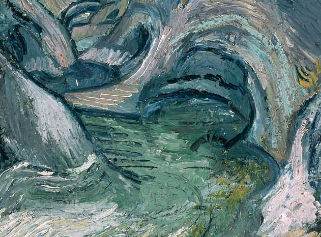
Vincent Van Gogh’s Ravine (1889) sits in the Impressionist Room of the Boston MFA, a breathtaking work of cool, subdued colors and broad-brushstroke technique. Set in a bright room under light cascading and reflecting off the other Impressionist works, Van Gogh’s Ravine is not immediately eye-catching. In contrast to the other works in the room by Signac, Renoir, and Monet, Van Gogh’s piece, though painted in the same Impressionist style, is not done in bright fluttering colors, but in cool tones of grays and blues that provide a more subtle feeling upon viewing. While the Renoir pieces to its right and left rely on heavy pinks, oranges, reds, and yellows, Van Gogh’s Ravine seems almost to hide from the eye at first, rather drawing its power from its simple and subdued cool impressions.

Van Gogh's "Ravine"; 1889; image courtesy of the MFA

Van Gogh’s “Ravine”; 1889; image courtesy of the MFA, Boston, MA

Utilizing the full spectrum of cool tones to paint the ravine walls, Van Gogh creates an undersea aura as he decorates the gray ravine walls with splashes of green, blue, and white. As the charcoal-gray tones set the backdrop for the ravine, Van Gogh’s introduction of the blues over it breathes into the work a sense of depth without which it would seem plain and flat.

A Clever Eye-Line and Clearly Cut Contours

Van Gogh illustrates for the viewer an eye-line looking directly along the ravine’s bottom, as if one were standing in the ravine itself. With his use of gray and black to sketch the cuts of the ravine walls, Van Gogh starts to depict for the viewer the illusion of a three-dimensional landscape. Yet if Van Gogh were to have used his blacks and grays exclusively, his illusion of a three-dimensional scape would not have been as effective as it is. By introducing blues and whites, Van Gogh takes his three-dimensional construction steps further. The navy coloring along the edges of the river carves out the path the flowing water takes as it winds its way through the canyon, and his use of grungier and brighter whites along the ravine walls creates for the viewer a sense of movement in the water.

Curvature of the river's cared out path

Curvature of the river’s cared out path


Movement Through Color

With the water movement outlined through his masterful use of blues and whites, Van Gogh then turns his brush towards giving the rushing body a depth for the viewer’s eye. Contributing sea-greens to the rushing bend of the water in the foreground of the painting, Van Gogh succeeds in creating for the viewer the illusions of depths of water flowing over one another, as the surface rushes and crash into bursts of white and light gray along the sides of the ravine. Indeed, Van Gogh uses particular colors to cut contours as well; his use of black (rather than a use of navy or gray) to cut out the small recess in the foreground of the painting makes the recess all the more stark and powerful, contributing to the overall movement-aesthetic of the work.

But perhaps Van Gogh’s greatest triumph in his color-usage in Ravine is the way he uses his colors to create movement and power in other areas besides the river. In the top recesses of the painting, Van Gogh uses lighter blues over grungier whites and splashes of navy to create the same moving sky as in many of his paintings. Indeed, the movement in the sky seems to mimic that seen in The Starry Night (1889). More than that, though, the sky seems to mimic the water of the river: the light sky-blues laid over the navy’s and whites create a rippling effect evocative of light on water.

The light-blue rippling sky above the ravine

The light-blue rippling sky above the ravine

With the sky rippling above, Van Gogh sets about creating the walls of the ravine. There, sharp contours of black cut in mismatched and jagged patterns alongside gray rock-faces and navy shadows. The most striking thing about the way that Van Gogh paints the ravine walls is the strokes with which he does it; rather than straight lines intersecting at random points, Van Gogh uses swirling brushstrokes to create a flowing downward motion and feeling, opting only to create a few jagged protrusions toward the ravine’s bottom. In doing so, Van Gogh presents the walls of the ravine not as entities separate from the river and sky, but as similar parts of the same whole.

Screen Shot 2015-03-26 at 6.50.29 PM

The flowing sea-like plants on the ravine’s wall, right side


The flowing sea-like plants on the ravine's wall

The flowing sea-like plants on the ravine’s wall, left side

Upon the ravine walls, Van Gogh paints flowing canyon plants in red-oranges and sea-greens, with the plants having the added effect of resembling sea anemones and underwater seaweed. By adding such unique plants to the sides of the already flowing walls of the ravine, Van Gogh completes his creation of a marine world within the walls of the ravine. As if mirroring the flowing currents of an ocean or river, the waving plants dot the upper sides of the canyon walls, creating a “pop” for the viewer with their bright colors against the backdrop of the gray-blue-white walls.

Little Eddies of Stillness

Perhaps the greatest expression of movement with color in the painting, though, is Van Gogh’s use of dark grays and white to create boulders in the bottom portions of the work. In using such colors coupled with his curved brushstrokes, Van Gogh creates portions of the painting that act as metaphorical voids of movement; these voids are perhaps the only “stable” parts of the work, and in turn starkly contrast with the portions of the painting where real movement flows. For example, the boulders in the lower left-hand corner of the painting exhibit a very different type of brushstroke than that used to depict the plants and river around them. With their curved, almost subdued brushstrokes, the boulders create a break in the movement of the brushstrokes around them. Like an eddy in a river disrupting the initial inertia of the river’s flow, the boulders serve as barriers against which the movements of Van Gogh’s other brushstrokes crash.

The boulders in the lower left corner, providing a stillness

The boulders in the lower left corner, providing a stillness

With his brushstrokes long, loose, and flowing and his paint thickly applied, Van Gogh adds to Ravine the same feeling and effect as exhibited in his more famous works such as The Starry Night and Bedroom in Arles (1888). As in his painting The Starry Night, Van Gogh utilizes the technique of dividing the painting into sections, with each ravine wall making up a triangular section and the sky completing the final area.

Black and White

Still, though, one of the most intriguing aspects of the painting is not Van Gogh’s usage of marine and tropical colors, but his use of black and white. Indeed, Van Gogh uses white as a true color rather than a place holder, making use of different shades, with bright white “popping” off the walls of the ravine and the surf in the middle of the work, and a more subdued white blending with the blues in the sky. Van Gogh addressed this notion of black and white color usage in a letter to Émile Bernard in June 1888, stating, “I am going to put the black and the white, just as the color merchant sells them to us, boldly on my palette and use them just as they are” (Chipp, Theories of Modern Art, 1968, p. 32).

Black strokes blended with the greens and blues

Black strokes blended with the greens and blues

True to his declaration in his letter, Van Gogh uses the colors black and white as real colors in the work, not simply as backdrop colors to make the other colors of the painting appear more vivid. Rather than using black simply to define the lines and contours, Van Gogh blends black strokes in the with green plants, using it to add shadow and depth to the motion and flow of the plants along the ravine walls. Similarly, rather than using white to create a simple void on the canvas where other colored paint colors do not appear, Van Gogh blends in in the with river movements and the along the lower cliff faces, creating the rush of the surf crashing along the canyon walls.

Marine World

With his usage of broad brushstrokes, thickly applied paint, subdued colors mixed with brighter “popping” ones, compartmentalization within the painting, and rippling movement, Van Gogh’s Ravine is a brilliant tapestry of masterful techniques. Creating an almost marine-like world in the middle of a ravine, Van Gogh plays with something as basic as the setting of the painting, while at the same time still delivering strong movement through broad strokes (the river and the canyon walls) around areas of rest (the boulders). In pulling all of these aspects together, Van Gogh experiments not only with the nature of flow and movement, but also with the effects of particular colors upon those very motions.

The Lie of “Live Won’t Save Music”

The Introduction

Yesterday, I posted my second article inspired by Fred Wilson’s comments to Jason Calacanis during LAUNCH, wherein I focused on his comments about Kickstarter regarding the music and movie industries. The post itself became too long to explain the economics of the paradigm (of the music industry, at least), so I figured it would be better to do so here in a more focused post. So let’s jump in.

The Lie

In the music business, there’s a well-known adage: “Live won’t save music.” This is the argument that many within the established major label machine use to fend off the assertion that free distribution of music would actually help the music industry in the new digital era. The argument is that artists can’t make enough on a live performance to offset losses they would see by distributing their music for free. And in some cases this is true; income from live shows may not be able to offset those losses…for the major label artists, who have huge stage crews, large arena shows, and a long list of people to pay back (not least of which is their record label). 

The Secret

What industry professionals don’t tell you is that live shows are where artists have historically always made most of the money that goes into their pocket. Money from album sales most often gets paid back to the record label and company, whose “signing” of the artist was simply a monetary advance in the first place. In 1993, well-known artist/producer Steve Albini took aim at the expenses squeezed from artists in his essay “The Problem With Music.” Excerpts from the essay clearly detail how the real economics worked behind the scenes.

The Simple Economics

This simple economic reality means two things: 1) That it’s true that major label artists like Beyoncé and Robin Thicke may very well have a hard time making any real money from live shows and will possibly need to continue to rely on the age-old system’s business practices, and 2) That newer, increasingly independent artists can leverage this new business dynamic to their advantage. Whereas their major label peers are essentially tied to the old system (and streams) of revenue, newer artists who are either fully independent, or have contracts with smaller indie labels which afford them more control, don’t need to sell 150,000 albums or fill an arena tour to make a profit. In fact, they will have an easier time of it, precisely because their “stage crew” many times may only consist of a friend from high school watching the merch table.

And this is where Wilson’s comment comes into play, and is exactly right; crowdfunding platforms like Kickstarter and Indiegogo provide a way for artists (both inside and outside the music sphere) to secure funding for that next tour without being on the hook for ~$400,000 in album distribution and tour expenses.

In fact, there are many artists now exploring the possibilities of free precisely as a way to use their music as a means of marketing to jack up the money they’re able to raise on sites like Kickstarter. By using their music as a “free sample” of their brand, artists are able to explore the dynamic of giving their prospective fans a reason to come out and see them live, buy a shirt, bring a friend—all things that are better for them than the money for one album sale anyway. Music is increasingly being used by these artists as major means of marketing and branding, rather than solely as an end commodity for sale.

You can’t argue with math, and here’s reality: How many times are you compelled to and/or do you buy a song or album? Just once. Why would you buy it again unless you had to? But if you examine the same dynamic with respect to going to a show, or buying a t-shirt, suddenly the answer is “as many times as you want.” It becomes a self-feeding cycle, wherein new possibilities are presented by the power of crowdfunding, and not having to go to a major label for the financing. It boils down to simple arithmetic.

The Album You Had to Buy Over and Over Again

It’s worth noting, also, that the established music industry got used to people buying the same album(s) over and over again because they had to. With each subsequent technological change, that Led Zeppelin album you loved so much became obsolete, and thus you needed to shell out more money for something you already had. Buying music on ’45’s became buying the same music again on LP’s, then again on cassettes, again on CD’s, and then again as basic mp3 files (usually off iTunes).

But something happened during that last transformation: music became distilled down to only the information, sans any physical product, and with the power and reach of the internet, distribution costs dropped to zero. Suddenly, the ability to reproduce and distribute music became the cost of 10 minutes of your time, and didn’t even require the kind of distribution networks that record labels had spent decades building, growing and protecting.

And who was it who lost out the most? The demographic that gleaned most of their revenue from physical album unit sales—the major record labels. But the artists now had a new reality in front of them: mass distribution, but without having to indenture themselves to the “physical CD sales-dynamic.” They were (and are) free to make money where they always have: in the live sphere with grass-roots ticket sales and merchandise sales. Thus it becomes clear that the statement “Live won’t save music” is inherently a biased lie. Live won’t save the old music industry, but those within the industry who are adapting to the new terrain are doing just fine exploring the new possibilities before them.

The New Free/Live Dynamic

Those are the people I would place my bets on. They have no stake in the old paradigm, and are happy to push it aside to see what the new free/live dynamic can do for them. This is where the real money in the music industry will be in the next decade. Not grasping with frail fingers at a business model quickly fading away, but exploring with wide-open eyes the opportunities that “free/live” afford both those in the music trenches, and their prospective fans. Don’t be fooled; there’s still a ton of money and opportunity in the music industry. You just need to know where to look.

Why Isn’t the Music Business Fully Crowdfunded?

Last week, I posted an article detailing VC Fred Wilson’s thoughts on investing, in which I drew on a few things he’d stated during his interview with Jason Calacanis at LAUNCH. This time around I want to explore another statement Wilson made during his time on stage which I thought received way too little attention at the time. In fact, I’m quite shocked that more people haven’t really latched onto this sooner.

At one point during the conversation, Wilson mused, “I don’t understand why the music business isn’t fully on Kickstarter,” to which there was some murmuring (I heard sitting in the audience), but no real discussion thereafter of that particular comment. While I was just as interested in the next point that Wilson discussed with Calacanis (the subject of my previous post), I couldn’t (still can’t) get my arms around how something so stark to many people seems to fly under the radar. But before I get too incoherent, let me back up and explain my exasperation.

The wonderful thing about Kickstarter (or any of the other crowdfunding platforms) is the freedom that they give to artists. In the case of the music industry, the freedom I’m referring to is the ability to not have to sign to a major record label in order to have money to finance an album, tour, video, etc. Instead, artists can go directly to their own fanbases and raise the required capital from them, thereby side-stepping the very real consequence of having to sign away some amount of creative control (ever hear of master tapes?) to the major label. As a result of this, artists consequently side-step the dynamic of accruing a similar sort of debt with the label itself. (I will explain the deeper economics at play here in a later post).

The dynamic of crowdfunding has changed the entire paradigm of the music industry. Wilson’s comments struck me so much because of how true they really are. He doesn’t need to be a guitarist in a band to understand that the freedom that services like Kickstarter give content-producing artists is invaluable (clearly the reason he invested in Kickstarter in the first place). His own “I don’t understand why” comment exhibits his understanding of the services that used to be out of reach of artists, which are now readily available thanks to crowdfunding dynamics.

Of course, crowdfunding alone can’t and won’t control an entire vertical like, say, the music industry. It’s one part of a larger mechanism. But it’s nonetheless a shift in the paradigm of music production, distribution and consumption that was previously unavailable. Where crowdfunding really comes into play is when it totally disrupts the age-old adage “live won’t save music” (but that’s an argument for a later post).

Here’s the real point: Fred Wilson is an investor, not a guitarist or aspiring singer. Yet he sees the value of crowdfunding so much (investment interest aside) that he doesn’t understand why any artist would forgo the opportunities presented by these new services. And I’m inclined to agree with him (and I’ve been in the music industry now for years). So here’s the real question: if he gets it, and I get it, don’t you think that all the new artists out there get it too?

It just might be a very short time until the music business is fully (or mostly) crowdfunded.

Tell Me Again How There’s No Monopoly in the Music Industry

Most all of the record labels you know are owned by three major parent corporations: SONY, Universal Music Group (UMG), and Warner Music Group (WMG). Even Sub Pop, the once-famous Seattle independent label, is now owned by WMG. The only pseudo-famous label not on here is K Records, which became famous around the same time as Sub Pop for releasing off-beat alternative music in the ’90s. But for most everyone else, it’s just a question of which corporation you have pulling the strings. Tell me again how there’s no monopoly in the music industry.

(Click image for larger preview.)

The Big Three Record Labels, and All Their Subjects

The Big Three Record Labels, and All Their Subjects

SONY:

  • SONY/ATV
  • RCA
  • Epic
  • Columbia

Universal Music Group:

  • EMI
    • Virgin
  • Island
  • Motown
  • Def Jam
  • Republic
  • MCA
  • Capitol
  • Geffen
  • Interscope

Warner Music Group:

  • Reprise
  • Atlantic
    • Elektra
    • Roadrunner
    • Atco
  • Sub Pop
  • Fueled by Ramen
  • Parlophone