Unbundled: Introduction to the Bundle

Why the unbundling of the music universe matters.

1--e4y3Jsz54uHEZ2XfyC51Q.jpeg

In recent years, the dynamics of bundling and unbundling have changed everything in media. But they’ve had an especially palpable effect on music.

This is an exploration of the bundling and unbundling dynamics taking place in the music universe right now. Because of the massive amount of information discussed herein, it is necessary to cover it in series of parts, each explaining a particular aspect of change and restructuring.

This series will appear as the following:

  • Introduction to the Bundle
  • Part I: Reformatting the Barriers
  • Part II: Shifting the Paradigm
  • Part III: Democratizing the Future

Additionally, all four pieces (including the introduction) will subsequently appear as a single, holistic text, entitled: Unbundled: The Story of Music.

This is the first entry in the story.

A New Emerging Dichotomy of Freedom and Reach

A few months ago, Chris Saad penned an article on the dynamics of bundling, and how they’re affecting a number of fields. In his piece, Saad addressed how concepts of bundling are impacting areas of creativity like art and music, among others. Ironically, it had a similar air to Joshua Topolsky’s earlier article on media companies, which itself prompted my response on music-startup realities.

Such examples were only briefly mentioned, but one can go deeper on them, particularly in the way of music. Things are happening now to the age-old structure of music that arguably haven’t changed for the better part of five or six decades. And even that is only the tip of the iceberg.

Part of what was so intriguing about Saad’s examination of these morphing areas is just how much change is going on which is not being discussed. In many ways, Saad’s piece shines a light not only on the changing bundling and unbundling dynamics taking place in music, but how these two different forms—yin and yang—are interacting with one another to shape a new musical landscape. What we see is an emerging dichotomy of freedom and reach that we haven’t seen in quite a while.

Three Trends in a Specific Order

Within the context of music, three trends—unbundling, bundling, and unbundling again—matter. And they matter in that sequence. This is so because each (un)bundling action touches a different area of the music arena, and thus their interaction together forms a new paradigm.

They lay out as follows:

unbundled

Covered in Part I, Reformatting the Barriers

  1. Choice
  2. Format

BUNDLED

Covered in Part II, Shifting the Paradigm

  1. Bundled in the Wrong Way
  2. Power and Paradigm Shift
  3. Sexy vs. Unsexy

unbundled

Covered in Part III, Democratizing the Future

  1. Power, Gatekeeping, Scarcity, and Democratization
  2. Ownership
  3. Money and Community
  4. The Expansive Powers of Identity

The music industry, like all other forms of media, is undergoing such a massive tectonic shift that we’re only beginning to now see how big the fissures are. The most interesting thing will be how these changing power paradigms affect the music coming out, and the communities which are built around the material.

Stay tuned!


Find me on Twitter @adammarx13 and let’s talk music, tech, and business!

100 Awesome Independent Album and EP Releases You Probably Missed in 2016

It’s that time of the year again — when all those “Best of…” lists come out telling us the supposed cream-of-the-crop releases in music. And as happens every year, they skate right over the slew of amazing independent releases that dropped into our lives.

Last year, I drew up a list of 100 independent albums you probably missed in 2015. Now it’s time to do the same for 2016.

In the interest of fairness, it’s important to note that most of these releases simply follow my personal taste in music genre-wise; they certainly don’t encompass all the amazing independent albums that came out this year in jazz, EDM, rap, classical, or other styles.

As with last year’s list, these 100 albums and EP’s come from artists all over the world. This year’s list has artists from: Canada, the U.K., France, Italy, Ireland, Spain, Portugal, China, Denmark, Iceland, Sweden, Norway, Belarus, Germany, Israel, China, Mexico, the Philippines, Australia, New Zealand, and from 20 different U.S. states. That’s how big the independent universe is, regardless of genre.

So here are just 100 of the albums and EP’s that you probably missed in 2016. All were released during the 2016 calendar year, so this gives you an idea of just how small a window into the music world the mainstream actually cuts. As always, albums are in no particular order. Do yourself a favor and go expand your universe. You’d be shocked at what you discover.

  1. Forget About ItIt’s Butter – Los Angeles, California, USAa1993529676_16
  2. I Talk to StrangersI Talk to Strangers – London, England, UKa0865780043_16-1
  3. The Centauri Conspiracies: Part 1 — The AwakeningSunshine & Bullets — Tampa, Florida, USA
    Print
  4. Colours Chelsea Shag — Atlanta, Georgia, USA600x600bb
  5. Good DaysSkyline — Austin, Texas, USAa0007603069_10
  6. Muster PointJeeps — London, England, UKa3598822201_16
  7. ScarsForever Still — Copenhagen, Denmark12
  8. Body WarsJune Divided — Philadelphia, Pennsylvania, USAjune-divided-body-wars-ep
  9. Silent ElephantSilent Elephant — Lille, Francea2226111291_16
  10. The Parts We SaveHeel — London, England, UK
    heel-the-parts-we-save-album-cover-artwork
  11. Breaking FreeA Truth Divides — Fall River, Massachusetts, USAa1106324655_10
  12. EmergenceHour 24 — Temperance, Michigan, USA4a92d0_efe37ce2146445358c6a8af10e5ef140.png
  13. Hardly Loaded EPPhantomHead — Lynchburg, Virginia, USAa2643529918_16-1
  14. Tough LoveBloody Diamonds — Toronto, Ontario, Canada13308599_990879211032274_8926664851863017403_o
  15. A Moment of SilenceThe Funeral Portrait — Atlanta, Georgia, USA14563572_1125466497544768_7992703852251309118_n
  16. EpicentreBouquet of Dead Crows — London, England, UKa0429878601_10
  17. She SpeaksShe Speaks — Kildare, Irelanda2252113179_16
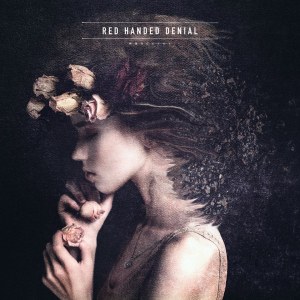
  18. WandererRed Handed Denial — Toronto, Ontario, Canada12799213_10153426011084071_1317740590743645433_n
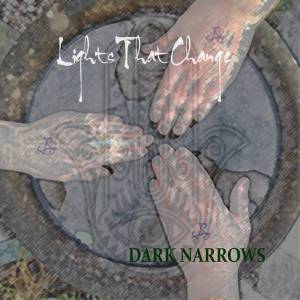
  19. Dark NarrowsLights That Change — Flintshire, Wales, UKa2142808787_16
  20. The ReIntroductionAlmost Kings — Atlanta, Georgia, USA0006541155_10
  21. BlackSuan — Athy, Irelanda0731599391_16
  22. Mean SomethingKinder Than Wolves — Orlando, Florida, USAa3400336724_16
  23. For Your ObliterationThe Dead Deads — Nashville, Tennessee, USAa0316039504_10
  24. No Mirror / Baby StepsBirdeatsbaby — Brighton, England, UKa2859507464_16
  25. Screech BatsScreech Bats — London, England, UK12764898_977824338969132_6112466179685560664_o
  26. Five KitesFive Kites — Uckfield, England, UKa3539413199_16
  27. Pow WowRed Apple — Madrid, Spaina0626135829_16
  28. HoopdriverHoopdriver — London, England, UKa1149210371_16
  29. The Mud Lords EPThe Mud Lords — San Francisco, California, USAa2762874709_16
  30. StonesCherry Water — Wilmington, North Carolina, USAa2364345222_16
  31. Please Welcome Imperial JadeImperial Jade — Barcelona, Spaina4135821107_16
  32. From The CaveFrom The Cave — London, England, UKa0846461208_16
  33. Imminent for Your InterestsPeople Like Us. — Los Angeles, California, USAAlbum Art rough
  34. Otra Vez ISidewatcher — Detroit, Michigan, USAa0310545470_16
  35. EraserheadEraserhead — Aurora, Illinois, USAa0142508800_16
  36. AlterhoodAlterhood — Tel-Aviv, Israela3217298871_16
  37. Eugenia EPDarla and the Blonde — London, England, UKa2573911246_16
  38. Cosmophonie EPCosmophone — Trois-Rivières, Quebec, Canadaa1977159592_16
  39. Hit the AirBasic Land — Monterrey, Mexicoa2682732415_16
  40. Born to DancePürple — Brighton, England, UKa2572290725_16
  41. Double A-SideThe Mis-Made — Sydney, Australiaa0839401698_16
  42. Refuse to Shine EPMr.Mountain — Portsmouth, England, UKa1375774276_16
  43. Gaining PerspectiveGlory Days — Brisbane, Australiaa3697331310_16
  44. The Sky, the Lie, and Who We Are Before We Die — True North — Los Angeles, California, USAa1878484356_10
  45. Luxury EPPatio — New York City, New York, USAa1711486514_16
  46. PhantasmagoriaWhite Claudia — Chicago, Illinois, USAa0392641707_16
  47. Cruise DealMirror Travel — Austin, Texas, USAa0016514373_16
  48. Call Me by NameGood Fiction — Albany, New York, USAa1006386476_16-1.jpg
  49. BipolarKreepy Krush — Minsk, Belarusa3570746258_16
  50. Good HangsLauren Patti — New Jersey, USAa3026102687_16
  51. Copper CrownCopper Crown — Toronto, Ontario, Canadaa0415375489_16
  52. Cuatro —  Tranparentes — Alicante, Spaina0741328815_16
  53. It’s Too Bright InsideLush Vibes — Vallejo, California, USAa1998902662_16
  54. Ropes EndRopes End — New York City, New York, USAa3134658973_16
  55. Only RosesCarissa Johnson — Boston, Massachusetts, USAa2929911764_16
  56. Theories of the UniverseHaunted Ghost Town — Sunnyvale, California, USAa2755326863_16
  57. Soft Grudge — Mulligrub — Winnipeg, Manitoba, CanadaMulligrub-Soft-Grudge--640x640
  58. Dirty LyxxDirty Lyxx — Boston, Massachusetts, USAa2040502891_16
  59. StagesKopacetic — Shreveport, Louisiana, USAa2728269849_16
  60. Much Love — Microwave — Atlanta, Georgia, USAa1730261151_10
  61. MetadonnaMetadonna — Valencia, Spaina0150878033_16
  62. Break Down the WallsBreak Down the Walls — Hawthorne, New York, USAa1176554633_16
  63. Stuff EPMy Cruel Goro — Icelanda2414949285_16
  64. ShadowboxVivienne the Witch — Perugia, Italya3238750359_16
  65. In the Arms of the SunVox Vocis — Phoenix, Arizona, USAa2512338494_16
  66. DiscourseSex With Strangers — Vancouver, British Columbia, Canadaa2127562643_16
  67. Sleep Tight, When You Wake Up We’ll Be GoneThe Few. — St. Louis, Missouri, USAa2511948533_16
  68. Harmony and DisconnectRising Down — Tampa, Florida, USAa2963571272_16
  69. VectorsYeah Sure Whatever — Marin, California, USAa1649515922_16
  70. DEVILTRAINDEVILTRAIN — Bamberg, Germanya1542791299_16
  71. Buried in the SoundLost Frontiers — Pomona, California, USAa3721344826_16
  72. Nosebleed WeekendThe Coathangers — Atlanta, Georgia, USAThe-Coathangers-Nosebleed-Weekend
  73. The Eternal SeaThe Eternal Sea — Tauranga, New Zealanda2466588262_16
  74. Traces EPTraces — Phoenix, Arizona, USAa2543588091_16
  75. Elevation —  We Are The Catalyst — Gothenburg, Swedena2368062794_16
  76. MABON SONGSCrypt Trip — San Marcos, Texas, USAa0313274180_16
  77. Angel — Heroes — Los Angeles, California, USAa4173242852_16
  78. Swan Valley Heights — Swan Valley Heights — Munich, Germanya0676605006_16
  79. Abandoned — Counter Theory — Valparaiso, Indiana, USAa0689683623_16
  80. AntsAnts — Rivergaro, Italya1366200431_16
  81. The Journey (EP)Rusty Joe — Casais, Portugala3938316616_16
  82. SpectraMyrrias — Philadelphia, Pennsylvania, USAa1053203725_16
  83. Dimensionauts EPRobot Jurassic — Edgewater, Maryland, USAa1323032774_16
  84. BelieverWeird Neighbours — Sarnia, Ontario, Canadaa0850762461_16
  85. Hell Is Not Other People, It’s YouThe Republic of Trees — Scarborough, England, UKa3751139773_16
  86. The LippiesThe Lippies — Grand Rapids, Michigan, USAa0852829300_16
  87. Far Away, As We Fade —  AggronympH — Yichang, Chinaa3169651902_16
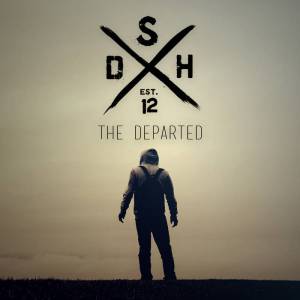
  88. The DepartedSummer Drive Home — Weymouth, England, UKa0290939636_16
  89. Mix TapeThe Hang Lows — Pittsburgh, Pennsylvania, USAa0584312114_16
  90. SweetMeatThe BlackLava — Torino, Italya3220774202_16
  91. Singularity — Fight Like Sin — Lafayette, Indiana, USAa3594774885_16
  92. Chasing a PhantomChanging Scene — Bel Aton, Maryland, USAa1533314418_16
  93. Abandoned HomesThe Aesthetic — Seattle, Washington, USAa1922360043_16-1
  94. ConnectorFable Circuit — Shepherdstown, West Virginia, USAa3669455937_16
  95. InburnInburn — Illigan City, Phillipinesa2748366475_16
  96. The Lost Ones (EP)LUNGS — Sacramento, California, USAa2346140061_16
  97. AmbulanceThe Amazing — Stockholm, Swedena0811660077_16
  98. DetoxPyke — Arendal, Norwaya4237766781_16
  99. Start AgainThe Middle Ground — Milwaukee, Wisconsin, USAa3612480243_16
  100. Valley Queen EPValley Queen — Los Angeles, California, USAa2154869007_16

    If you enjoyed this please share, and feel free to Tweet me. Let’s talk music and tech!

    Or follow me on that new Snapchat thing! 😎 🤘

    CdhrnNSXEAEa2t1

How to Write Like an Editor

How thinking like an editor can bullet-proof your writing.

Originally published on my Medium on December 2, 2016.

1-Kgjc4NQCIGF_UzuxC5y19Q.gif

I come from a family of writers. My parents are both attorneys, and I spent my formative years in school learning how to write bullet-proof essays. It wasn’t until long after college, though, that I really began to see writing in more lights than simply as “a writer.” In fact, it was only recently that I’ve been able to think and write like an editor.

If you look around the blogosphere, and on Medium in particular, you see a lot of the same stuff. Not the same topics per se, but the same issues with the writing. A lot of it’s choppy, half-baked, passionate but not convincing, and many times riddled with grammatical mistakes. A lot of this can be avoided though.

A lot of time people see writing as a number of things — none of them good. They see it as tedious, superfluous, nonchalant, boring, or easy.

Writing is not easy, and writing on a higher level than “just writing” is a skill which takes constant practice and dedication. But for time-sake, here’s a crash-course to make your writing tighter, stronger, and all around better.

(Note: This won’t cover non-writing aesthetic choices, like pictures, gifs, videos, etc. This is focused solely on the art of writing and editing.)

Here’s a quick rundown:

  1. Grammar
  2. Spelling
  3. Tenses
  4. Formatting
  5. Thesis
  6. Argument
  7. Length
  8. Style

1-HuftSD-ACZWieNRzKR5dEA.gif

Grammar

Let’s get this one out of the way early. Poor spelling and grammar will kill any piece you write. Every time. Without fail. Don’t think you’re fooling anyone — we can all tell when you’re too lazy to proofread your article for mistakes. Learn to love multiple drafts.

So Rule #1 in writing like an editor: edit your damn article.

Caveat: I’ll cover this more in Style, but keep in mind that sometimes the most readable pieces aren’t necessarily the ones that follow 100% of grammar rules. This took me a long time to learn and become comfortable with. Be at ease using contractions, beginning sentences with “and” and “but,” and using slang terms like “gonna,” “bullshit,” and “fuck.” This gives your writing personality and makes it much less stilted. Just remember not to go overboard with things. If it doesn’t serve your argument, don’t fuck around with it.

Rule #1: Edit your damn article.

Spelling

We live in the era of spell-check. There’s literally no reason for spelling mistakes. If you don’t care enough to use spell-check, I don’t care enough to read it, end of story.

Tenses

This usually falls under grammar, but it’s important to break it out here. A lot of people seem to have problems with tensing, even some of the smartest, most insightful writers I enjoy reading (including hyper-successful founders, investors, marketers, etc.). It’s something people stumble over when it doesn’t make sense, and a lot of times it’s hard to pinpoint.

The best advice for keeping proper tensing is to read the wonky sentence out loud and see if it flows. If you’re having trouble with it, your readers will too. It should flow easily off the tongue, and if not, reexamine your tenses.

Formatting

Like grammar and tenses, formatting is one of those things you’ll need to take a step back on and read through an editor’s eyes. It’s one of the most tedious parts of editing, but one of the things that sets good pieces apart from complete crap.

Look and Feel: First, does it look good? If it’s blocky and hard to read, chances are people will never read it (unless you’re maybe already famous). Break things up — the “new paragraph” is your friend.

Italics, bold, and underline are essential to making something interesting to the eye, but don’t overdo it. Too much bold and you’re shouting at me; too many italics and you’re making me read a French pastry recipe.

ALL CAPS: Like bold, all caps is akin to yelling at me. Try to stay away from this. However, if you’re going to yell at me, make it count. Do it only if you really need to.

1-W2yScwD9KSLbRmEMWI_BRg.jpeg

Bullet-points: Learn to love bullet-points, but don’t go overboard. Unless it’s an article that’s meant to be mostly in list-form, don’t overdo it. Not everything has to be bulleted — I’m reading your article, not your grocery list.

Punctuation: Vary your punctuation (more on this in Style). Learn the difference between a hyphen (-) and a dash ( — ), and when to use them to break up your text.

Rule: Hyphens are for combining words (like punk-rock) while dashes are used to break sentences (see 3rd paragraph of introduction).

Quotes: Ok, say it with me now: Double quotes (“ ”) are for the beginning/end of any quotation, while single quotes (‘ ’) are for a quotation within a quotation. That means if you’re quoting an article in which the article is quoting something or someone else, you need both. Also learn when to use block-quoting as opposed to singular, smaller quotes (Medium has thankfully made this much easier for people to understand and use).

Colons and Semi-colons: For fuck-sake, do not use colons or semi-colons if you’re not 100% clear on how to do it. Your writing won’t suffer much — if at all — if you leave them out. It will suffer A LOT if you put them in and don’t know how to use them. Stick to what you know and don’t try to over-impress your reader.

For the record though: Colons usually break a sentence right before you list something, or move to a clause or phrase which is meant to clarify the previous clause or phrase.

Semi-colons break a sentence and separate two independent clauses which tackle the same thought.

[Brackets]: Last thing, but very important. Brackets are used to tell your reader that you’re changing something from the original quote, but more for formatting, aesthetic, or clarification reasons. For example, if you’re simply changing the tenses of a word from singular to multiple, just put the “s” in brackets so I know you’re making a minor edit.

Like this: “Kurt Cobain drew influence[s] from his favorite album[s] when writing the follow-up to Nirvana’s second album.”

Remember: [Brackets] are not the same as (parentheses)!!

Thesis

This is the “idea” we all learned about in 3rd grade that “goes at the end of your first paragraph.” Except that’s bullshit, and much too simple.

Your thesis is your main concept, but isn’t necessarily your “argument” (see next point) and doesn’t necessarily need to come at the end of your first paragraph. It goes wherever it fits best, though this is usually towards the top of your article.

The thing to remember about your thesis is that it’s your broad topical concept, which means it’s flexible. Flexibility is good. Don’t feel shackled to a boring, hyper-specific point. If broad works better for the sake of your piece, then go broad, and get more specific in your argument.

This is how you write like an editor: accept that flexibility is a good thing, and that there is no 1, 2, 3-step process for plugging in pieces to make a good essay. Experiment, beginning with your thesis.

Argument

I see this a lot as an editor. People confuse their thesis with their argument. They are not the same thing. Your thesis is the concept or topic you’re going to tackle; you’re argument is how you hammer your points home.

Do not, for the love of God, use the 5-paragraph essay format unless it fits your topic and article. This is meant to be a learning tool, not something you do when you actually start writing complex pieces. It’s too constraining, and makes people put in (or leave out) points depending on how many spots they have left between their intro and conclusion. Again, writing is about flexibility, not rigidity.

Here’s the big secret: make your argument fucking bullet-proof. Take a side, and pound your theory home. You don’t need to be a jerk about it, but hedging your bets and sitting on the fence is a very tough thing to do right, and takes a ton of practice. And even then, it’s really only good in certain situations.

If I can drive a truck through holes in your argument, reexamine it. Leave some flexibility for yourself so you don’t back yourself into a corner, but make your argument solid. (Hint: this is where you use all those wonderful quotes, links, and examples we’re all so fond of).

Length

This is something that’s become somewhat taboo in our bite-sized, bloggish culture. The concept of writing anything long is considered “old” and “ramble-y.” Posts that appear “too long” are labeled “tl;dr” and relegated to the bottom of the pile.

But the reality is that some pieces should be longer. Or not. It all depends on the article and what you’re writing about.

If you’re just giving me a list of things (ideas, tips, etc.), then let me know at the beginning that it’s a listicle. If it’s just a fleeting thought to consider, don’t gear me up at the beginning for a long thought-piece, otherwise when you end abruptly, it feels like the bottom has just dropped out.

But if it’s a topic and argument that demands a long-form length, then be damn sure you give the piece what it requires. Trying to squeeze too much into a bite-sized article is a sure-fire way to tell your readers you have no idea how to articulate what you want to say. There’s a reason that publications like The New Yorker specialize in long-form content: they know how to flesh out an argument, and how to do it well.

Cut, Cut, Cut

Be willing to cut. Sometimes less is more. Be honest with yourself: if those extra two paragraphs don’t serve your argument or style, kick ’em to the curb. Learn to love deleting extra junk. There’s nothing as paralyzing as “blank-page” syndrome, but there’s nothing more unsightly than flabby content that serves no purpose. If you write 3 pages and delete everything except for the 1 paragraph that’s exceptional, it’s a good day.

Understanding length and how to use it to your advantage is equally as important as understanding how to format to your advantage.

Style

Now we’ve finally come to the most important thing no one tells you about and everyone forgets about: your style is everything. It took working as an editor for me to understand that everyone has a unique style, and that’s what makes someone’s writing compelling — or boring.

Writing like an editor means understanding what style works for you, and really flexing your creative muscles with it. It means exploring the types of slang that make your writing your own, what types of structure you totally own, and what topics are in your wheelhouse. If you’re an expert in something, write like you are. If you know you’re not, then proceed more gingerly and don’t try to pretend you’re something that you’re not.

Use punctuation that you’re a master at; there’s no “learning on the job” when it comes to punctuation. Poorly chosen punctuation can absolutely kill a piece with potential.

The reader can always tell.

The irony is, the more you write about something, the more you know about it, and the more you begin to develop original thoughts on it.

Your voice is your own, and is the one thing you have complete control over. Understand that voices change and evolve over time — your early writing will look a lot different from your more mature pieces. This is a good thing. Learn to isolate what makes your writing voice special without getting bogged down in the past. Once you have it, run with it.

And that’s about it, for the moment.

And that’s about it, for the moment. I could tackle tons of other topics like introductions, conclusions, transitions, titles, citations, or writing a series of pieces, but I think I’ll save those for another day. The important thing to remember is that writing is a process. One and done isn’t how to play the game.

If you’re going to write something, get in the trenches and get dirty. Don’t make me read some half-hearted piece of crap if you don’t have anything real to say. The hard part is knowing what’s real enough to write about, so I’ll leave that up to you.

Find me on Twitter and let’s talk tech, writing, and music!
Stop Telling Me I Need to Code

Originally published on my Medium on September 15, 2016.

1-cmysgxsibbtifn63bqzdpw

An argument for those of us who write best with sentences, not code.


I’m Not a Coder

Let me start off by saying that I am not and have never been averse to learning a new skill, even one outside my general comfort zone. In fact, I quite enjoy expanding my horizons and learning how to see the world in different ways.

But I’m not going to learn to code.

At least, I’m not going to learn to code well enough to build something completely on my own. I’ve done various courses on Codecademy and it was interesting to me to begin to see the possibilities of tech and information in a new light. But that’s not my background and not my wheelhouse. My wheelhouse is broad trends, analysis, synthesis, and communication.

In college, I studied a wide variety of non-tech/coding subjects. And I’m not alone. I studied:

  • Art (as did Brian Chesky)
  • Psych (like Jason Calacanis)
  • Sociology and philosophy (as did Chris Dixon and Stewart Butterfield)
  • English and Poli-Sci (like Jessica Livingston and Morgan DeBaun)
  • And come from a family of lawyers (something I feel Chris Sacca might relate to)

I also studied a ridiculous amount of history. These things—not code—are what help me put the world into a larger context.

First Coming to Tech

When I first got into tech, I felt overwhelmed. And I felt inadequate. It seemed that everyone knew how to code except me, though I resolved to find a way to learn. And I powered through a few Codecademy classes. But it didn’t stick in the way that would allow me to build an app or site myself.

I understood the concepts behind basic design, and had a better understanding of the work it took to make something materialize—but I knew I was never going to be the one to do it. It never got easier, and it’s still challenging for me.

Easy for me is sitting down for a couple hours and drafting, editing, and blasting out a solid, synthesized argument. But in those early moments, that didn’t seem to be on par with knowing how to code in java.

1-3x8rzvijokgf2zhbs209xg

While in the headspace of “I need to learn to code or I don’t belong,” I seriously underrated what I was good at. And that’s people.

I’m Good at People

I love networking; I never knew there was even a term for it—I just figured it was called talking. I love hearing the stories of others, connecting them to potential partners, and trying to identify mutually beneficial opportunities for both (or all) parties involved.

I’m better at reading people than I am at reading code. People are flexible and creative—code is not. (That is, it’s not to me).

I come from lawyers. I come from the mindset of there is never one right answer;” it all depends on how good your argument is, and how you can continually restructure your thought process. The notion that a line of code doesn’t work because one character is out of place is foreign to me. The same way that lateral thinking—that there might be multiple, arguable right answers—is foreign to others.

Unintended Microaggressions

Whenever I read the sentence “you should learn to code,” my first thought is “you should learn to write (well).” The concept that code is the new literacy is—frankly—bullshit. It’s undeniable that coding is a hyper-important skill in the 21st century—but it’s not the end-all, be-all of literacy. Literacy spans a variety of languages, communication tools, and colloquial, idiomatic trends. There is no “one” magic bullet.

1-cdujzefcc83zxrac6ahiww

Treating it as such is short-sighted and arrogant. Arguably, it’s an—albeit unintended—micro-aggression that dissuades non-tech founders and Humanities majors from taking the dive into tech. Similarly, telling me that it’s “easy to learn” is a matter of opinion, not fact. And again, it’s arrogant.

How Good Is Your Writing?

I read staggering amounts of material online. Much of it is posted by super smart founders, investors, and thinkers. And from a writing perspective, a ton of it sucks.

A lot of it rambles, comes off as tone-deaf, is too splayed, and hasunforgivable grammar errors. In fact, some is so grammatically jarring simply because the writers use grammar rules that are ancient, while ignoring new colloquially correct dynamics. This makes the writing unbearably stilted. When writing an article in my world, you make it tight and you make it bullet-proof. I don’t understand writing that isn’t structured like this (creative writing aside, of course).

1-pmwofcv5vuismhawsqzwqw

Growing Into My Skin as a Non-Tech Founder

I’m not bitter, though. I know I’ll never write code like Mark Zuckerberg, and I’m ok with that. I have amazing team members and connections who can do a better job there than I ever could. So why not let them win where they naturally win?

I’ll continue to refine the coding skills I have as much as I can, but I harbor no delusions of coding grandeur. I’ve now grown more comfortable in my non-tech founder skin. I’ve grown more adept at identifying the real things in code that I need to understand, and the ones that are nice, but superfluous for my skill-set.

1-ayddzj5ri7sivb4noohizw

Instead of telling me I “should learn to code,” lend to me a plethora of tools I can use, and articulate to me that I’m not inadequate and no less a founder if it doesn’t come so easily.

In an industry with such a high rate of failure, teamwork, communication, and vision should be prioritized above most everything else. That’s the only way any of us succeed.


 Find me on Twitter @adammarx13 and let’s talk music, tech, and business!

Dear Medium Publishers, Do Not Request My Story If…

Dear Medium publishers, do not request my story if you’re not going to respond to my follow-up emails. I work very hard on every piece that I write, and I take my writing seriously.
You should take it seriously too.

tumblr_inline_mvi5orayc41rgs66v

What I Want to Know

Any time someone requests to put one of my stories in a publication, there are some things I want to know. These are:

1. When will you want me to submit it?

Some publications want to wait a certain amount of time before publishing and some do not. I don’t want my piece just floating out there in the ether. If you want to wait and push it out later, let me know so I can plan for that.

2. Will you want to change anything, and how will we agree upon that?

I’m very particular about what I write and how it’s written. I have no issue with altering it a little to fit the publication’s desires, but I want to know how the process goes. Is it casual and easy, or are you going to act like my boss? (Hint: this is not the right way to persuade me.)

3. What kinds of things will you want to change?

Every publication is different and has certain things they want to project. I respect that. But I need to know what sorts of things in my piece you might want to change. Are they stylistic things, title or header changes, or will you want to change something that now affects the overall message of the piece?

Some style things I can do to part with, others I will not—it just depends on the piece and the message. And it depends on how accepting and respectful you are of my style as a writer. If the article in question just cannot be morphed to fit the publication, perhaps we can collaborate together on an idea for a new piece that is exactly what you’re looking for. But never try to force anything.

4. How’s your grammar?

Grammar is extremely important to me. I am obsessive about the need for grammatical correctness, so make sure your publication seeks to make sure every piece is grammatically well-written—I want to be in the company of other competent writers.

It nonetheless is a tricky play because phrasing and writing can sometimes be grammatically incorrect even if it is colloquially correct (for example, if I’m writing an informal piece and use the phrase “I wanna”). As an editor of a publication, I expect you to be able to identify the difference between colloquially correct phrasing and straight grammatically incorrect sentence structure.

5. Who has the final say?

It’s your publication and you decide what’s good enough to go in; I respect that. But this is such an important question because of how Medium is set up. Once a piece is submitted and accepted into a publication, it’s open to the editor to edit as they see fit. This is one reason I’m extremely picky about who I work with.

Based on the questions above, I want to know who will have the final say. If you want my piece to say one thing and I want it to say another, I want to know if you’re just going to go over my head and edit my post without my knowledge or consent. I’m much more likely to continue to submit to your publication regularly if you respect my ability to say, “I’m not sure I want to edit this piece like that, but perhaps we could do another piece together.”


What a Request for My Story Should Look Like

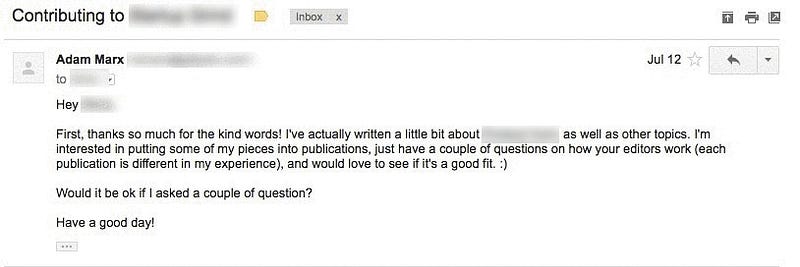
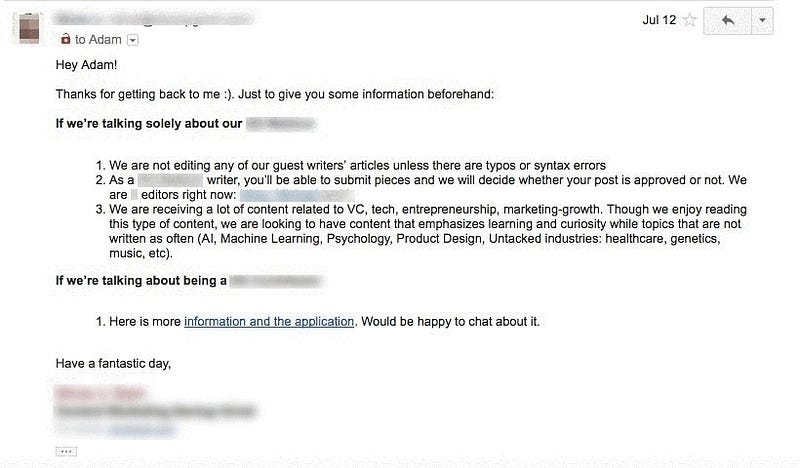
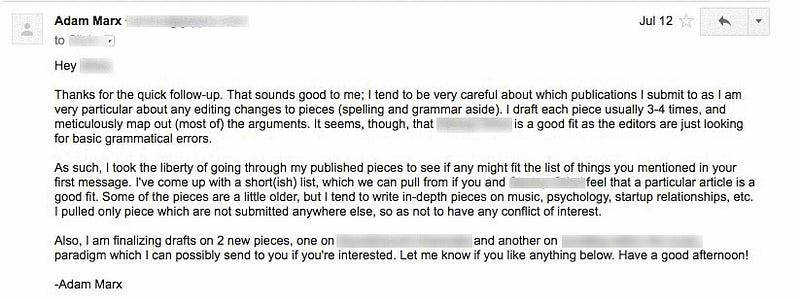
This is a conversation I had with an interested editor during July. Notice how the person was extremely accommodating to my questions and patient when providing the answers. This is how a request for my story or collaboration should go:

My email, after the initial request for my story:

Their response:

My further response, and the beginning of a working relationship:

That’s how your requests should pan out if I have questions.

A Response Email Takes Five Minutes

In writing and publishing, as well as in every other part of life, it’s about the relationship that’s cultivated.

This is especially important if you’re asking me for material with an understanding that there will be no monetary compensation. 

There have been a lot of great pieces recently on freelance writers and not writing for free or for “simple exposure.” Personally, I think think this is an individual choice for each writer. At this point in my career, I’m ok with it, as long as what I get out of it in the end is a solid relationship with real opportunities for networking and exposure. If you tell me you’re going to give me exposure, then do it: tweet about my article, and tag me so that I can continue to build my writing reputation.

Not Answering My Follow-up Email

Because these are some of the basic things I consider when I’m writing a piece, requesting my piece and not emailing me back about my questions tells me:

  • a. You’re not serious about really wanting my piece
  • b. You don’t care how I feel about my piece as a writer
  • And/or c. My piece isn’t important enough to you to send me a simple response email

Time is valuable, and I don’t expect you to answer all of the above (and any further questions I might have) in one sitting. You don’t need to write me a book of a response, but really, a response email acknowledging my questions takes five minutes. My time is valuable too. If you want to work with me, then work with me, and treat my time as a writer as equally important as I treat yours as an editor/publisher.


Find me on Twitter @adammarx13 and let’s talk music, tech, and business!

What Artists Can Learn from Startups, Part 2

Who Do You Promote?

Recently, I wrote a post entitled, “What Artists Can Learn from Startups” in which I began looking at a number of strategies which startup companies (mainly tech) use to generate leads and interest in their products and services.

The more I think about it, the more certain strategies really stick out as things that artists should be considering and implementing. One in particular is something which holds my attention.

In tech (startups, at least), there isn’t the same reticence to publicize and promote someone else’s product or service as there seems to be in music. Among artists, there seems to be this gospel-like belief that if you promote an artist or song you don’t love with all your soul, then you’re somehow being disingenuous. In all forms of art, and music especially, the concept of reputation is taken extremely seriously. Sometimes to a fault.

Whereas I see founders from all over the startup world promoting one another, I see more resignation in the music community to follow suit, and truthfully for no good reason.

I have no qualms about promoting a product or service that I don’t use, or don’t use regularly. Before you come down on me for having a hidden agenda, though, take a moment to think about all the things you can promote someone for that have little to nothing to do with their service or product.

So often, I find myself tweeting and posting about the people behind the product, either because they’re so magnetic, so innovative in their thought process, or so willing to help others. It has so much more to do with their character than anything else. And this is something artists could so easily cash in on and make their own.

When someone helps you set up a show, helps promote your band or music online, or introduces you to someone new, tweeting out a “thank you” and promoting them isn’t being disingenuous at all. Quiet the opposite. It actually solidifies you as someone who returns favors and good karma, and thus builds your own reputation, even if it’s in the service of others (for the moment).

Positive service of others is service to ourselves, if only indirectly. Artists would do well to begin to reexamine their practices in how they promote others, from the decision process to the execution. Starting to have more fluid strategies here could greatly expand their networks in relatively short amounts of time.

More to come on this soon.

Why Silicon Valley Is Rebuffing the Wall Street Journal’s ‘Andreessen Horowitz’ Piece

Marc Andreessen (left) and Ben Horowitz (right); image courtesy of Forbes

Marc Andreessen (left) and Ben Horowitz (right); image courtesy of Forbes

First Serve

Yesterday, the Wall Street Journal ran an article on the VC firm Andreessen Horowitz (hereafter, ‘a16z’). The piece took a look at the firm’s raise-rounds and returns, and was critical of a16z’s placement among other “venture-capital elite” like Sequoia, Benchmark, and Founders Fund.

While the article is quick to throw around numbers and buzzwords like “elite” and “blockbuster [investments],” the main premise is that a16z hasn’t yet earned the “premier reputation” that it has amongst those in the tech community.

Second Serve — Response

The response from the tech world basically ate up the rest of yesterday afternoon and night.

It started with a response blog post from a16z managing partner Scott Kupor, which was posted not long after the original piece went up: When Is a “Mark” Not a Mark?

One thing Kupor points out immediately is that “marks” and “returns are two very different things in the realm of venture capital. Further, “[c]ash or stock actually realized and distributed to LPs is the only real, non-manipulable measure of a firm’s interim success.”

Kupor is articulating that the data which the WSJ published is somewhat misleading because it chose the metric of unrealized returns to match the title of the article. He further fleshed out this argument as the post went on.

Then the flood began.

Mark Suster wrote a great response of his own here: What to Make of Andreessen Horowitz’s Returns?

One of Suster’s most intriguing points is when he plots the line of thinking lot of VC’s have had about a16z over time, from “ ‘We love Ben and Marc’ and ‘they raised how much’ to ‘…they sure are hiring a ton of staff…’ and ‘How can we hire more staff to keep up with the services they offer?’. ”

More importantly, though, Suster puts into context a reason why a16z might already have the reputation that it does — that most entrepreneurs perceive it as a place of great connections and services, and that he himself has had positive experiences with the firm when they’ve done deals with Upfront Ventures (oh which Suster is a part).

Twitter Thoughts

All the while, I was intrigued to see the flow of responses over Twitter:


Why the WSJ’s Focus on a16z’s “Rivals” Is Misplaced

Part of what I find so intriguing is the direct aversion to a dynamic that is perpetuated in the original piece. Whereas the WSJ article paints a broad picture of a16z in relation to its “top rivals,” here are numerous responses from VC’s who run other funds seemingly going to bat for Andreessen Horowitz. In my opinion, this is something exceedingly important which the article skates over.

Yes, these different funds and investors compete for the best deals and the best founders/companies to work with. But most don’t do in a way that makes it easy to label them as rivals.

The term “rival” has a finality to it, as if it’s a forgone conclusion that those two parties will always be on opposite sides of the table. Yet inasmuch as everyone in this business wants to “win” at deals, the metaphor I see is more of a music one than a sports one. In the latter, there’s one winner, one champion. The former, however, creates a paradigm where multiple winners can exist, and where there is a fluidity regarding partnerships and mutual benefits.

Funnily enough, the WSJ added this little blurb to the original article not long after, though really without restructuring its initial argument to account for Kupor’s points:

Screen Shot 2016-09-02 at 12.03.58 PM

So what’s the takeaway in all of this?

  • First and foremost, understand the numbers, terms, and dynamics you’re working with and writing about. That seems to be a point of disconnect between the original article and the response pieces.
  • Second, things are rarely ever as simple as they appear to be.
  • Third, there is a way to write hard-hitting journalism without [publically] making enemies; if you don’t know how to do this, you should alter your writing strategy.

While I wouldn’t call the response to the initial article “biblical” by any sense, it nonetheless provides a good window into the dynamics of venture capital thought and strategy. If nothing else, founders have now been given a good variety of response posts to read and understand, particularly with regard to VC fund calculation and long-term plays.

I know what I’ll be doing this weekend.


If you enjoyed this, find me on Twitter @adammarx13 and let’s talk music, tech, and business!

What Artists Can Learn from Startups

First Thoughts

Lately, as I’ve been changing parts of my pitch to artists, I’ve been referencing things I never thought would be applicable in such a way. Whereas it’s common to reference other music services and discuss how things can be done differently—what voids still have yet to be filled—it’s less common to discuss companies with seemingly no great musical focus.

Recently though, I’ve referenced names like Mattermark, Harry Stebbings’ The Twenty Minute VC podcast, Eric Willis’ StartupTV snapchat channel,Startup Study Group, and others because these types of things can help artists begin to think about themselves as something more than just creative minds. They can—and need—to start thinking of themselves as business people too. As startup founders of sorts.

I spoke with an artist just yesterday and referenced Product Hunt within the context of building a community. Everyone in music talks about fanbases, but the discussion usually centers around collecting people who are likely to enjoy your music. I use PH as an example in pitches because it provides a good litmus test for how a collective—be it a startup company or band—can capture me as a loyal user and evangelist despite the fact that I was never much of a tech person before.

Imagine my surprise when this artist—whom I’ve known for years and has never been heavily into tech—said that he was familiar with PH because he loves to listen to Tim Ferriss and finds a lot of his material in the podcast section. Here is exactly the approachable quality about the aforementioned entities that artists need to start employing.

Music needs to be expansive in its thought and practice. Hyper-curation is great for a lot of things, but in music, it can sometimes become a drag on potential growth. Hyper-locality is great when you want to see bars and shops near you, but not when you want to break out of the ecosystem in which you already exist. The music-streaming wars may already be drawing to a close, but the music-community wars are just gearing up.

It’s going to be an interesting next few years.

More to come on this soon.

Why the Open DMCA Letter to Congress Is About Ten Years Too Late

484816692.0

Photo by Christopher Polk/Getty Images for TAS

Four Letters, One Problem

Recode published an article this morning detailing the (mainstream) music industry’s elevated fight against the video service YouTube. Their focus? Four letters: DMCA, the 1998 law that set forth the expectations and guidelines for music business in the new millennium.

Of course it’s no secret that the Digital Millennium Copyright Act is woefully obsolete and insufficient; that’s a discussion topic that has been floating around the music universe since about 2005. It was a good holdover between the end of the ‘90s and the beginning of the 2000’s, but it’s basically become the butt of every music business joke since then.

Today, though, the major label music industry is targeting it, and YouTube, as perpetrators in the perceived ongoing crime of “we’re not being paid enough for our music.” And they’ve signed up a bunch of new big guns to do the shooting.

To be clear, this is going on in the mainstream, major label music industry, not the independent universe. Though many independents similarly sneer at the inadequate abilities of the DMCA, their approach is much less writing letters of complaint and much more exploring new avenues and opportunities. The major label music universe, though, is not so adept at change. The mainstream music industry is also somewhat tone-deaf in these scenarios, as exemplified by one of their new “big guns.”

A Tone-Deaf Gladiator

The addition of popstar Taylor Swift to the “big guns” category on the fighting roster poses more issues than it solves. I’ve written numerous times how Swift’s actions over the last couple years have been not only self-serving, but outright predatory in nature. Inasmuch as legendary Eagles/Journey manager Irving Azoff needs all the help he can get in fighting YouTube—arguably an easy target rather than the sole perpetrator—he would do well to remember the flurry of shitstorms Swift has herself caused over the last couple of years.

From her mishandling of Swiftgate with Spotify to suing her own fans with no legal basis, Swift has certainly flexed her muscles before. And that’s not even the tip of the iceberg, lest we forget about her hypocritical saga with Apple last year, which received all of the attention when it was resolved, but none of the attention when it came out she was exactly the kind of hypocrite she was supposed to be protesting.

In many ways, the addition of Swift to the ranks of mainstream artists “fighting against” YouTube is poetic but predictable. The real fight isn’t against YouTube, but against the obsolete major label paradigm as a whole. Indeed, YouTube itself appears to see not the changing dynamics, as exemplified by its somewhat botched release of YouTube Key last year. The fact that Swift now has an additional target for her “righteous fury” is great for journalists, but ultimately pointless in the end. If it wasn’t YouTube it would be someone else.

Obsolete Business Models and the Emperor’s Clothes

In many ways, this is the real issue plaguing people like Azoff. They don’t see how the industry is changing and thus provide a vehicle for artists to broaden their reach without seeing any benefits themselves. Royalties are the Emperor’s Clothes, and things will never be as they were. Azoff and other established veterans would do better to look for alternative revenue streams and business models rather than trying to fit an outdated model into a new paradigm.

The argument that this is simply just a public licensing-negotiations tool seems like a good one to me. It’s not the first time we’ve seen this kind of strong-arming (Sony in particular loves this tactic, as evidenced by their dances with Spotify and SoundCloud), and it likely won’t be the last.

In many ways I feel bad for Azoff. I think he genuinely is trying to change how the business works for the better with the tools available to him. But from where he sits, I think he is unable to see how his efforts benefit others’ agendas, and do not (will not) achieve the ends he desires. I think his concept of music structure and power may be obsolete, while he leads the charge on an argument now that should have been pursued back in 2005.

His apocalyptic prediction that artists will take their music off YouTube if the service doesn’t bend is both false and irrelevant; most artists won’t because it’s simply a good avenue for them, and it’s irrelevant because the avenue of artist-to-fan is no longer linear. There are now multiple avenues, services, and tools available for this precise dynamic, and the boycotting of one is more or less detrimental only to the artist long-term, not the service. Artists know this, which is why even after all her fits, Swift relented when Apple caved and gave her exactly what she wanted; it’s a strong-arm tactic, nothing more.      

The music industry is changing; in fact it now encompasses two separate industries and universes. Continuing to treat it as one whole paradigm is a grave mistake. Music veterans as well as startups would do well to remember that and plan accordingly.


If you enjoyed this piece, ping me on Twitter and let’s talk music and tech.

The Hit List: 20 Demos, Albums and EP’s You Need to Hear Right Now — May 29, 2016

Hey from Israel everyone! So I’m not sure what my wifi situation will look like tomorrow, so I’ll just post this week’s Hit List tonight :D. A lot of great music spinning around again this week, so hit these people up and show them some love. Happy listening!

  1. Break the DistanceThe Alibi – 2014

a2213430581_16

2. Music to Forget the FutureKick the Robot – 2015

MI0003689915

3. Dark NarrowsLights That Change – 2016

a2142808787_16

4. Pow WowRed Apple – 2016

a0626135829_16

5. Like We’re Wild – SingleRoyal Street – 2015

a4069786382_16

6. Snakes and SpidersSafe Secrets – 2016

a2648735928_16

7. Lion’s MouthLion’s Mouth – 2014

a1328265310_16

8. Cruise DealMirror Travel – 2016

a0016514373_16

9. No Mirror / Baby Steps – Birdeatsbaby – 2016

a2859507464_16

10. I Believe You, OkPost Pink – 2016

a4116425616_16

11. Slug Life EPAtomic Walrus – 2014

a3303001975_16

12. I Don’t MindThe Horse Traders – 2016

a3903112178_16

13. GhostsFallen Edge – 2016

a2816850409_16

14. EPSolar Tantrums – 2016

a1711692366_16

15. S L U R R S – Slurrs – 2016

a1412187734_16

16. Only RosesCarissa Johnson – 2016

a2929911764_16

17. The Mud Lords EPThe Mud Lords – 2016

a2762874709_16

18. Errata Naturae – Phonocaptors – 2016

a3607997767_16

19. RiverlustThe High Divers – 2015

a3770714265_16

20. BelieverWeird Neighbours – 2016

a0850762461_16