Four Music Industry Posts Refocused

This week I threw a lot of notions and facts about the music industry out there, so I thought I would take a moment today to help refocus on them. Rather than write another post and add to the pile of important things to understand, I thought it better to simply restructure this past week’s posts in an easier, more digestible way of reading them. Here’s a short list for a few posts that went up this week, with a short description of each.

1. Two Stories of Sexism in the Music Industry – Two stories of my own experience that illustrate the sexism and gender inequality in the music industry that needs to be rooted out and eliminated. As with the tech industry, the music business has refocused and taken aim at gender discrimination, but these two short examples prove how things need to be better.

The sexism problem that needs to be solved

The sexism problem that needs to be solved

2. The Lie of “Live Won’t Save Music” – The wonderful adage of “Live won’t save music”—and why it’s a flat-out lie. The dynamics of the “live” factor in the music business (including the economic realities), and why “Live won’t save music” only applies to those artists and music professionals still grasping at the old, obsolete business model. An examination on how people need to restructure their thoughts on the music business if they want to be able to create a new, more lucrative business model.

3. Why Isn’t the Music Business Fully Crowdfunded? – Inspired by some things which I heard VC Fred Wilson postulate during the LAUNCH festival earlier this month. Discussions of the freedom that crowdfunding has allowed artists, and why it’s contributing to a trend towards staying independent. More than that, though, an examination of how artists can leverage the dynamic of crowdfunding for a better return in their own pockets.

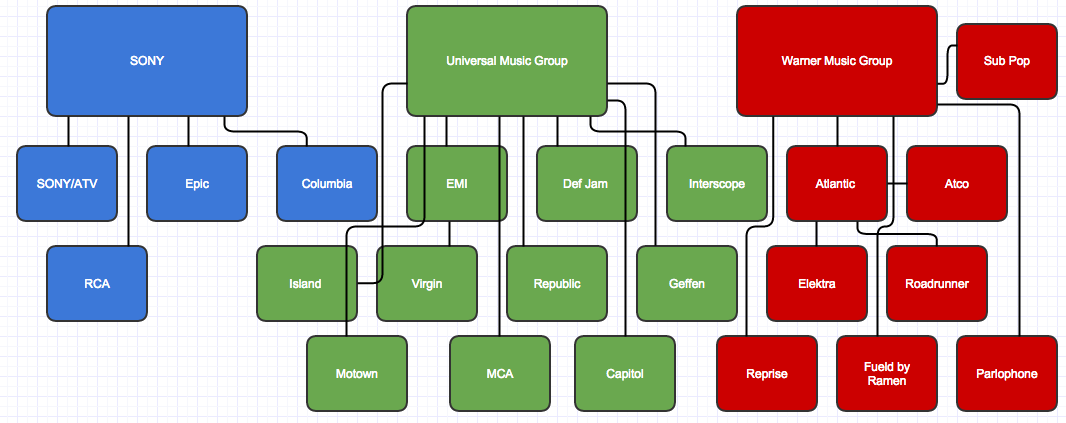
4. Tell Me Again How There’s No Monopoly in the Music Industry – A simple chart that shows the incredibly monopolistic spiderweb of the major record labels and their subjects. With SONY in blue, Universal Music Group in green, and Warner Music Group in red, it’s not hard to see how three CEO’s (of these respective companies) essentially control all the music in the mainstream. If that’s not a monopoly, I really don’t know what is.

(Click for larger preview) 

The Big Three Major Labels and Their Subjects

The Big Three Major Labels and Their Subjects

New articles coming next week. There’s a lot more in the music industry to uncover, and definitely a lot more than needs to be changed.

Two Stories of Sexism in the Music Industry

The kind of BS sexism we need to eliminate

The kind of BS sexism we need to eliminate

The Scourge of Sexism

With the issue of gender equality fast becoming one of the central topics in Silicon Valley (and by extension, the tech and startups industries) at the moment, I can’t say I’m anything but pleased. The problem of gender discrimination and the glass ceiling is long overdue for a solution. While I harbor no fantasies that such a solution will be found overnight, I am nonetheless pleased to see that there is a major effort being made to reform these shortcomings in the tech industry.

As a male, I can confidently say that gender discrimination hits very close to home for me; my parents both practice civil rights litigation, with a focus in employment discrimination and sexual harassment. I grew up seeing cases of blatant discrimination (and unfortunately it makes me angry to say I still do), where the the ugly beasts of intolerance and sexism were clearly visible. The latter, in particular, surprises me again and again because we are taught to believe that we’re moving forward in eradicating sexism—but not fast enough in my opinion. We still have a lot of work to do.

While the tech industry is starting to really spotlight and root out sexism within its ranks (as well it should), other industries are lagging too far behind in my opinion. The music industry, for example, is still too hampered by outright sexism for my taste, even after movements like third-wave feminism and Riot grrrl punk began to shatter the mold. It’s not a foregone conclusion by any means, and there are many within the music trenches who are trying very hard to change it for the better—to level the playing field so that gender becomes irrelevant—so that talent is acknowledged and validated by its inherent existence, regardless of the artist’s gender.

But let me provide two examples of what can be changed, and how people can step in to make the music arena more tolerant and progressive. Neither example makes me happy to share (less happy to have experienced), but perhaps that underscores their importance.

The Sleazy Promoter

The first example happened a couple of years ago, in the spring of 2013, and goes like this: I am good friends with a band whose members included a female element (the singer and drummer). The group was set to work with a promoter to book shows in their home state (which, though eliminated by name, I can say is quite a big market for independent music). The promoter made inappropriate and unwelcome advances towards the female band member(s) and the group cut ties, not wanting to work professionally with someone of such poor character quality. The promoter then retaliated by threatening to call every promoter within the state, seeking to destroy the group’s reputation, thus effectively cutting out their feet from under them. (In this particular state, I can say with confidence that there are at least seven major cities and/or scenes that they most likely split their time between).

I was in Amsterdam at the time, on my study abroad program. I woke up one day to a frantic “what do we do?? we’re going to get totally screwed by this person!” email from the singer. Even through text it wasn’t hard to clearly read her fear and anger over the situation. So her solution? Reach out to me in search of some advice.

The response I sent her was simple: I explained to her that I was behind her, and would throw the entire weight of my blog and radio show behind her and the band (and would bring in other artists I knew for support if need be). I even offered to write a letter as a professional contact (DJ and journalist) attesting to their quality as a band and professionalism as people, which they might use to send to anyone to rebuke the slanderous threats of this sleazy promoter. She seemed calmed by that offer (and most thankful, as you can imagine!) and we decided to see just how events would proceed.

In the end, the promoter never made good on his threats, and the whole situation seemed to blow over. But I never forgot that frantic email (I’m sure she hasn’t either), and to this day I’m still good friends with her and the band. The point is this: such a situation should never have occurred, and it very quickly seemed to spin out of control. But in situations like these, one needs to have the wherewithal to step up for what’s right. I didn’t do anything I didn’t think others wouldn’t do in the same situation. You don’t do it for pats on the back—you do it because it’s right.

The Sexist Tweeter

The second example happened more recently, during the Super Bowl this year. One of the Super Bowl commercials was to promote the hashtag #LikeAGirl to promote gender equality. This is one commercial I loved and supported, and I made so known on Twitter. This was the result:

The sexism problem that needs to be solved

The sexism problem that needs to be solved

I was actually staggered by the sheer sexism of the comment that I saw on my post. Someone telling me that I was sure to “get laid” for supporting “those feminists.” I was angry—actually I was seething. Not only had this person insulted the women that my comment was meant to support, but had dragged my name down too by insinuating that my motive was “to get laid.” I work with numerous artists—many of them with a female element—and I was pissed that this person had seen fit to insult not only people I work with, but people who are my friends.

The music industry is like the tech/startup industry in this respect—not perfect by any stretch of the imagination, but trying very hard to get better. And here was someone dragging us back to the dark ages. This is exactly the sort of thing that people in both industries (or any industry) need to find and root out. The people who make these comments and hold these views are toxic. It’s not (and won’t be) easy, but it has to be done. And it will be.

I for one will be on the lookout for it in the music industry, and will call anyone on it. I encourage other to take aim at sexism and gender discrimination in their respective industries which they know best. Music is my world, and I will not have it polluted with this sort of poison. Don’t step into my house and disrespect my business contacts and friends, it’s as simple as that.

The Lie of “Live Won’t Save Music”

The Introduction

Yesterday, I posted my second article inspired by Fred Wilson’s comments to Jason Calacanis during LAUNCH, wherein I focused on his comments about Kickstarter regarding the music and movie industries. The post itself became too long to explain the economics of the paradigm (of the music industry, at least), so I figured it would be better to do so here in a more focused post. So let’s jump in.

The Lie

In the music business, there’s a well-known adage: “Live won’t save music.” This is the argument that many within the established major label machine use to fend off the assertion that free distribution of music would actually help the music industry in the new digital era. The argument is that artists can’t make enough on a live performance to offset losses they would see by distributing their music for free. And in some cases this is true; income from live shows may not be able to offset those losses…for the major label artists, who have huge stage crews, large arena shows, and a long list of people to pay back (not least of which is their record label). 

The Secret

What industry professionals don’t tell you is that live shows are where artists have historically always made most of the money that goes into their pocket. Money from album sales most often gets paid back to the record label and company, whose “signing” of the artist was simply a monetary advance in the first place. In 1993, well-known artist/producer Steve Albini took aim at the expenses squeezed from artists in his essay “The Problem With Music.” Excerpts from the essay clearly detail how the real economics worked behind the scenes.

The Simple Economics

This simple economic reality means two things: 1) That it’s true that major label artists like Beyoncé and Robin Thicke may very well have a hard time making any real money from live shows and will possibly need to continue to rely on the age-old system’s business practices, and 2) That newer, increasingly independent artists can leverage this new business dynamic to their advantage. Whereas their major label peers are essentially tied to the old system (and streams) of revenue, newer artists who are either fully independent, or have contracts with smaller indie labels which afford them more control, don’t need to sell 150,000 albums or fill an arena tour to make a profit. In fact, they will have an easier time of it, precisely because their “stage crew” many times may only consist of a friend from high school watching the merch table.

And this is where Wilson’s comment comes into play, and is exactly right; crowdfunding platforms like Kickstarter and Indiegogo provide a way for artists (both inside and outside the music sphere) to secure funding for that next tour without being on the hook for ~$400,000 in album distribution and tour expenses.

In fact, there are many artists now exploring the possibilities of free precisely as a way to use their music as a means of marketing to jack up the money they’re able to raise on sites like Kickstarter. By using their music as a “free sample” of their brand, artists are able to explore the dynamic of giving their prospective fans a reason to come out and see them live, buy a shirt, bring a friend—all things that are better for them than the money for one album sale anyway. Music is increasingly being used by these artists as major means of marketing and branding, rather than solely as an end commodity for sale.

You can’t argue with math, and here’s reality: How many times are you compelled to and/or do you buy a song or album? Just once. Why would you buy it again unless you had to? But if you examine the same dynamic with respect to going to a show, or buying a t-shirt, suddenly the answer is “as many times as you want.” It becomes a self-feeding cycle, wherein new possibilities are presented by the power of crowdfunding, and not having to go to a major label for the financing. It boils down to simple arithmetic.

The Album You Had to Buy Over and Over Again

It’s worth noting, also, that the established music industry got used to people buying the same album(s) over and over again because they had to. With each subsequent technological change, that Led Zeppelin album you loved so much became obsolete, and thus you needed to shell out more money for something you already had. Buying music on ’45’s became buying the same music again on LP’s, then again on cassettes, again on CD’s, and then again as basic mp3 files (usually off iTunes).

But something happened during that last transformation: music became distilled down to only the information, sans any physical product, and with the power and reach of the internet, distribution costs dropped to zero. Suddenly, the ability to reproduce and distribute music became the cost of 10 minutes of your time, and didn’t even require the kind of distribution networks that record labels had spent decades building, growing and protecting.

And who was it who lost out the most? The demographic that gleaned most of their revenue from physical album unit sales—the major record labels. But the artists now had a new reality in front of them: mass distribution, but without having to indenture themselves to the “physical CD sales-dynamic.” They were (and are) free to make money where they always have: in the live sphere with grass-roots ticket sales and merchandise sales. Thus it becomes clear that the statement “Live won’t save music” is inherently a biased lie. Live won’t save the old music industry, but those within the industry who are adapting to the new terrain are doing just fine exploring the new possibilities before them.

The New Free/Live Dynamic

Those are the people I would place my bets on. They have no stake in the old paradigm, and are happy to push it aside to see what the new free/live dynamic can do for them. This is where the real money in the music industry will be in the next decade. Not grasping with frail fingers at a business model quickly fading away, but exploring with wide-open eyes the opportunities that “free/live” afford both those in the music trenches, and their prospective fans. Don’t be fooled; there’s still a ton of money and opportunity in the music industry. You just need to know where to look.

Why Isn’t the Music Business Fully Crowdfunded?

Last week, I posted an article detailing VC Fred Wilson’s thoughts on investing, in which I drew on a few things he’d stated during his interview with Jason Calacanis at LAUNCH. This time around I want to explore another statement Wilson made during his time on stage which I thought received way too little attention at the time. In fact, I’m quite shocked that more people haven’t really latched onto this sooner.

At one point during the conversation, Wilson mused, “I don’t understand why the music business isn’t fully on Kickstarter,” to which there was some murmuring (I heard sitting in the audience), but no real discussion thereafter of that particular comment. While I was just as interested in the next point that Wilson discussed with Calacanis (the subject of my previous post), I couldn’t (still can’t) get my arms around how something so stark to many people seems to fly under the radar. But before I get too incoherent, let me back up and explain my exasperation.

The wonderful thing about Kickstarter (or any of the other crowdfunding platforms) is the freedom that they give to artists. In the case of the music industry, the freedom I’m referring to is the ability to not have to sign to a major record label in order to have money to finance an album, tour, video, etc. Instead, artists can go directly to their own fanbases and raise the required capital from them, thereby side-stepping the very real consequence of having to sign away some amount of creative control (ever hear of master tapes?) to the major label. As a result of this, artists consequently side-step the dynamic of accruing a similar sort of debt with the label itself. (I will explain the deeper economics at play here in a later post).

The dynamic of crowdfunding has changed the entire paradigm of the music industry. Wilson’s comments struck me so much because of how true they really are. He doesn’t need to be a guitarist in a band to understand that the freedom that services like Kickstarter give content-producing artists is invaluable (clearly the reason he invested in Kickstarter in the first place). His own “I don’t understand why” comment exhibits his understanding of the services that used to be out of reach of artists, which are now readily available thanks to crowdfunding dynamics.

Of course, crowdfunding alone can’t and won’t control an entire vertical like, say, the music industry. It’s one part of a larger mechanism. But it’s nonetheless a shift in the paradigm of music production, distribution and consumption that was previously unavailable. Where crowdfunding really comes into play is when it totally disrupts the age-old adage “live won’t save music” (but that’s an argument for a later post).

Here’s the real point: Fred Wilson is an investor, not a guitarist or aspiring singer. Yet he sees the value of crowdfunding so much (investment interest aside) that he doesn’t understand why any artist would forgo the opportunities presented by these new services. And I’m inclined to agree with him (and I’ve been in the music industry now for years). So here’s the real question: if he gets it, and I get it, don’t you think that all the new artists out there get it too?

It just might be a very short time until the music business is fully (or mostly) crowdfunded.

Tell Me Again How There’s No Monopoly in the Music Industry

Most all of the record labels you know are owned by three major parent corporations: SONY, Universal Music Group (UMG), and Warner Music Group (WMG). Even Sub Pop, the once-famous Seattle independent label, is now owned by WMG. The only pseudo-famous label not on here is K Records, which became famous around the same time as Sub Pop for releasing off-beat alternative music in the ’90s. But for most everyone else, it’s just a question of which corporation you have pulling the strings. Tell me again how there’s no monopoly in the music industry.

(Click image for larger preview.)

The Big Three Record Labels, and All Their Subjects

The Big Three Record Labels, and All Their Subjects

SONY:

  • SONY/ATV
  • RCA
  • Epic
  • Columbia

Universal Music Group:

  • EMI
    • Virgin
  • Island
  • Motown
  • Def Jam
  • Republic
  • MCA
  • Capitol
  • Geffen
  • Interscope

Warner Music Group:

  • Reprise
  • Atlantic
    • Elektra
    • Roadrunner
    • Atco
  • Sub Pop
  • Fueled by Ramen
  • Parlophone

Everyone Wants to Be a Rock Star

Yesterday I posted a list of music-centered movies that were some of my favorites and which I thought everyone should see at least once. While I will undoubtedly be adding to the list, I thought it would be a good idea to go into each one a little deeper and explain why I love it so much. As a lot of these flicks have inside jokes all the way through, I’m excited to point out just why some of them are so funny.

Up first, the incredibly underrated movie Rock Star (2001), starring Mark Wahlberg and Jennifer Aniston, among other recognizable names. While I quite like Wahlberg’s performance and Aniston is good as always (and is it just me, or does she just seem to be in everything?), one of the coolest things about this film is the laundry list of actual rockstars that are in it: Jason Bonham (Led Zeppelin/UFO/Foreigner), Zakk Wylde (Ozzy Osbourne/Black Label Society), Jeff Pilson (Dokken), and Stephen Jenkins (Third Eye Blind). Frankly I’d watch it just to see those people in the cast.

(And I promise not to give away anything that’s not in the promotional trailer).

Rock Star; 2001

Rock Star; 2001

The plot itself is a nod to the real-life story of Tim “Ripper” Owens, a Judas Priest fan who ascended to become the new singer of Priest when Rob Halford left to explore his solo project (1996-2003). The movie mirrors Owens’ life so closely, in fact, that the beginning of the film finds Chris “Izzy” Cole (Wahlberg) as the singer of Blood Pollution, a Steel Dragon tribute band (in real life, Owens was the lead singer of British Steel, a Judas Priest tribute band). (Though his part is minor, it’s still really awesome to see Jenkins play the rival singer from the other Steel Dragon tribute band). With his business manager/girlfriend Emily (Aniston) by his side, Cole gets kicked out of his band amid internal conflicts, only to find himself in an audition for the real Steel Dragon following the departure of their original singer.

While Cole explores the trappings and excesses of the late 1980’s hair metal scene in L.A., he soon finds that his Steel Dragon bandmates (played by Bonham, Pilson, and Wylde) don’t exactly view him as an equal, stunting his artistic (and personal) growth. It’s not long before Cole is consumed by the excess and decadence of the glam metal scene, and Emily voices a desire to leave and open a business with her roommate in Seattle (foreshadowing anyone??).

I won’t give too much away, but I will say that the end of the film is a clear nod to the death of the glam metal scene, and the rise of grunge. Without describing too much, pay close attention to Cole’s dress towards the end, and see if he reminds you of anyone (if you’re a music history fan, you should figure it out in about ten seconds).

All in all, Rock Star is just one of my favorite music movies because it’s got a good, simple message, and it’s entertaining to watch. The laundry list of real rockstars in it would give any music addict aneurysms, and the history that’s commented on beneath the surface is pretty cool to see. Not a blockbuster, but still a great film in my opinion.

30 Music Movies You Need to See Right Now

While racing my brain today for a topic to blog about, I found my mind wandering to the music-centered movies that I wanted to watch this weekend. After some listing in my head, that seemed like a cool topic in and of itself, since I find that so many of my favorite music movies go under the radar. As it’s been a while since I last posted a list at all, I figured that today seemed an ideal time to put up a new one. So here are some of the best music movies in my opinion—docu-/rockumentaries, mockumentaries, and just plain good flicks. These are just some of my favorites based on my taste—there are a ton of other amazing music-centered movies out there (in no particular order). Check ’em out:

Mockumentaries

  1. This Is Spinal Tap – 1984

Rockumentaries

  1. About a Son – 2006
  2. 1991: The Year Punk Broke – 1992
  3. Hype! – 1996
  4. PJ20 -2011
  5. LoudQuietLoud: A Film About The Pixies – 2006
  6. The Decline of Western Civilization – 1981
  7. The Decline of Western Civilization Part II: The Metal Years – 1988
  8. The Decline of Western Civilization III – 1998
  9. The White Stripes: Under Great White Northern Lights – 2009
  10. Some Kind of Monster – 2004
  11. Anvil: The Story of Anvil -2008
  12. A Band Called Death – 2012
  13. Rush: Beyond the Lighted Stage – 2010
  14. It Might Get Loud – 2008
  15. Metal: A Headbanger’s Journey – 2005

Biopics

  1. 8 Mile – 2002
  2. Walk the Line – 2005
  3. Ray – 2004
  4. The Runaways – 2010
  5. Hysteria: The Def Leppard Story – 2001
  6. What We Do Is Secret – 2008

Fictional

  1. School of Rock – 2003
  2. Rock Star – 2001
  3. Empire Records – 1995
  4. That Thing You Do! – 1996
  5. The Blues Brothers – 1980
  6. High Fidelity – 2000
  7. Almost Famous – 2000
  8. Tommy – 1975

Why I Practice Singing As Much As Pitching

Image courtesy of HamptonsAudioVisualRentals.com


Years before I started practicing my business pitch as a CEO, I was practicing how to do two other things in front of people: speak publicly and sing. Exercises in public speaking began as early as grade school, and served me well during science fairs and group presentations. However short-lived my science career turned out to be (another story for another time), the science fairs on the county and state levels bolstered not only a comfort, but an enjoyment in speaking before a crowd.

As I entered high school, though, I began to do something else just as seriously: I began to sing. I began to practice singing as often as I could, and not just in the shower. I was practicing with headphones, a microphone and amplifier setup so I could know exactly how my voice sounded coming through a loudspeaker (of sorts). I was doing the band thing with my friends, and we were going to conquer the world. That meant I needed to be able not only get up in front of a crowd and make some sort of sound come out of my mouth, but I needed to be able to control it.

I needed to be able to control every aspect of my voice: the tone, the inflections, the power, the breath, the range, and the melody. That’s what it took to be a lead-singer and/or rockstar, and that’s what I was going to do. I couldn’t have known it at the time, but all that practice for my music career—understanding the qualities of my voice and what it was (and wasn’t) capable of—is proving invaluable well beyond my intended career as a musician.

I’ve blown my voice out numerous times in the past exploring new ranges, techniques, pronunciations, and vocal styles. I’ve had days where people inquired about my “laryngitis.” But it’s ok, because a day later I’m all ready to go again, and each time I nail a new song and find the delivery that works for my voice, I get to know my own talkbox a little better. With that discovery comes a deeper understanding of how my voice sounds to other; its melody, its tone, its inflections. (It also has helped with my breathing, which is something I believe every public speaker should continually work on).

But the most important thing I’ve grown to have a deeper understanding of is the power and range that my voice can have. That’s something that transcends the rock stage and applies directly to my trajectory now as a CEO. Speaking comes with the territory, and having a notion of my range and potential power is like having an ace up my sleeve. I know how far I can push myself before my voice disappears under too much strain, and I what I can now do to avoid that blowout.

I practice singing any number of things as I continue to test my voice and its boundaries: post-grunge, alternative rock, ska punk, pop, metal, classic rock, rap, reggae, male vocals, female vocals—anything that piques my taste and can give me more of an edge. In retrospect, practicing singing has been as much of an advantage as practicing my business pitch. I would suggest to anyone who spends time speaking in public to start singing—really singing: really try to nail that melody, try to match and control your breathing, find the inflections that work best for you, and find your own power.

Besides, we all wanted to be rockstars at some point, right? Maybe there’s still time for some of us—maybe all of us.

Mean People Fight; Creative People (Sometimes) Argue

In his essay “Mean People Fail” a few months ago, Paul Graham has provided more food for thought (for me, at least) than much of anything I’ve read of late. [1] The essay itself is a clear caution against acting nastily to others, as such actions can impede or prevent one’s intended goals. Most of the themes discussed therein I agree with readily as they are so common-sense that to disregard such proposals seems utterly preposterous.

There is, however, one area which Graham touches on lightly that I feel needs a little more attention. Graham’s short paragraph on fighting is truthful (I believe) in its intended message and account of reality. However, we all speak from our own experiences, and I feel that the term “fighting” may be too broad a term, particularly for an industry as genuinely artistic and creative as startups and tech. While I understand Graham’s point here (he is undoubtedly using the term “fighting” to refer to pointless disagreements, high tempers, and accusatory tones that lead nowhere), I think a deeper examination is warranted.

I fear the term “fighting” may be overrepresented in cases where the term “arguing” fits more appropriately. In an industry where creativity and outthinking the competition are not only realities but necessities for successful startups, it may very well be in times of arguing differing views that an answer or pivot point presents itself. Good answers and opportunities do not always appear within the vacuum of “a good day” and sometimes take a little more pressure to fully crystalize.

Much like the music industry where arguments between band members or artists and producers can (and many times do) produce the best creative results, arguing is not only a luxury but a necessity. The creative frustration can at times reach a critical mass before a meltdown occurs. But if the proper alternative lines of thinking are presented at the right time, then that critical mass not only returns to normal, but can yield a result not viewable before the high rise of creative pressure and focus. It is this creative force which drives many musicians, and which I’m sure can be likened to the creative drive to build that drives those within the tech space.

Creation is a messy, dissonant, sometimes quite frustrating process. But it’s precisely that power and sheer will to succeed that many of the great ideas (albums) are born from. Graham is not wrong about his discussion of fighting; pointless accusations and infighting drain a startup’s (as well as a band’s) lifeforce and ability to thrive (it’s this definition of “fighting” that I am convinced Graham is referencing in his essay). A band, like a startup, is very much like a marriage: both are living, breathing organisms, requiring constant care, adjustment, and which, at times, can become arenas for argument and restructuring. But, though the prospect of adjustment may pose a distasteful reality for a startup team, it could lead to bigger and better things. Then you go from being Iron Maiden with Paul Di’Anno to being Iron Maiden with Bruce Dickinson. [2]


Thanks to Mom, Dad, Charles Jo, Terrence Yang, and Scott Menor for reading earlier drafts of this.


Notes


[1] This essay does not reflect the beliefs of Paul Graham or any of those mentioned in his “Thanks” section, except where the original essay’s thesis was referenced. These are merely my own thoughts on the the thesis that Graham presented in his original text.

[2] Though I prefer the lead vocals of Bruce Dickinson, I quite like the Paul Di’Anno releases of Iron Maiden (1980) and Killers (1981) as well, since both albums are notable in their own rights. However, it is indisputable that Iron Maiden grew to new heights under Dickinson’s leadership, thus the point of the example in the essay.

Why Music Journalism Bias Works

A Shopworn Adage

When I began music blogging, one of the first things I heard repeated over and over was the phrase, “you need to be unbiased in your journalism.” I heard it even more when I shifted my focus from writing about artists that everyone already knew about to ones that people should know about. As I retuned my radar (under the moniker Underground Takeover) to scan for artists that were up and coming, I noticed that the skepticism became more palpable; it seemed that writing a post slamming a new artists—being “unbiased”—was somehow a badge of honor that marked one as “a real journalist.” Yet something didn’t fit.

Me with Those Mockingbirds at The Middle East in Cambridge, MA, 3/9/14

Me with Those Mockingbirds at The Middle East in Cambridge, MA, 3/9/14

The shopworn adage that music journalists should be and need to be unbiased when reviewing music doesn’t work in practice simply because it’s based upon a flawed premise. Non-bias works well in coverage of politics and economics—however, it does not work well within the realm of music and art. Music is an individualized, subjective response to the world or to life by each respective artist. It is a contradiction in terms to try to judge that individualized, subjective response by an impersonal, objective standard, even assuming that we could agree on what that standard is. In addition to that internal contradiction, the fact is that so-called “objective” music journalism is unenjoyable to read either by the music fan or by the artist. Indeed, I didn’t—and still don’t—like writing negative music journalism. Concluding that a work of music is either “great” or “terrible,” or somewhere in between, fails to provide the reader with an understanding of the artist’s intent, or worldview, or what the artist was seeking to express by his or her creation.

Music At Its Core

At its very core, music is simply another form of art; an expression by one or more creative minds of how they see and interact with the world. As with all forms of art, you either like something or you don’t. You may like it somewhat, or it may grow on you after a period of time. All of these possibilities have nothing to do with how “good” or “bad” something is. Within the context of art, concepts of “good” and “bad” don’t exist. How can they? I’m not much of a Rolling Stones fan, but there are a ton of people who are. I’d prefer to listen to a Wipers album (if you know who the Wipers are, then I’m impressed), but my preference doesn’t make me right or wrong.

What I learned from my days in music journalism is that, regardless of what one might glean from watching Almost Famous or reading Rolling Stone, today’s world with the internet and plethora of music blogs and journalists has brought about the democratization of music journalism. This has created a new view of music journalists within the music community, both by artists and by journalists as well. This new perspective is that if you write negative pieces, you’re just some fool with a laptop and internet connection; but if you write positive pieces, then you become a credible news source. And amazingly, this new understanding of music journalism is held as much by music fans as by the artists themselves. After all, when someone attacks an artist I love as “derivative” and “overdriven,” then that journalist attacks me by extension, an action which does not engender a positive feeling in me for the writer.

Me with Sunshine & Bullets at Smith's Olde Bar in Atlanta, GA, 7/5/14

Me with Sunshine & Bullets at Smith’s Olde Bar in Atlanta, GA, 7/5/14

I expect that the established music journalism world will say that without articles ripping new album releases, music fans will be unable to know what’s “good” and what’s not. But as demonstrated already, that line of thinking is flawed in itself since the notions of “good” and “bad” don’t exist within the confines of art at all. You either like something or you don’t—”good” or “bad” simply don’t enter into the equation. (Outside the scope of music journalism, interestingly enough, Marc Andreessen makes a similar point about journalism in general in the new age here, when he spoke last year at Stanford).

I do not advocate for writing positive pieces about music one doesn’t like. If you don’t like a piece of music, it’s impossible to fake a positive review written well enough to fool a reader. Thus it becomes clear that one should write about the music that really resonates with one’s personal tastes. Don’t write rap music journalism if you’re a punk fan. But the flip side is also true: when you’re writing about something you absolutely love and can barely contain yourself long enough to lay the words down on paper because you’re dying to get back to that song again—well your audience can also tell that, and from my experience, that’s when you have them hooked.

Don’t Be “The Enemy”

The added benefit to writing positive pieces about music you like is that you very quickly begin to develop relationships with those very artists. You will no longer be held at arm’s length—as “the enemy” portrayed in Almost Famous. Instead, as you become as much of a fan as those who attend the artists’ shows, you will benefit from reciprocal artist loyalty in most cases that becomes indispensable to you as a writer. I could never have imagined how much reputation is tied to what and how you write until I started getting emails from friends of friends of artists I’d reviewed, asking me to review or interview bands they knew, or their own bands. This opened me up to opportunities I’d never even considered but retrospectively was so lucky to be able to be exposed to (something that Steven Sinofsky talked about here, when he spoke at UC Berkley last year).

Me with June Divided at Warped Tour Atlanta, 2012

Me with June Divided at Warped Tour Atlanta, 2012

Within my own universe I began to do things I’d never thought of. Writing music articles turned into artists seeking me out to do interviews (and making themselves readily available to do so), artists sharing demo mixes with me weeks or even months before final products were released, and artists asking for my opinion, initially just as a fan and eventually as a friend. It’s a wonderful feeling to see your name in the liner notes of an album by an artist you so doggedly support.

Through all of these experiences, I became privy to things that I never could have, had I been shut out as the “enemy journalist.” Having a reputation as an “album killer” may be good for climbing the corporate ladder at an established music magazine, but it’s counterproductive in the real world of music. If you want to sit behind a desk all day and write reviews that will garner views because of how ruthless they are, by all means do that. But if you got into music journalism to talk to artists (which I do daily), to go to shows and (very possibly) get waved past security backstage (which I have been often), to get press access to festivals like Warped Tour (draw your own conclusions here), and grow a reputation as someone to be in contact with within your industry (draw your own conclusions here too), then I highly suggest reaching out with a positive keyboard to this industry.


Thanks to Dad, Charles Jo, Scott Menor, and Terrence Yang for reading drafts of this.