No, Everyone in Management Is Not a Programmer

Just over a couple weeks ago on New Year’s Day, Techcrunch ran an article entitled “Everyone in Management Is a Programmer.”

Though I’m sure that the author, Adam Evans (co-founder and CTO of RelateIQ), had only the best intentions in trying to show programmers that any of them could cultivate the skills necessary to be effective managers, I think the way he’s attempting to go about illustrating his point is limiting when examined within the greater context of tech and business.

In targeting programmers and/or coders in the title of his article, Evans, whether he means to or not, excludes from his discussion those of us who might not have the technical abilities of programmers. While I agree with Evans’ attempt to encourage tech-savvy people to step out of their comfort zones and become successful managerial material, I disagree with his implied suggestion that one must have technical prowess to become a successful manager, and by extension, a founder, CEO, or any other executive within the tech field. The concept leaves out a whole slew of professionals within the tech space who do not consider themselves coders, but who still bring to the table skills that are just as important as programming knowledge.

I certainly understand Evans’ thought process and commend it: those who identify as programmers can certainly cultivate the skills to become effective managers and break out of their comfortable and familiar role as “the tech person.” But I think the ability to better oneself comes from drive and dedication derived from one’s inner character, not from the specific function which one performs at any particular time, whether it be coding or something else. While laudably encouraging programmers and coders to step outside of their comfort zone and become managers, Evans goes to the opposite extreme by suggesting that only programmers and coders can aspire to managerial positions.

It is teamwork that builds great companies. Great managers are those members of the team who lead others, who motivate the other team members and drive the enterprise forward. Yes, programmers and coders are important players on the team, but they are not the only players. Those involved in marketing, finance, public relations, design and layout, legal, and public speaking are also members of the team, and with the requisite leadership skills may realistically aspire to become great managers as well.

Perhaps one of the best recent examples of how the “coding persona” need not be the only one in a company’s top tiers is Ruben Harris’s article “Breaking Into Startups” which was posted a few days ago. The article received a lot of attention (and rightly so, in my opinion) as it describes Harris’s transition from a finance/banking background in Atlanta to a position at a tech startup in Silicon Valley. At this point, I’ve read Harris’s piece a few times already—it’s well-written and insightful, encouraging without becoming preachy. (Truly the mark of a great writer is when the reader of the piece feels as if the piece were written specifically for them). I think my personal most significant takeaway from the article is how Harris demonstrates that it was his desire and networking prowess (and the financial/marketing knowledge he knew he could bring to the table) that led to his successful introductions and subsequent job opportunities.

Evans’ thesis is flawed for a second reason; the belief that people can be programmed the same way as a computer code is flatly false. Concerning this thought process, firstly, no, they can’t—people are not computers precisely because they can be unpredictable and do not work within the same dynamics as a programmable machine and/or line of code. It is this unpredictability and ability for non-linear thinking that creates the very pool from which innovation and unique thoughts spring. To assume that this can be contained, measured, predicted, programmed—well it’s about as predictable as Ian Malcolm’s chaos theory-dinosaur point in Jurassic Park. [1]

Secondly, to attempt to “program” a person (whether that person is your customer, VC investor, employee, team member, etc.) does not reflect well on one as either a manager or a person. Rather than a productive quality, it more than likely comes across to other people as a need to resort to forms of manipulation in order to move one’s business ahead—not a realization I would want to have if I was an investor, employee, potential partner, etc.

Evans’ article takes a good step by encouraging programmers and coders to move into managerial positions. His appeal to coders I think carries with it a deep respect for those whose work he understands first-hand, and whom he seeks to benefit by sharing his own experience and knowledge. However, not everyone in management is a programmer, and people cannot be “programmed.” Successful managers—whether or not they are programmers—are those who find ways to motivate their peers (employees, teams, investors, customers, etc.) that come across as win-win situations, not as attempts at “programming” and predicting their actions in the future.

My respect to Evans for attempting to help his fellow programmers move out from their comfortable places behind the keyboard to take more active, managerial roles in their companies. I think his intentions will serve his team and company well. But I caution against alienating those who are not coders. Rule number one of any business: never seek to speak to one portion of your customers at the expense of alienating another. Those of us who are not coders are still here, and we are still integral in the equation. We build the same kinds of companies and assume the same levels of leadership; we just do it differently.


Thanks to Dad for reading early drafts of this essay.


Notes:

[1] Dr. Ian Malcolm, the mathematician character in Michael Crichton’s novel Jurassic Park (1990), was a characteristic cynic, though no more so than when he scoffed at the idea that the park’s creator, John Hammond, thought he would be able to “control” nature. Malcolm demonstrated his cynicism mathematically through explanations of fractal design and chaos theory as they pertained to nature and the growth of life.

10 Things Startups and Local Bands Should Avoid Screwing Up On

For those who may not know, we in the music industry are quite fond of lists. Best albums, best songs, best guitar players, etc.—we love to compile and compile. And we love to argue our points a thousand times over, and then a few more thousand times after that. It makes for good dialogue.

One of the more popular lists to compile now, though, has a bit more meaning behind it (in my opinion) than the writer simply touting his or her new favorite picks for the week. Lately, the list of annoying things that (local) bands do has been getting longer and longer, and they’re becoming more prevalent within the community. A good (though albeit too lengthy) example is the one that MetalSucks compiled back in 2008 which I’ve seen making its rounds again in the new year.

As I read through it again, however, it occurs to me that many of the points that are being made might very well apply to startups within the tech sphere as well (or any other industry for that matter). Malicious intentions not withstanding, numerous points jump out at me as translatable in an almost eery way. Thus I will take what I think are 10 of the most important points and translate them from the independent (local) music arena to that of the startup tech world. Let’s begin:

1. Bands who feel a need to bang on their drums and guitars in an annoying display of a lack of talent before the doors to the club have even opened = Startups that feel a need to tell you they will have the next big thing before they have written a line of code or made any effort to set up a structural base for a company. You’re not fooling anyone, and just come off as delusional and annoying until you have an actual product to play/build/sell. (The term “stealth mode” comes to mind).

2. Bands who have more roadies than actual band members = Startups that have more employees/cofounders than are actually needed to get the job done and run a company efficiently. You’re only hurting yourself in the end and people actually look at those extra cooks in the kitchen as a detriment too early on. 

3. Bands who arrive at the club and state that they’ve talked to “someone” about a paying gig, but when asked who, can’t remember the person, all the while insisting that it was “just someone who worked at the club” = Startups who try to “network” by insisting they have a mutual contact and that the person has totally introduced you once before. Again, you’re not fooling anyone, and in fact are coming off as scheming and dishonest. Take the time to build the relationships you want to cultivate rather than trying to take the shortcut to your end goal. 

4. Bands whose draw is so bad that even their guests don’t show up = Startups who have absolutely no feedback at all because not even their friends want to use and try out their product. If you can’t at least sell your music or product to your friends, you have a major problem. 

5. Bands who have no guests because they have no friends = Startups who have no users or support because they too have no friends. This one is arguably an extension of #4. Takeaway: have a product that’s at least good enough for your friends to want to use it. (Double takeaway: don’t be a tool; have friends who want to champion you). 

6. Bands who show up wearing “All Access” laminates at a club where “all access” means just about nothing since it’s just a stage and soundboard area = Startups who wear what they think they’re supposed to (maybe hoodies and quirky shoes) and act they way they think they’re supposed to (take this to mean whatever you will) in order to be “real” founders. Posing isn’t just an insult in the punk vein of the music industry; poseurs are everywhere and they are most easily identified as the people who seem really deep until you start interacting with them. Then you realize that they sing the song and dance the dance, but that’s about it. You don’t want to have this reputation as a band, and you certainly don’t when you’re a startup looking to break out amongst the competition. 

7. Bands who market themselves as “We’re ________, but with a mix of ________ and a hint of _________’s vocal/guitar sound” (Example: We’re just like Nirvana, but with some Green Day-style vocals and killer Van Halen guitar licks) = Startups who market themselves as “We’re _________, but for ________” (Example: We’re like Netflix/Uber/Facebook, but for candy/socks/refrigerators). No you’re not, and you’re cheapening both these companies and yourselves by suggesting so. If you have a similar business model, say that, but don’t speak in all analogies (especially since you want to distinguish yourself anyway). 

8. Bands who can’t play longer than a 10-minute set = Startups who have no idea how to last longer than a few months (i.e. have not thought about any structure or organization of the company beyond the writing of the code). This tells investors, customers, and your peers that you’re not capable of sitting down with a pad and pen and planning out how to take your idea from: an idea => a working prototype => a viable, long-term business. This is a particularly essential thing to figure out before you take any financing (think of it as having more than 3 songs before you get up on that stage).

9. Bands who don’t even have enough respect for their fans and musical peers to stick around for the whole show after their set is finished = Startups who don’t even have enough respect for their peers to reciprocate feedback when they receive it. Seriously, this is both a stupid and jerk move. Firstly, it earns you a poor reputation as someone who won’t reciprocate the good will shown to you because one of your peers may end up “competing” with you sometime in the future. Secondly, it’s stupid because you lose out on anything you might have learned from the experience to make your own startup a better company. 

10. Bands who grow supermassive egos and forget their fans and musical peers when they get a little taste of success = Startups who grow supermassive egos when they taste a little success and seem to forget their early supporters. Regarding bands/artists, yes this does happen (I’ve experienced it myself) and no, it doesn’t end well. Don’t forget the people who came out to your show before anyone knew you, or the other bands who took you on tour when you were nobody. Regarding startups, it may happen a little less often (in particular ways), but I can’t imagine it doesn’t happen at all (again, I’ve experienced it myself). Don’t forget your early supporters and believers, and certainly don’t ever forget your core customer-base. When the smoke clears, they’re most likely the only people who will stand by you (unless you’re very lucky).   

These are just a few points that occurred to me to have crossover appeal and application. Certainly more exist, though I think these are the some of the most obvious. In many ways being in a startup is like being in a new local band (who would’ve thought?)—we should all strive to avoid these pitfalls. Otherwise, we’re just that crappy local band that everyone wishes would just finish their set and get off the stage.

Navigating Swift Currents

As we come to the end of 2014, things seem quiet in the music-tech arena—at least for now. Yet it wasn’t too long ago that things were blowing up between Spotify and a number of artists over royalty rates and compensation practices. No doubt the most famous of these disputes (this year) was between the streaming service and popstar Taylor Swift. In what has come to be known by some in the tech and music communities as SwiftGate, Taylor Swift abruptly pulled her entire catalogue from Spotify just around the same time that she released her new album 1989. The response was nearly biblical.

All I saw for weeks on end was a back-and-forth exchange of words, accusations, arguments, and media coverage between Swift and Spotify. Even the service’s CEO Daniel Ek took time to release a public statement responding to Swift’s qualms with the service. This was definitely a story with legs—it just didn’t seem to die down.

Yet what struck me the most were not the statements made by either side, or even the statistics each used to bolster their respective cases. I was more focused on the amazingly divided response that Swift’s actions and statements generated from her fans. Personally, I’m ambivalent—I enjoy some of Swift’s music, though not all, and would not call myself either a major fan or a hater. When Swift wrote her op-ed piece in the Wall Street Journal earlier this year, though, there were immediately a couple of things I didn’t agree with. Perhaps the most presumptuous statement I thought, though, was:

“Music is art, and art is important and rare. Important, rare things are valuable. Valuable things should be paid for. It’s my opinion that music should not be free, and my prediction is that individual artists and their labels will someday decide what an album’s price point is. I hope they don’t underestimate themselves or undervalue their art.”

This statement, though most likely made with the best of intentions, comes across to many within the music community as narrow-minded and out of touch. First, I readily agree with Swift that music is indeed art; art is subjective and highly personal to each person who experiences it. But art is not inherently rare. Nor should it be. This is an outdated concept that smacks more of a stuffy art-history academic than a modern musician. Art as a commodity, or even simply as a means of expression, should derive value from its inherent existence and experience; economic value is secondary to the very nature of what art is. In stating that art requires qualities of rarity and economic value in order to be valuable as art, Swift thus demonstrates a misunderstanding of what art functions as at its core. The concept of music as free is a notion that I will tackle in a later post (probably more than one), but what I will say with regard to Swift’s analysis is to point out how narrow its definition is. There are a great many artists who distribute their music for free, either online or as free giveaways at shows. By insinuating that these artists are devaluing their own art by making the decision to freely distribute, Swift does two things: 1) she demonstrates a worldview that is essentially narrow in its scope, and 2) she effectively succeeds in insulting these artists, more or less stating that they’re not smart enough to “know better.” It’s been a while since I performed as an artist in my own right, but even I still take offense to the above insinuations. Am I really to believe that Swift never played a pass-the-hat acoustic set at a Starbucks or diner somewhere when she was just starting out? [1]

But back to the response to Swift’s sparring with Spotify. If the goal was to generate a media response, then such a goal was certainly achieved. The responses from Swift’s fans in the general music community were far more diverse than even I would have thought. They ranged from those championing her decision and statements to those swearing they will never buy another Swift album from here on out (of course, the latter of those is hardly a statistic that can be confirmed at present). Yet what I focused on through this whole maelstrom of attention and biting back-and-forth comments was the way it could very conceivably (and most likely did) affect Swift’s fans on a psychological and emotional level.

Music, as stated, is emotional and highly personal. There’s a certain identification that one feels when one identifies with a particular artist, song or album. The psychology of wearing a shirt with an artist’s moniker on it effectively marks one as flying a flag for that artist—they become an extension of oneself—an extension of us. We use an artist’s music as a way to expand our sense of expression to the world. That makes our identification with that music highly volatile. Snap decisions like Swift’s have the opportunity to aggressively backfire (depending on one’s point of view, I suppose). Thus I question the long-term effect of Swift’s actions and statements. Yes, the immediate effect was fantastic for her: sales of her new album 1989 blew through the roof upon it’s release on Oct. 27, 2014. It opened at number one on the Billboard 200 and sold over 1 million copies. But I can’t help but focus on the gripes of those fans who felt personally betrayed by Swift’s removal of her catalogue from and subsequent sparring with Spotify. Are those fans going to go see her on tour? Buy a shirt? Tell their friends about her new album? Probably not. The way I see it, Swift has effectively traded long-term benefits for short-term gains. One thing I know about music and artist-loyalty is that it can be a fickle beast. The possible (probable?) effect of dividing her fanbase I think will constitute a major challenge for Swift to overcome in the future. She will have to spend time, energy, patience (and most likely money) trying to reconnect with those fans she might have alienated or even lost.

While it’s possible that the short-term gains may have been worth it to Swift and crew, I think the next currents will prove more difficult to navigate in the coming months. I think Swift has a lot of work ahead of her, and a lot of damage-control to partake in (ironically, not unlike the damage-control that Metallica faced in the wake of the whole Napster controversy). [2] I suppose only time will tell. We’ll reassess in the new year.


Thanks to Alyssa Shaffer, Charles Jo, Mom, and Dad for reading drafts of this. (And to Paul Graham for reminding me that thanks are as much in order for assistance as much as publication of the final product).


Notes

[1] Within the music community, the term “pass-the-hat” most readily refers to a (usually) acoustic set where no cover charge is required, and the artist relies mostly on the generosity of the audience to throw a few dollars in a hat or the guitar case to show their appreciation for and enjoyment of the performance.

[2] As many may remember, when Metallica waded into the thick of the Napster controversy in 2000 (most visibly driven by drummer Lars Ulrich), their rabid fanbase subsequently split into those who supported Metallica’s decision and those who vehemently opposed it. The alienation of a portion of their fanbase proved a challenge that took Metallica a number of years to surmount (and arguably one they are still surmounting). It affected both their sales of merchandise/tickets and their reputation within the music community.

Basquiat’s Prevalence in the Tech Space

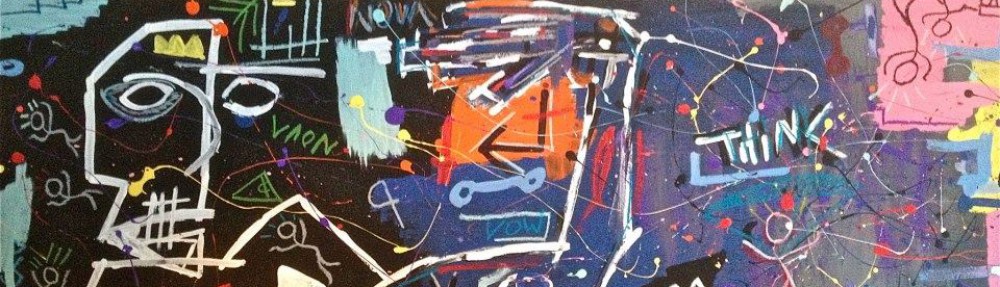
As an art history student, Jean-Michel Basquiat spoke to me on a very cerebral level. He was (and is) art in its rawest form since perhaps the action paintings of Jackson Pollock, with half the amount of time lived, and probably a quarter (or none) of the experiences of Pollock. Basquiat’s death at 27 (yet another addition to the 27 Club) was tragic in more ways than one, but perhaps the greatest loss from an academic perspective is the loss of such a natural talent and artistic genius. It makes sense for Basquiat to command so much of my attention; I studied art history in college and find something calming about it. But what’s so intriguing to me is that prevalence of Basquiat’s work in the tech community, something I’m beginning to see more and more.

Jean-Michel Basquiat

Jean-Michel Basquiat

I’ve seen Basquiat paintings retweeted and made as backgrounds, and have come to question just how much Basquiat’s work connects with those outside the art community. Certainly works by one of his contemporaries, Keith Haring, are popular in society today. They grace shirts, backpacks and the sides of water-bottles. But comparatively, Haring’s work is understandably more mainstream-acceptable: there’s a unique sense of balance in it that appeals to the human emotion. As far as graffiti art goes, to the mainstream mind, it appears as doodles, almost child-like in its composure. And that’s exactly the way Haring wanted it–that was his style.

Crack Is Wack!; Keith Haring; 1986

Crack Is Wack!; Keith Haring; 1986

Basquit’s style, though, presents more of a bitter pill for a mainstream audience to swallow. It’s wild, rude, crass, raw, racial, emblematic, poetic, nonsensical, grungy, sloppy, brilliant. It’s not a pretty picture, nor a balanced composition, and thus presents the audience with an almost reversible set of emotions. It is at once both obsessive and nonchalant, as if Basquiat cares so much up until a certain point, then doesn’t at all beyond that. (More of the deep artistic undercurrents of Basquiat’s work later).

Boy and Dog in a Johnnypump; Jean-Michel Basquiat;1982

Boy and Dog in a Johnnypump; Jean-Michel Basquiat;1982

And through all this artistic rage and raw power, I’m intrigued by what I perceive of the minds of some in the tech community (though this, admittedly, is based on my own experience). Perhaps it makes sense that an industry and community so centered around creation would find such a riveting painter fascinating. Certainly it can be said that a good many within the tech sphere are driven by the desire to create and view the world from a continually evolving perspective. Would this, then, explain why I’ve seen Jean-Michel’s work pop up more than a few times in this intriguing community of tech enthusiasts? More research is necessary to find out.