Tell Me Again How There’s No Monopoly in the Music Industry

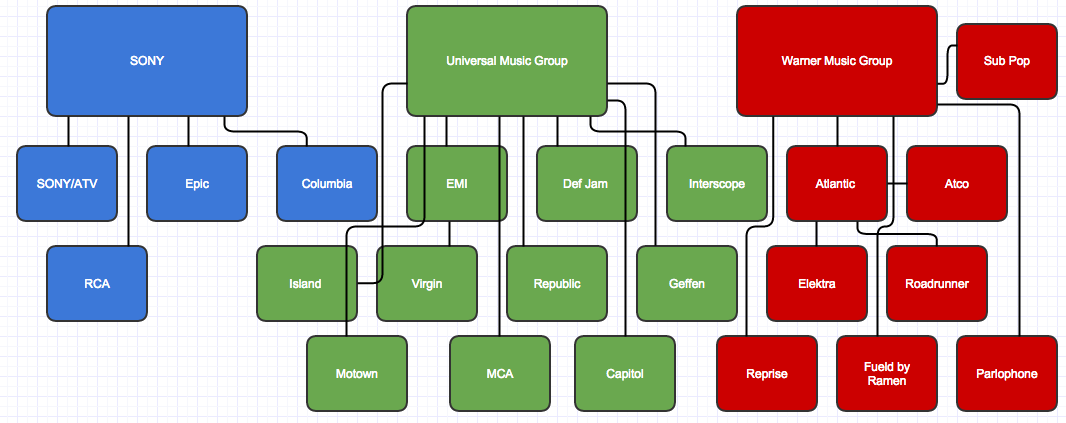
Most all of the record labels you know are owned by three major parent corporations: SONY, Universal Music Group (UMG), and Warner Music Group (WMG). Even Sub Pop, the once-famous Seattle independent label, is now owned by WMG. The only pseudo-famous label not on here is K Records, which became famous around the same time as Sub Pop for releasing off-beat alternative music in the ’90s. But for most everyone else, it’s just a question of which corporation you have pulling the strings. Tell me again how there’s no monopoly in the music industry.

(Click image for larger preview.)

The Big Three Record Labels, and All Their Subjects

The Big Three Record Labels, and All Their Subjects

SONY:

  • SONY/ATV
  • RCA
  • Epic
  • Columbia

Universal Music Group:

  • EMI
    • Virgin
  • Island
  • Motown
  • Def Jam
  • Republic
  • MCA
  • Capitol
  • Geffen
  • Interscope

Warner Music Group:

  • Reprise
  • Atlantic
    • Elektra
    • Roadrunner
    • Atco
  • Sub Pop
  • Fueled by Ramen
  • Parlophone

Why I Practice Singing As Much As Pitching

Image courtesy of HamptonsAudioVisualRentals.com


Years before I started practicing my business pitch as a CEO, I was practicing how to do two other things in front of people: speak publicly and sing. Exercises in public speaking began as early as grade school, and served me well during science fairs and group presentations. However short-lived my science career turned out to be (another story for another time), the science fairs on the county and state levels bolstered not only a comfort, but an enjoyment in speaking before a crowd.

As I entered high school, though, I began to do something else just as seriously: I began to sing. I began to practice singing as often as I could, and not just in the shower. I was practicing with headphones, a microphone and amplifier setup so I could know exactly how my voice sounded coming through a loudspeaker (of sorts). I was doing the band thing with my friends, and we were going to conquer the world. That meant I needed to be able not only get up in front of a crowd and make some sort of sound come out of my mouth, but I needed to be able to control it.

I needed to be able to control every aspect of my voice: the tone, the inflections, the power, the breath, the range, and the melody. That’s what it took to be a lead-singer and/or rockstar, and that’s what I was going to do. I couldn’t have known it at the time, but all that practice for my music career—understanding the qualities of my voice and what it was (and wasn’t) capable of—is proving invaluable well beyond my intended career as a musician.

I’ve blown my voice out numerous times in the past exploring new ranges, techniques, pronunciations, and vocal styles. I’ve had days where people inquired about my “laryngitis.” But it’s ok, because a day later I’m all ready to go again, and each time I nail a new song and find the delivery that works for my voice, I get to know my own talkbox a little better. With that discovery comes a deeper understanding of how my voice sounds to other; its melody, its tone, its inflections. (It also has helped with my breathing, which is something I believe every public speaker should continually work on).

But the most important thing I’ve grown to have a deeper understanding of is the power and range that my voice can have. That’s something that transcends the rock stage and applies directly to my trajectory now as a CEO. Speaking comes with the territory, and having a notion of my range and potential power is like having an ace up my sleeve. I know how far I can push myself before my voice disappears under too much strain, and I what I can now do to avoid that blowout.

I practice singing any number of things as I continue to test my voice and its boundaries: post-grunge, alternative rock, ska punk, pop, metal, classic rock, rap, reggae, male vocals, female vocals—anything that piques my taste and can give me more of an edge. In retrospect, practicing singing has been as much of an advantage as practicing my business pitch. I would suggest to anyone who spends time speaking in public to start singing—really singing: really try to nail that melody, try to match and control your breathing, find the inflections that work best for you, and find your own power.

Besides, we all wanted to be rockstars at some point, right? Maybe there’s still time for some of us—maybe all of us.

Fred Wilson Believes in Things That Everyone Else Thinks Are Wrong (But Are Actually Right)

A couple of weeks ago I attended the LAUNCH Festival in San Francisco, where I saw a number of amazing speakers over a three-day period. Needless to say the cross-country trip from Atlanta was worth it. However, despite the fact that there were numerous speakers whose points have stuck in my head since then (particular favorites of mine were Yancey Strickler (Kickstarter), Jeff Weiner (LinkedIn), Chris Sacca (VC) and Tony Hawk (yes I’m a huge fan of skating and the Brown Brigade)), the speaker whose comments were most easily accessible to me was Fred Wilson (Union Square Ventures).

Since the wrap-up of the festival, Jason Calacanis has published a couple of posts and tweets noting the fact that his fireside chat with Wilson was one of the most popular interviews of the whole event. This I readily believe, as I sat with rapt attention as Wilson discussed a number of topics. Actually, Wilson made so many good points during his chat that I need to dissect it through a number of posts rather than in just one.

Of particular interest to me though was one thing that Wilson said. It clearly demonstrated to me his line of thinking when it came to identifying new companies that he liked to become (or was likely to become) involved in: “Believe in something that everyone thinks is wrong (but actually turns out to be right).”

That terse statement, which Wilson actually attributes as something Bill Gurley once wrote, underscored his thinking when it comes to herd-mentality and how he identifies opportunities. While I’m sure there are certainly other factors at play, the qualifier word “wrong” is an interesting choice for his (Gurley’s) adage; it implies quite clearly that he identifies opportunities not only in areas or with companies that might be viewed as rare or unconventional, but ones which may be entirely against the grain of “logical” thinking at the time. This by extension highlights the fact that one can expect Wilson’s current and future investments to be in areas or companies wherein others might not dare even entertain the notion of involvement. He benefits from the fear factor that clears the road in front of him to make it an open highway while others see the words “do not enter.” [1]

Though I’ve followed Wilson’s blog for some time now, since LAUNCH I’ve been reading his posts with this new thought in mind. With each new post I read, there’s now that nagging question in the back of my mind: “what’s the thing in this post that Wilson has identified that others think is flat-out wrong (but is actually right)?” There isn’t always a phrase with a blinking sign screaming “it’s me!” but the point remains that with each subsequent post comes a learning opportunity to go back and reexamine a possibility that I might have dismissed earlier as a “do not enter” sign.

I’m interested to see Wilson’s posts over the next month or so. I’m curious to see what piques his interest enough to blog about it that others may have already dismissed or avoided. I suspect that Wilson’s thought process might very well be as alternative as his Egon Schiele-esque Twitter profile pic (by the way Fred, kudos on that; art-history nerds like me rejoice in the fact that so many within the tech industry use so much modern art imagery). I believe that’s precisely how he’s able to identify opportunities that others miss, or dismiss altogether.


Thanks to Dad for reading drafts of this.


Notes


[1] Wilson also stated that he had been on the board of a non-profit called DonorsChoose for a few years, which, as he put it, “does exactly, exactly what Kickstarter does” for teachers and public schools. As a result of his involvement with this previous venture, which was raising between $30-40M at the time, Wilson notes that he had a bit of an inside look at the very sort of mechanism upon which Kickstarter was building.

Mean People Fight; Creative People (Sometimes) Argue

In his essay “Mean People Fail” a few months ago, Paul Graham has provided more food for thought (for me, at least) than much of anything I’ve read of late. [1] The essay itself is a clear caution against acting nastily to others, as such actions can impede or prevent one’s intended goals. Most of the themes discussed therein I agree with readily as they are so common-sense that to disregard such proposals seems utterly preposterous.

There is, however, one area which Graham touches on lightly that I feel needs a little more attention. Graham’s short paragraph on fighting is truthful (I believe) in its intended message and account of reality. However, we all speak from our own experiences, and I feel that the term “fighting” may be too broad a term, particularly for an industry as genuinely artistic and creative as startups and tech. While I understand Graham’s point here (he is undoubtedly using the term “fighting” to refer to pointless disagreements, high tempers, and accusatory tones that lead nowhere), I think a deeper examination is warranted.

I fear the term “fighting” may be overrepresented in cases where the term “arguing” fits more appropriately. In an industry where creativity and outthinking the competition are not only realities but necessities for successful startups, it may very well be in times of arguing differing views that an answer or pivot point presents itself. Good answers and opportunities do not always appear within the vacuum of “a good day” and sometimes take a little more pressure to fully crystalize.

Much like the music industry where arguments between band members or artists and producers can (and many times do) produce the best creative results, arguing is not only a luxury but a necessity. The creative frustration can at times reach a critical mass before a meltdown occurs. But if the proper alternative lines of thinking are presented at the right time, then that critical mass not only returns to normal, but can yield a result not viewable before the high rise of creative pressure and focus. It is this creative force which drives many musicians, and which I’m sure can be likened to the creative drive to build that drives those within the tech space.

Creation is a messy, dissonant, sometimes quite frustrating process. But it’s precisely that power and sheer will to succeed that many of the great ideas (albums) are born from. Graham is not wrong about his discussion of fighting; pointless accusations and infighting drain a startup’s (as well as a band’s) lifeforce and ability to thrive (it’s this definition of “fighting” that I am convinced Graham is referencing in his essay). A band, like a startup, is very much like a marriage: both are living, breathing organisms, requiring constant care, adjustment, and which, at times, can become arenas for argument and restructuring. But, though the prospect of adjustment may pose a distasteful reality for a startup team, it could lead to bigger and better things. Then you go from being Iron Maiden with Paul Di’Anno to being Iron Maiden with Bruce Dickinson. [2]


Thanks to Mom, Dad, Charles Jo, Terrence Yang, and Scott Menor for reading earlier drafts of this.


Notes


[1] This essay does not reflect the beliefs of Paul Graham or any of those mentioned in his “Thanks” section, except where the original essay’s thesis was referenced. These are merely my own thoughts on the the thesis that Graham presented in his original text.

[2] Though I prefer the lead vocals of Bruce Dickinson, I quite like the Paul Di’Anno releases of Iron Maiden (1980) and Killers (1981) as well, since both albums are notable in their own rights. However, it is indisputable that Iron Maiden grew to new heights under Dickinson’s leadership, thus the point of the example in the essay.

Their Response Was Not a Fuckup; It Was Exactly Right

Just a few minutes ago, Product Hunt CEO Ryan Hoover posted a tweet and article on Medium acknowledging what he called a terrible fuckup; Product Hunt’s validation programming had made the erroneous assumption that all founders are male by using the article “his” when discussing validated identity.

Screenshot of tweet to Product Hunt, earlier today 2/19/15

Screenshot of the tweet to Product Hunt, earlier today 2/19/15

The reaction from Hoover and Product Hunt to the tweet was exactly what it should have been: mortification at such a presumptuous error, speedy rectification of the problem, a personal apology to Allyson (the tweeter), and an immediate blog post owning up to the misstep for others to be mindful of. Frankly I would have been impressed by the first two things; but to see all this unfold in sequence in an expedited manner reaffirmed the reasons I use PH, and why I consider them an example of a company to emulate.

Response tweet by Ryan Hoover to the discovered problem

Response tweet by Ryan Hoover to the discovered problem


The corrected response on Product Hunt

Screenshot of the corrected response on Product Hunt

I have to give it up to the whole PH team; it’s not easy to admit a mistake, particularly when it’s brought to one’s attention in such a public arena. But they really went above and beyond in their response, and the subsequent Medium piece by Hoover really underscored their commitment to gender equality that I very much respect them for.

Well done PH, take a bow. We should all strive to be as good as this.


Notes

[1] The images used in this post were taken from Ryan Hoover’s original Medium blog post.

Why Music Journalism Bias Works

A Shopworn Adage

When I began music blogging, one of the first things I heard repeated over and over was the phrase, “you need to be unbiased in your journalism.” I heard it even more when I shifted my focus from writing about artists that everyone already knew about to ones that people should know about. As I retuned my radar (under the moniker Underground Takeover) to scan for artists that were up and coming, I noticed that the skepticism became more palpable; it seemed that writing a post slamming a new artists—being “unbiased”—was somehow a badge of honor that marked one as “a real journalist.” Yet something didn’t fit.

Me with Those Mockingbirds at The Middle East in Cambridge, MA, 3/9/14

Me with Those Mockingbirds at The Middle East in Cambridge, MA, 3/9/14

The shopworn adage that music journalists should be and need to be unbiased when reviewing music doesn’t work in practice simply because it’s based upon a flawed premise. Non-bias works well in coverage of politics and economics—however, it does not work well within the realm of music and art. Music is an individualized, subjective response to the world or to life by each respective artist. It is a contradiction in terms to try to judge that individualized, subjective response by an impersonal, objective standard, even assuming that we could agree on what that standard is. In addition to that internal contradiction, the fact is that so-called “objective” music journalism is unenjoyable to read either by the music fan or by the artist. Indeed, I didn’t—and still don’t—like writing negative music journalism. Concluding that a work of music is either “great” or “terrible,” or somewhere in between, fails to provide the reader with an understanding of the artist’s intent, or worldview, or what the artist was seeking to express by his or her creation.

Music At Its Core

At its very core, music is simply another form of art; an expression by one or more creative minds of how they see and interact with the world. As with all forms of art, you either like something or you don’t. You may like it somewhat, or it may grow on you after a period of time. All of these possibilities have nothing to do with how “good” or “bad” something is. Within the context of art, concepts of “good” and “bad” don’t exist. How can they? I’m not much of a Rolling Stones fan, but there are a ton of people who are. I’d prefer to listen to a Wipers album (if you know who the Wipers are, then I’m impressed), but my preference doesn’t make me right or wrong.

What I learned from my days in music journalism is that, regardless of what one might glean from watching Almost Famous or reading Rolling Stone, today’s world with the internet and plethora of music blogs and journalists has brought about the democratization of music journalism. This has created a new view of music journalists within the music community, both by artists and by journalists as well. This new perspective is that if you write negative pieces, you’re just some fool with a laptop and internet connection; but if you write positive pieces, then you become a credible news source. And amazingly, this new understanding of music journalism is held as much by music fans as by the artists themselves. After all, when someone attacks an artist I love as “derivative” and “overdriven,” then that journalist attacks me by extension, an action which does not engender a positive feeling in me for the writer.

Me with Sunshine & Bullets at Smith's Olde Bar in Atlanta, GA, 7/5/14

Me with Sunshine & Bullets at Smith’s Olde Bar in Atlanta, GA, 7/5/14

I expect that the established music journalism world will say that without articles ripping new album releases, music fans will be unable to know what’s “good” and what’s not. But as demonstrated already, that line of thinking is flawed in itself since the notions of “good” and “bad” don’t exist within the confines of art at all. You either like something or you don’t—”good” or “bad” simply don’t enter into the equation. (Outside the scope of music journalism, interestingly enough, Marc Andreessen makes a similar point about journalism in general in the new age here, when he spoke last year at Stanford).

I do not advocate for writing positive pieces about music one doesn’t like. If you don’t like a piece of music, it’s impossible to fake a positive review written well enough to fool a reader. Thus it becomes clear that one should write about the music that really resonates with one’s personal tastes. Don’t write rap music journalism if you’re a punk fan. But the flip side is also true: when you’re writing about something you absolutely love and can barely contain yourself long enough to lay the words down on paper because you’re dying to get back to that song again—well your audience can also tell that, and from my experience, that’s when you have them hooked.

Don’t Be “The Enemy”

The added benefit to writing positive pieces about music you like is that you very quickly begin to develop relationships with those very artists. You will no longer be held at arm’s length—as “the enemy” portrayed in Almost Famous. Instead, as you become as much of a fan as those who attend the artists’ shows, you will benefit from reciprocal artist loyalty in most cases that becomes indispensable to you as a writer. I could never have imagined how much reputation is tied to what and how you write until I started getting emails from friends of friends of artists I’d reviewed, asking me to review or interview bands they knew, or their own bands. This opened me up to opportunities I’d never even considered but retrospectively was so lucky to be able to be exposed to (something that Steven Sinofsky talked about here, when he spoke at UC Berkley last year).

Me with June Divided at Warped Tour Atlanta, 2012

Me with June Divided at Warped Tour Atlanta, 2012

Within my own universe I began to do things I’d never thought of. Writing music articles turned into artists seeking me out to do interviews (and making themselves readily available to do so), artists sharing demo mixes with me weeks or even months before final products were released, and artists asking for my opinion, initially just as a fan and eventually as a friend. It’s a wonderful feeling to see your name in the liner notes of an album by an artist you so doggedly support.

Through all of these experiences, I became privy to things that I never could have, had I been shut out as the “enemy journalist.” Having a reputation as an “album killer” may be good for climbing the corporate ladder at an established music magazine, but it’s counterproductive in the real world of music. If you want to sit behind a desk all day and write reviews that will garner views because of how ruthless they are, by all means do that. But if you got into music journalism to talk to artists (which I do daily), to go to shows and (very possibly) get waved past security backstage (which I have been often), to get press access to festivals like Warped Tour (draw your own conclusions here), and grow a reputation as someone to be in contact with within your industry (draw your own conclusions here too), then I highly suggest reaching out with a positive keyboard to this industry.


Thanks to Dad, Charles Jo, Scott Menor, and Terrence Yang for reading drafts of this.
Flexibility in a Deviceless Atmosphere

Mattermark CEO Danielle Morrill just published a Medium post detailing her transition from being a laptop-laden executive to living (work) life sans laptop. According to her post, she now relies on four main devices, only two of which account for work-based devices: 1) 5K iMac with iMac Cinema Display (work), 2) older iMac version (home), 3) 13″ MacBook Pro (home), and 4) iPhone 6+ (work and home).

One of the reasons she notes for her transition to fewer devices in her work life is the health benefits that come with such a transition (under the subtitle “Walking More”). Short and to the point, her basic explanation is that the changeover has allowed her to begin taking part in a healthier lifestyle. As Morrill notes, laptops are heavy (relative to an iPhone, for example), and carrying one back and forth to work can certainly be a tax on one’s back and muscles. I know—I carry mine everywhere when I go out to Starbucks to get some work done or to a business meeting.

Yet one of the things that Morrill lightly touched on was her desire to walk more to and from the office, and reap the benefits of being able to do so sans laptop. This struck a particular chord with me because of the amount of physicality that’s associated with my own job.

Being in the music business can be physically taxing: nights spent at shows—standing in dive bars or clubs—for hours on end waiting to speak to artists after the set-list finishes can be a challenge sometimes. While I’m certainly not in the habit of bringing my laptop out to a show (nor would I bring a tablet), reliance on my iPhone is just half of the equation; the other half is being able to stand for that 4-6 hour window—oftentimes in a smoke-filled (dingy) atmosphere next to sweaty bodies (and even sometimes in a moshpit)—and remain limber enough to talk to that artist after the show and project a professional vitality on par with their high of playing to an audience. In this industry, if you can’t project that to an artist, you have close to nothing.

And that’s the reason Morrill’s piece resonates with me on such a deep level: though we work in completely different industries, her thoughts about moving around unencumbered—”No backpack. No purse. No laptop[,]” as she puts it—are sentiments that hit me directly precisely because they can and do apply so much to the music business. Running a tech startup is a challenge, but the ability to transition between tech CEO and music industry professional is critical; perhaps so much so because one must be able to talk with and pitch artists most times without any graphs, slideshows, or devices available—you need to be able to speak their language, and that most times consists of nothing more than a vision, a business card and damn pitch.

So while Morrill’s experience in transitioning to a lesser device-filled professional track comes from experience in a different industry, the basic premise of health and flexibility carries over in a very palpable way. I look forward to (and hope to see) Morrill writing a further update on the changeover; in a funny way, it provides a good roadmap for those of us with highly physical jobs to see how one can be simultaneously flexible and productive.

Taylor Swift Can’t Sue Me Yet

Last week, I posted an article detailing Taylor Swift’s statement that she intends on trademarking phrases from her most recent album 1989 like “this sick beat” and “party like it’s 1989.” I found the statement equally outrageous and unsurprising, as Swift seems intent on continuing to provide headlines in the wake of Swiftgate. [1] My disdain for this sort of play by Swift is fairly apparent.

Taylor Swift; Image courtesy: Getty Images for Moet & Chandon Astrid Stawlarz

Taylor Swift; Image courtesy: Getty Images for Moet & Chandon Astrid Stawlarz

But let’s back up for a moment. My disdain is not brought on by some anti-business philosophy or pro-starving-artist sentiments. That would make it super convoluted and essentially amorphous in meaning. It’s actually a lot simpler than that: my disdain is driven by how Swift’s actions are affecting her fans, and the subsequent results that may (and most likely will) occur. While I applaud Swift, and artists like her, for taking their business futures by the horns and seeking to transform themselves from solely artists into artists/business people, I do not agree with the way in which Swift is going about it. And apparently, neither do some of her fans.

Today, Buzzfeed reported that Swift’s lawyers began threatening Etsy sellers with legal action (which we all know is code for “we’re going to sue you the minute the ink dries”) if they didn’t take down products they were selling which referenced either Swift’s lyrics or music. Normally this would be a completely reasonable thing to request (though in this case, the “request” is actually a demand), except for 3 things:

  1. The respective Etsy sellers were selling one-off items, or just cobbled-together fan paraphernalia; hardly enough to either cause Swift any sort of economic hardship or make her any real money anyway
  2. Swift doesn’t own the trademarks yet
  3. Swift is biting the hand that feeds her (her fans), and appears happy to keep doing it

So let’s take these one at a time. Regarding point number one, we’re talking about little pieces of jewelry or candles with bits of Swift’s lyrics referenced—hardly enough to be of any real threat (or benefit) to her “empire.”

Number two, as is clearly spelled out in this Time article, in 2014 Swift merely applied for the trademarks she’s already aggressively protecting. That means she actually has no right to be sending letters with threats of legal action right now; at least not until the USPTO awards her ownership over her prospective trademarks. So, from a strictly legal point of view, Swift is very clearly jumping the gun on threats of any sort of trademark infringement lawsuit. [2] That means that this great song by progressive-metal artist Peculate is not only awesome, but completely legal (at least for the time being):

Now the last point, and actually the most important of the three: Swift is actively alienating her fanbase and leaving a bitter taste in the mouths of (possibly former) fans. Swift is so focused on protecting her (as of yet un-granted) trademarks that she is biting the hands that feed her. Let’s see what some of the Etsy sellers/Swift fans have to say:

One Etsy owner/fan said:

When we got the email that the trademark infringement occurred [(which, by the way, it hasn’t yet)], we were shocked…We were scared. We didn’t even make enough money for a lawyer…That same day, we saw that Taylor was attempting to trademark a variety of phrases trying to get them blocked from being sold. After seeing that, we grew a little angry and felt targeted by her camp. It didn’t seem like much of a coincidence anymore.

Another wrote:

Obviously an artist has a right to their art and people should respect that. But at the same time most people, like us, are trying to be respectful and contribute to the excitement that the artists brings into our lives. When that is taken away, it leaves us with a bitter taste in our mouths. It feels as though we don’t matter [to her.]

Swift’s actions will cost her very much in the long run, I believe. While it’s true that Swift is entitled to a share of any money made through sale of products that reference her material, I wonder if alienating her fans could possibly be worth the $1.60 she might receive in a one-time royalty. One commenter on the Buzzfeed article pointed out the reality that there is a ton of fan-made Harry Potter stuff floating around out there for sale, but J.K. Rowling doesn’t go around sending cease-and-desist letters to all those sellers.

Ironically, so many times in the music business, artists encourage fan art and expression; it helps them to build their brand and following. In fact, I see daily posts on my Twitter feed by the artists of fans’ work that they love. I’ve seen drawings of band members, bracelets and jewelry with the band name, and shirts with artists’ logos and lyrics all submitted by fans to the artists as away of showing their support. And so many times I find the artists so grateful for the allegiance and passion that they repost the pictures and encourage other fans to send in pictures. This is how you build a bridge to your fans.

In the music industry, it’s all about reputation: reputation amongst peers and reputation amongst fans. Few other things matter as much as those realities because those are the two realities that one can count on, particularly when things get tough. It can be a hard market, but if you’re an artist with a great reputation amongst peers, other artists will continue to want to play shows with you, vouch for you, encourage their fans to go see you. And your own fans will take up your flag. But if your reputation sucks, frankly, you’re lessening your chances of having any of those things.

Maybe Taylor Swift doesn’t care—I can’t and won’t presume to know. Here’s what I do know: her reputation is taking a beating in the music trenches, even if her wallet isn’t. 1989 sold a ton of copies and that’s great, but selling album copies doesn’t automatically rehabilitate one’s image amongst one’s contemporaries. Ironic though it may seem, the way things are going, Swift’s own fans are going to be a major headache for her camp in the future. Many of them feel betrayed, targeted, taken for granted. And that’s rule number one in this industry: never ever take your fanbase for granted.


Thanks to Mom for reading drafts of this.


Notes

[1] My first article on Swiftgate can be found here, with the follow-up piece here.

[2] This means that the poem I wrote at the bottom of my post last week is completely legal. (Though one could also argue quite successfully that it would be anyway whether Swift has been granted the rights or not since it falls under a creative parody license).

The Unflattering Spotify Light

With the first month of 2015 under our belts, things continue on in the music industry that hearken back to the last quarter of 2014 in almost predictable ways. YouTube and Apple are trying new paths forward for their music services (which I will cover in later posts), but perhaps the most telling of dynamics is what’s going on with Spotify right now.

Most anyone who paid any bit of attention in October-November of last year will remember the meltdown between artist Taylor Swift and music streaming service Spotify so cleverly termed Swiftgate. Purportedly over compensation (or lack thereof) for music streaming royalties, the spat between the pop star and the streaming service was a true story with legs, continuing for weeks on end. As each side released statements following Swift’s pulling of her entire catalogue from the service, Spotify CEO Daniel Ek and Swift’s management engaged in a series of statements, each seeking to portray themselves in a positive light.

Many of us within the music industry suspected that Taylor Swift’s underlying motive was a PR move enacted to boost numbers of Swift’s upcoming album release (and one which absolutely worked). Swift’s October release of her album 1989 blew well past one million in sales by 2014’s end, and has now been certified 4x Platinum (in excess of four million copies shipped). [1]

At the time I predicted that the dance was not over—that things would continue to evolve in 2015—and they have: last week, Spotify released a statement noting the termination of its contract with PR agency M&C Saatchi PR, originally tasked with heading up the music service’s accounts in the consumer, corporate, and b2b arenas. The dropping of M&C is telling in more ways than either company appears ready to admit.

It is impossible to avoid the conclusion that Spotify dropped M&C because the latter botched Swiftgate. Whether originating initially from M&C itself, or from Spotify CEO Daniel Ek, it is clear that their subsequent comments on Spotify’s royalty rates and on the questions of fairness were neither well-timed nor well-received within the music community. Instead of resolving the Swiftgate debacle for the music service, it managed to stir up even more questions. What Spotify should have done (or had done on its behalf by M&C) in the course of Swift’s scathing comments is essentially recuse itself of the whole situation; their response only made matters worse. In the end, Swift got all the publicity she (most likely) wanted, and her album blew through the roof with record numbers for the year. Spotify, on the other hand, was cast, yet again, in the same light that has proved unflattering and awkward for other services like Pandora and Rdio.

Though it might be too much to assert that M&C had any control over those events, it is clear that whatever work it did in the wake of Swiftgate was at the very least misguided. In the music industry, he said/she said battles are fought out in the trenches of the fanbases, not in conference rooms, and not in statements released to the media. Though I think Swift’s move was intended more to benefit herself than her fans, a great many of those fans felt the opposite, and will migrate away from Spotify to find her music elsewhere. Swift achieved her goal by spinning the argument as being about her fans and about fairness for artists. Though the truth may be debatable, what is indisputable is that Swift came off to many as having taken proactive action for the sake of her art and fans.

Spotify (and M&C by extension), would have been well advised to spin Swiftgate as a pop star being presumptuous and out of touch with her fanbase. Instead, Spotify/M&C’s purely reactive response allowed Swift to spin the debate as being about royalty rates and artist compensation. Thus, in “commenting on Swift’s departure,” Ek ended up obliged to defend his company’s compensation policy as a whole. A simple statement by Ek that Spotify was disappointed to lose Swift’s catalogue, but that he respected her decision, would have taken the legs out of Swiftgate. Instead, his ineffective efforts to justify Spotify’s compensation policy gave Swiftgate legs, made Swift into the David fighting Goliath, and left Spotify with enough lasting bad press to make it look around for a different PR agency.

Spotify’s dance with Taylor Swift may now becoming to an end with its dropping of M&C as its PR agency, but Swiftgate opened the door for other artists to take shots at the company. Royalty rates are not about to get any better, and life for the Spotify camp is not about to get any easier concerning artist compensation. The streaming music wars have only just begun; hopefully Spotify’s next PR firm will find the right ammunition to fight them.


Thanks to Dad, Charles Jo, Scott Menor, and Terrence Yang for reading drafts of this.
 

Notes

[1] It is important to note that RIAA certifications such as gold and platinum do not always mean copies sold. Over the last few decades, certifications have extended to sometimes include multiple discs within one album (a double-album, for example), or simply albums shipped by the record labels to retail outlets. More information on RIAA certification qualifications can be found here.

If You Have a “Party Like It’s 1989” Tattoo, You’re Screwed

Between yesterday and today, CNN, BBC, Rolling Stone, and Time all reported that Taylor Swift has trademarked a few phrases from her most recent album, 2014’s 1989. While I can certainly understand copyrighting a song, I find Swift’s actions today just a little over-zealous (okay, that’s a lie; they’re very over-zealous).

First, let’s draw a very clear distinction between copyrighting and trademarking. Copyrighting is something that most, if not all, creative artists do to protect their creative works (including songs, books, movies, etc.) against plagiarism and unsanctioned reproductions. Copyrighting is very normal, and no one gives it a second thought. Trademarking, on the other hand, is not the same as copyrighting. Trademarking means that one cannot produce any physical products with the trademarked material on them. For example, Apple’s logo is a registered trademark, and therefore can only be reproduced on merchandise like shirts or stickers with the explicit permission of the Apple corporation. Trademarking a logo or tagline makes a lot of sense in the business world. Trademarking random phrases (some as short as three words!) from a pop-music album does not.

While I can respect Swift for attempting to further her brand with what may appear as a savvy business move, I can’t understand how she intends to trademark certain phrases that are so general that I couldn’t believe any patent court could deliver ownership of them to her alone. Generic phrases like “this sick beat” and “party like it’s 1989” are among the pieces now off limits for production on a slew of products, including: aprons, napkin holders, walking sticks, and, indeed, “non-medicated” toiletries. Ironically, the lead single’s title, “shake it off,” is not on the list.

So here’s the takeaway: for anyone who turned 18 or 21 in 1989, no partying like it’s 1989—Taylor Swift now owns that year; that means no cute little party hats, no commemorative t-shirts, and no celebratory anniversary cakes with the banned phrase written in icing. Skaters and rockers, no scrawling “this sick beat” on your guitars and drumkits—Swift owns all sick beats that can be described as “sick” from now on. I really wonder just how problematic this is going to be for people who already have bits of these phrases tattooed on their bodies—do they have a certain time period during which they can have them removed without legal action…? Okay, if Swift gets “this sick beat” then I think it’s only fair I get to trademark “I like music.” In honor of this incredible piece of news today, I have composed a poem:

A Swiftly Flowing Love Ballad

I love a song’s rhythm and pulse

It’s become the only thing I want to know

This sick beat is such a treat

I hear it all up and down the street

It makes me think I’ll find my soul mate soon

I just hope it turns out to be you

And I feel lucky for just getting to listen

It’s just so nice to meet you, where you been

For all the time I was looking for new music

I could show you (some) incredible things

That’ll make you happy, and you’ll never lose it

And please don’t get upset if I get so riled up

‘Cause you know I think we’d never go out of style, bud

Let’s just walk together for a while

I’m sure we could do a couple miles

With your pop-star hand in mine

Here’s to a party like it’s 1989