Lending Artists Millions of Dollars Is a Terrible Idea

The Setup

This morning, Peter Kafka posted an article on a new company seeking to make its name in the evolving music industry: Alignment Artist Capital. The company, according to Kafka’s piece, wants to essentially work as a lending institution for artists who need the money. Except instead of doling out a couple hundred bucks here and there, it will have the resources to lend millions at a time.

money_bags

A Completely Outdated Business Model

This, for anyone who didn’t already think so by this sentence, is a terrible idea. It’s a rehashing of the same dynamic the record labels have had with artists for decades, sans the ownership percentages over artists’ creative material. Kafka is aware of this as well, noting that, “Alignment isn’t the first entity to advance money to artists…lending money to musicians is one of the core functions of music labels.” [1] That’s very true; lending money to musicians is one of the core functions of a music (record) label, and it’s one of the main reasons their obsolete business model is failing them now.

Don’t be discouraged, though. There’s still plenty of money to be made in the music industry. In fact, it’s on an upswing. But not in the major label space, or using any of the traditional business models of those labels. The new upswing is with the independents—that’s where I would lay my chips.

With all the tools now cheaply (or freely) available to budding new artists, the traditional artist/record label model doesn’t apply anymore (something which Kafka notes as well as “harder to justify”). The reality of the situation is that most artists can get the basic things that they need—access to distribution, access to recording equipment and programs, access to merchandising platforms, access to producers/promoters, etc.—without signing away anything. That begs the question of why they would choose to take a monetary loan if they can do most (if not all) of the necessary things themselves.

New Artists Don’t Need Millions (of Dollars)

And there’s something else: funding an artist (band or solo) like a startup is indeed a unique idea—but a misguided one. Artists don’t need millions of dollars out of the gate to be successful in today’s market(s). The sums of money are too large to apply to most of the new artists who might be interested in taking it, precisely because the economics don’t work in their favor; it’s highly unlikely that throwing a million dollars on your fire will create a lasting fanbase for you. Core fanbases are made on the road, sleeping on couches, driving crappy vans, connecting with your real fans—all things that can be done without a multi-million dollar loan on your shoulders.

In the startup world, there’s a delicate balance between taking VC money you know you’ll need to survive (to the next round), and not taking so much that you end up diluting yourself beyond reason. The same principle holds true here: the concept that new artists should take millions at a time is analogous to a startup raising a Series B when they only need a Seed investment of possibly a quarter of that.

Why Incur Debt You Don’t Need?

AAC cofounder James Diener is quoted in the article saying “We’ll give the artist and their entity financing so they can go build a record label.” That’s like giving someone financing so they can go invest in a line of new and improved floppy disks—i.e. obsolete and irrelevant. The fact that this seems to be one of the main drives behind AAC’s plan tells me that they are still mentally tied to the old model of the record label, only now they’ve decided to cut their prospective losses by dealing only with the financial side (and not the creative one).

Based on my years in the independent music arena, I see these sorts of monetary entities as having a very difficult time breaking into the independent spheres—essentially where they need to be in order to really thrive. Buying streaming services, record labels, summer homes—these are things most artists don’t care about and don’t think about. I suppose a few do, but the numbers of those people are well below anything you can build a real solid business model on. The Jay Z’s of the world are astronomically outnumbered by the independents who are on the rise, now with distribution at their fingertips.

I wrote last week that artists are becoming savvier business people, and I can see them steering clear of these sorts of institutions at all costs. They understand that injecting millions of dollars into their brand image doesn’t buy them fans—that’s a belief propagated by the major label industry. Rather, they know it has to be done by way of live shows, personal attention, and appreciation of core fans; all things which can be done on their own, and without incurring debt (remember my article on crowdfunding?). I suppose there will be some customers of course, but I don’t see this ever catching fire in the independent industry. And that’s the next growth phase of music.

So why would artists incur massive debt if they do’t have to??

I wouldn’t.

Would you?


Notes


[1] Notice here that Kafka used the term “music labels.” I have a friend who used to work for Warner Music who explained this phenomenon to me. The reason that the term “music” has replaced the word “record” is because the major labels have become so bloated with an obsolete business model, they need to start making money off of revenue streams that they traditionally never touched: live ticket sales and merchandise sales. Traditionally, their main revenue streams were from record (or CD) sales, hence the term “record label.” Yet in the wake of the massive disruption of their business model, they have taken to calling themselves “music labels” in order to explain their practice of now taking money from revenue streams traditionally left for the artists.

Further Musings on Writer’s Block: Day Two

As the writer’s block seems to continue, thoughts dance through my head that anyone who know’s me would be slightly confused with. Sure, it’s a well-known fact (at least by those who know me) that I’m a huge art, history and music buff, and as such, these are the topics that typically dominate my writing. Even business and tech have come to the forefront of my preferred subject lists, even as I continue to educate myself in them.

What only those closest to me know is my real fascination with things that are well outside the realm of any humanities study. I was never a strong math student; in fact, I hated math. I hated it every day, every night; because it never made sense in my head that there can be only one answer. I was raised by two lawyers—in my world there’s never just one answer. Thus it would follow that as I’ve completed my schooling and graduated from college, I would only interact with math in professionally necessary capacities: taxes, data metrics, simple calculations, etc.

Yet in times when I find the creative juices refusing to flow, times like today, I find my mind drifting back to topics of mathematical thought, and other topics that are most days seemingly beyond my appreciation. Because why should sitting and pondering mathematical principles appeal to me? I struggled every day in grade and high school with it. Want me to write an 8-page essay? No problem, done in a couple hours. Do these 30 math problems? I’ll see you next week.

Perhaps it’s precisely my artistic mindset that drives me to ponder about things like mathematical thought and application—the worst thing for an artist is to feel that you’ve mastered something so much that it’s become stale to your growth. Mastery of any such thing in itself is irrelevant; what matters is how it feels. Am I being challenged or is this a rehashing of what I did yesterday? Thus on day two of my writer’s block, I find myself thinking not of tech trends or the socio-economics of medieval Britain, but of the interconnections of math principles and philosophical thought. Go figure.

Why I Tend to Write Longer Posts

Some Topics Require Them

For those who have been reading and following my posts over the past couple months, it won’t come as much of a surprise that I prefer a longer format than just a couple of paragraphs. Of course this doesn’t mean that I seek to write book-length essays, but I find that a number of the topics which I’ve covered recently deserve a lengthier response. That said, in the digital age where news it consumed at a light-speed rate, I realize that there is certainly something to be said for the terse blog post as opposed to its longer cousin. I suppose it’s worth noting where my tendency for longer posts came from, and why its germination was welcomed at the time.

Terse Little Blurbs Did Not Suffice

When I first began my career in blogging, as a music journalist as it were, shortened posts never got the job done to my liking. Terse little blurbs are cute and easy to read, but within the context of the music reviews and explanations, they do not suffice (and indeed the reason I started writing in the first place was because the reviews I was reading were unfocused pieces of fluff at best). Thus for me, it became necessary to lengthen the music article so that it addressed its subject matter appropriately—or at least to my liking.

I decided that if I was going to write music reviews, than my readers were going to be able to “hear” the music after reading my article. They would get a basic rundown of the instrumentation, the time breaks, the lyrics—things that make songs really unique. Otherwise, I reasoned to myself, what would be the point of reading a music review anyway? Music journalism, at its core, should be about the music, not the intra-band politics that so many publications seem to think take premier importance.

But I digress.

Debating with the World

To go along with my penchant for writing detailed posts on music and performances, it’s also worth acknowledging that I am and always have been a student of history. For non-history majors, this means that in my world, research and arguments go hand-in-hand, and you would never dream of presenting one without the other. As a result, I find it quite against my grain to write a post and not back it up with a series of sources and/or further arguments.

Brevity is indeed a virtue in many parts of life, but too much of a good thing is never good (as the saying goes). Brevity used beyond its worth doesn’t help you present a good piece to your readership; it leaves you with a dangling point, and them with questions about where the rest of the argument is. Does that mean that every post should be footnoted at the bottom? Of course not. But it does mean that presenting an argument that is fully-fleshed out (or as much as you can make it so) is much harder to disprove. There is something to be said for viewing every blog post as an opportunity to debate with the world. And win.

Tidal Is Really Just a Ripple in a Larger Ocean

The Basic Background

Yesterday, Jay Z and company relaunched Tidal, the new music streaming company that they’re convinced is “the future of music.” After a $50+M purchase of Tidal (in the form of Aspiro) last year, Jay Z has been bending our ears with how the rerelease of the new service will be the best thing ever for artists, revolutionize the music industry, provide the best listening experience…blah, blah, blah. Only it likely won’t do any of those things.

Not the First Anything

In order to understand why Tidal likely won’t make good on any of the things Jay Z and his companions have promised, one needs to understand how the music industry works. First, let’s get something out of the way that’s been bugging me since I heard it during the launch party last night: “Tidal is the first ever artist-owned music service.”

No it’s not. NoiseTrade has been around since 2006, and was founded by singer/songwriter (that means artist) Derek Webb. So already it’s clear that the Tidal team needs to do a better job of researching their claims before making them.

No, It’s Really Not “Artist-Owned”

Next, the phrase “artist-owned service” is nice and poetic, but it’s frankly wholly untrue in this respect. Let’s examine the laundry list of artists now attached to the Tidal moniker and company:

  • Jay Z – Signed to Roc Nation (which he owns, and which had distribution deals with Sony Music (2009-2013) and Universal Music (2013-present)
  • Rihanna – Signed to Roc Nation (see above)
  • Beyoncé – Signed to Columbia (which is owned by Sony Music)
  • Alicia Keys – Signed to RCA (which is owned by Universal Music Group)
  • Daft Punk – Signed to Columbia (which is owned by Sony Music)
  • Madonna – Signed to Interscope (which is owned by Universal Music Group)
  • Kanye West – Signed to Def Jam (which is owned by Universal Music Group)

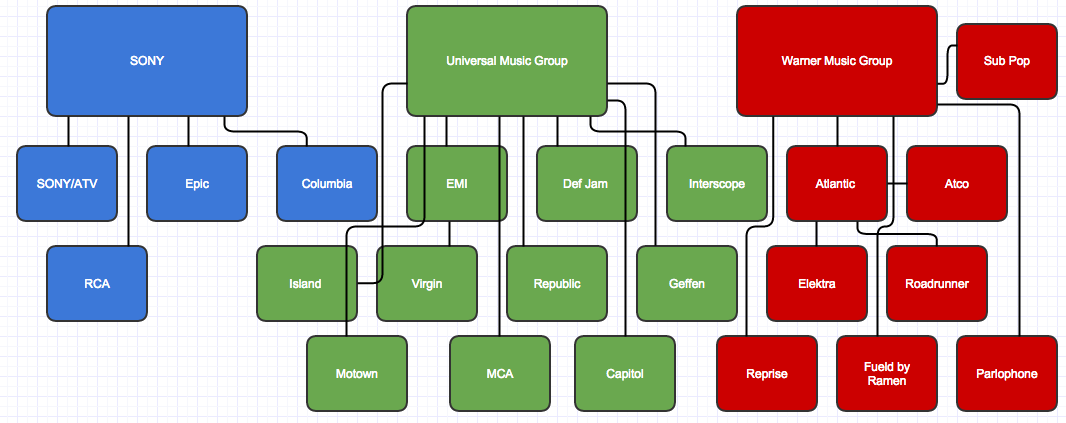
I could go on, but you get the point. This is not the “first ever artist-owned music service.” Frankly, it’s not really even “artist-owned;” it’s “label-owned by extension.” Let’s call it how it is, and pretending that these major label artists are independent operators is to fabricate an ideal (but false) reality. While it looks as if these artists belong to a whole slew of different labels, as my previous post on major label monopolies shows, this is a misleading thought process as they are more or less all owned by the Big Three. If anyone thinks that any of these artists will have the power to do things outside the interests of the three major record labels, they’re dreaming.

(click photo for larger preview)

The Big Three Major Labels and Their Subjects

The Big Three Major Labels and Their Subjects

Basically the Same Layout

Next, let’s talk about why the business model of Tidal is fanciful and unrealistic. TechCrunch reported earlier some details demonstrating that Tidal’s layout and functionality are basically a ripoff of Spotify’s layout. From what I’ve heard, Tidal basically copped Spotify’s layout, changed the colors, and added a few tweaks—but it’s not really all that different.

Married to An Obsolete Business Model

In terms of business model, what seems to make Tidal the most different is its decision not to offer a free tier (as Spotify and most other music services do). Rather, they will offer a high-quality lossless music experience for $20/month, and a downgraded, “premium” lower quality experience for the same $10/month that Spotify and other services charge (which, by the way, is an obsolete business model anyway). Jay Z and others at Tidal are banking on the hope that the rabid music fans out there will want to pay more money for higher quality music, in addition to more exclusive content on the Tidal service first.  While some music fans may in fact do this, it’s not a scalable hope because those fans are not the majority of music listeners.

Also, note that I said “more exclusive content on the Tidal service first“—which means it will definitely be available on other services too, just maybe a week or two later. And why not? Do you really think that the major labels who work with these artists are going to forego any revenue stream, just to keep Tidal more exclusive than the rest?? I don’t.

Tidal logo

 Tidal logo

So basically Tidal is going to offer the same major label music that is available everywhere else (including on non-music centered services like YouTube), but they’re going to nix the free tier (where most of Spotify’s conversions come from anyway) altogether and double the going rate for a monthly subscription. All the while, they will be aiming their service at a more niche market while providing non-niche music. Here’s my reality based on my experience in the music industry: high-fi, low-fi, it really doesn’t matter if your business model is outdated and your marketing strategy is insufficient for an overcrowded market. But yeah, this will definitely end well.

An Unscalable Model and Too Many Cooks in the Kitchen

Let’s move on, and I can’t believe no one has really focused in on this, especially those within the tech community (though it was mentioned a bit in the TechCrunch report): Jay Z has enticed these other major label names into becoming a part of this service not by offering them money up front, but by actually giving them equity percentages of the company. As reports that the equity numbers hover somewhere around 3%, this is an admirable shot by Jay Z. He’s trying to tie those artists’ respective loyalties to Tidal by making the service’s benefits their benefits. If Tidal does well and goes up in value, so do their stakes.

There are only two problems with this: 1) it’s not scalable, and 2) too many cooks in the kitchen. In an industry (tech startups) where founders are always told to limit the number of cofounders (the “too many cooks in the kitchen” nightmare”), Jay Z has amazingly disregarded the whole thought process and it seems no one has really noticed. What’s more, conducting company decisions in a “town hall” style is going to spell disaster for Tidal; you just can’t run a company like that. There needs to be one captain at the helm of a ship; any more and the ship will capsize. Also, keep in mind many of these artists don’t even work well with others in the studio—now they’re all going to run a company together? Right.

So to recap: unscalable business model and too many cooks in the kitchen.

More Dedicated to the Needs of Which Artists?

While I admire the desire by Jay Z and others to create a service that is more dedicated to “the needs and rights of artists,” let’s also be clear which artists those people are. They are not the artists the world-over who are coming up and trying to find their fanbases; they are the artists who already have legions of fans all over the world. We’re not talking about the girl from Minnesota who wants to be an R&B singer, or the punk band from Toronto who want to find their core fanbase. We are talking about (mostly) pop, rap, hip-hop, R&B, pop-rock, and other well-known stars who want to extend their control beyond their music to dip their toes in the music-tech industry.

I’m only critical because these are exactly the kinds of artists who really don’t need help right now. They have enough money, and even if they hop from label to label, their fans will follow. They have already found their fanbases and core listeners. It doesn’t matter which label or service they’re on, those fans will still find them and listen to their new albums and go see them on tour. So basically this is yet another rehashing of the same major label music that we’re already drowning in anyway. And while I’m a fan of some of these artists myself, I nonetheless am critical of what appears to be another desperate money grab. As the following screenshots demonstrate, though Jay Z and others may not see it that way, the point is that most of their fans will ( and do):

(click photos for larger previews)

Comment from BuzzFeed coverage of the Tidal release, number 1

Comment from BuzzFeed coverage of the Tidal release, number 1

Screen Shot 2015-03-31 at 3.12.36 PM

Comment from BuzzFeed coverage of the Tidal release, number 2

Screen Shot 2015-03-31 at 3.12.56 PM

Comment from BuzzFeed coverage of the Tidal release, number 3

Screen Shot 2015-03-31 at 3.13.12 PM

Comment from BuzzFeed coverage of the Tidal release, number 4

Screen Shot 2015-03-31 at 3.13.28 PM

Comment from BuzzFeed coverage of the Tidal release, number 5

If these artists really wanted to distance themselves from the major labels and the current music business dynamic, they would look for ways to explore other paradigms, rather than look for ways to make an obsolete system work.

In the End

In the end, I commend these artists for taking a step into a new arena, but I question their motives and the realities surrounding Tidal as a company. Personally, I think Jay Z way overpaid for Aspiro, and is seeking to build a service that really only artists (and that is to say a select kind of artist) will really appreciate and use. I don’t think that Tidal sets itself apart enough to really take over the demographics targeted by either Spotify, Apple Beats, or even SoundCloud. I think it’s a lot of bluster, but without any real solid business prospects. Only time will tell, but I think that Tidal is going to have a very tough time right out of the gate. We’ll see if Tidal is part of a rising tide, or simply another ankle-slapper service.

Artists Are Not “Bad Business People”

Two Differing Opinions

“Artists are not good business people; they need to be told what’s good for them.” Those were the exact words that came out of his mouth. And I disagreed with every single one of them.

But let’s back up. Last summer, I was having a conversation with an entrepreneurial peer of mine about the current state of the music industry, and possible avenues forward. He’d had some success with a small company working with a few venues, and with some other music industry professionals (who, as shall he, remain nameless). By all accounts, I thought my peer would have a positive outlook on the future of the music industry as he, like me, had experienced numerous problems that could be solved. And yet, his outlook was dreary at best; and at worst, insulting.

When we began discussing what possibilities there were to build tools to better enable artists to make informed business decisions, his response was terse, arrogant and negative: “Artists are not good business people; they need to be told what’s good for them.”

It’s All About Access to Knowledge

Immediately I knew our opinions on the evolving music industry would differ from then on. First, no, it’s not a true statement to say that artists are “bad business people” anymore than one could make the insinuation about construction workers, for example. In an industry where so much of the business has traditionally been done by a major label or other third party, artists are just now realizing that they have access to the tools to simply learn about how to be good business people, and many are taking advantage of the opportunity. No one would expect someone who’s never had access to a certain type of education to understand the intricacies of said education.

It comes down to simple access to tools and means of learning, traditionally things that have been outside the reach of most artists—after all, educating artists on the inner working of the music business never was in the best interest of the major labels. So if this is the case, why then would one criticize artists for not having knowledge of business dynamics when they have traditionally been denied such knowledge and experience in favor of a more “savvy” entity (a management firm or label, for example)?

Who Actually Knows “What’s best”?

Second, the statement that someone needs be told “what’s best” for them is beyond arrogant: it’s plain insulting. Many of the evolving concepts of business strategy that are popping up in the music industry nowadays I find are coming from the artists themselves. These are the people who are looking to new vehicles of distribution like the internet and new business models such as free or freemium as viable ways to push their careers forward. And from what I can tell, they’re getting pretty damn good at it. I find the things I learn that should have been so obvious to me many times come from discussion with artists themselves, opening my eyes to a reality I may not have previously considered or understood.

So if artists are continually researching and discovering new methods of business strategy to effectively compete in the new digital era, why is there still this pervasive view that they “need to be told what’s best for them?” Perhaps it’s just a difference of worldview, as with between my peer and myself. Whereas he appeared to see the world through a lens that was dismissive—and even bitter—I see possibilities abounding for how the industry can change with the technology available to give artists more power over their own careers. It’s arguable the in the end, the only opinions that matter are those of the artists, as they are the ones producing the material that so many other people are trying to find ways to monetize.

My Bet

Whatever the next big thing will be (and it’s anyone’s guess in this sort of fickle content market), what I don’t doubt is that artists will begin to step out from behind their guitars and amps to shape their own futures (much like programmers are being encouraged to step out from behind their keyboards and aspire to roles in management). I wouldn’t be so quick to underestimate the artists out there. In fact, just the opposite: they know what they want, and now they’re beginning to see how to successfully get it. For me, my bet’s on the artists 


Thanks to Mom and Dad for reading early drafts of this.

Four Music Industry Posts Refocused

This week I threw a lot of notions and facts about the music industry out there, so I thought I would take a moment today to help refocus on them. Rather than write another post and add to the pile of important things to understand, I thought it better to simply restructure this past week’s posts in an easier, more digestible way of reading them. Here’s a short list for a few posts that went up this week, with a short description of each.

1. Two Stories of Sexism in the Music Industry – Two stories of my own experience that illustrate the sexism and gender inequality in the music industry that needs to be rooted out and eliminated. As with the tech industry, the music business has refocused and taken aim at gender discrimination, but these two short examples prove how things need to be better.

The sexism problem that needs to be solved

The sexism problem that needs to be solved

2. The Lie of “Live Won’t Save Music” – The wonderful adage of “Live won’t save music”—and why it’s a flat-out lie. The dynamics of the “live” factor in the music business (including the economic realities), and why “Live won’t save music” only applies to those artists and music professionals still grasping at the old, obsolete business model. An examination on how people need to restructure their thoughts on the music business if they want to be able to create a new, more lucrative business model.

3. Why Isn’t the Music Business Fully Crowdfunded? – Inspired by some things which I heard VC Fred Wilson postulate during the LAUNCH festival earlier this month. Discussions of the freedom that crowdfunding has allowed artists, and why it’s contributing to a trend towards staying independent. More than that, though, an examination of how artists can leverage the dynamic of crowdfunding for a better return in their own pockets.

4. Tell Me Again How There’s No Monopoly in the Music Industry – A simple chart that shows the incredibly monopolistic spiderweb of the major record labels and their subjects. With SONY in blue, Universal Music Group in green, and Warner Music Group in red, it’s not hard to see how three CEO’s (of these respective companies) essentially control all the music in the mainstream. If that’s not a monopoly, I really don’t know what is.

(Click for larger preview) 

The Big Three Major Labels and Their Subjects

The Big Three Major Labels and Their Subjects

New articles coming next week. There’s a lot more in the music industry to uncover, and definitely a lot more than needs to be changed.

Two Stories of Sexism in the Music Industry

The kind of BS sexism we need to eliminate

The kind of BS sexism we need to eliminate

The Scourge of Sexism

With the issue of gender equality fast becoming one of the central topics in Silicon Valley (and by extension, the tech and startups industries) at the moment, I can’t say I’m anything but pleased. The problem of gender discrimination and the glass ceiling is long overdue for a solution. While I harbor no fantasies that such a solution will be found overnight, I am nonetheless pleased to see that there is a major effort being made to reform these shortcomings in the tech industry.

As a male, I can confidently say that gender discrimination hits very close to home for me; my parents both practice civil rights litigation, with a focus in employment discrimination and sexual harassment. I grew up seeing cases of blatant discrimination (and unfortunately it makes me angry to say I still do), where the the ugly beasts of intolerance and sexism were clearly visible. The latter, in particular, surprises me again and again because we are taught to believe that we’re moving forward in eradicating sexism—but not fast enough in my opinion. We still have a lot of work to do.

While the tech industry is starting to really spotlight and root out sexism within its ranks (as well it should), other industries are lagging too far behind in my opinion. The music industry, for example, is still too hampered by outright sexism for my taste, even after movements like third-wave feminism and Riot grrrl punk began to shatter the mold. It’s not a foregone conclusion by any means, and there are many within the music trenches who are trying very hard to change it for the better—to level the playing field so that gender becomes irrelevant—so that talent is acknowledged and validated by its inherent existence, regardless of the artist’s gender.

But let me provide two examples of what can be changed, and how people can step in to make the music arena more tolerant and progressive. Neither example makes me happy to share (less happy to have experienced), but perhaps that underscores their importance.

The Sleazy Promoter

The first example happened a couple of years ago, in the spring of 2013, and goes like this: I am good friends with a band whose members included a female element (the singer and drummer). The group was set to work with a promoter to book shows in their home state (which, though eliminated by name, I can say is quite a big market for independent music). The promoter made inappropriate and unwelcome advances towards the female band member(s) and the group cut ties, not wanting to work professionally with someone of such poor character quality. The promoter then retaliated by threatening to call every promoter within the state, seeking to destroy the group’s reputation, thus effectively cutting out their feet from under them. (In this particular state, I can say with confidence that there are at least seven major cities and/or scenes that they most likely split their time between).

I was in Amsterdam at the time, on my study abroad program. I woke up one day to a frantic “what do we do?? we’re going to get totally screwed by this person!” email from the singer. Even through text it wasn’t hard to clearly read her fear and anger over the situation. So her solution? Reach out to me in search of some advice.

The response I sent her was simple: I explained to her that I was behind her, and would throw the entire weight of my blog and radio show behind her and the band (and would bring in other artists I knew for support if need be). I even offered to write a letter as a professional contact (DJ and journalist) attesting to their quality as a band and professionalism as people, which they might use to send to anyone to rebuke the slanderous threats of this sleazy promoter. She seemed calmed by that offer (and most thankful, as you can imagine!) and we decided to see just how events would proceed.

In the end, the promoter never made good on his threats, and the whole situation seemed to blow over. But I never forgot that frantic email (I’m sure she hasn’t either), and to this day I’m still good friends with her and the band. The point is this: such a situation should never have occurred, and it very quickly seemed to spin out of control. But in situations like these, one needs to have the wherewithal to step up for what’s right. I didn’t do anything I didn’t think others wouldn’t do in the same situation. You don’t do it for pats on the back—you do it because it’s right.

The Sexist Tweeter

The second example happened more recently, during the Super Bowl this year. One of the Super Bowl commercials was to promote the hashtag #LikeAGirl to promote gender equality. This is one commercial I loved and supported, and I made so known on Twitter. This was the result:

The sexism problem that needs to be solved

The sexism problem that needs to be solved

I was actually staggered by the sheer sexism of the comment that I saw on my post. Someone telling me that I was sure to “get laid” for supporting “those feminists.” I was angry—actually I was seething. Not only had this person insulted the women that my comment was meant to support, but had dragged my name down too by insinuating that my motive was “to get laid.” I work with numerous artists—many of them with a female element—and I was pissed that this person had seen fit to insult not only people I work with, but people who are my friends.

The music industry is like the tech/startup industry in this respect—not perfect by any stretch of the imagination, but trying very hard to get better. And here was someone dragging us back to the dark ages. This is exactly the sort of thing that people in both industries (or any industry) need to find and root out. The people who make these comments and hold these views are toxic. It’s not (and won’t be) easy, but it has to be done. And it will be.

I for one will be on the lookout for it in the music industry, and will call anyone on it. I encourage other to take aim at sexism and gender discrimination in their respective industries which they know best. Music is my world, and I will not have it polluted with this sort of poison. Don’t step into my house and disrespect my business contacts and friends, it’s as simple as that.

The Lie of “Live Won’t Save Music”

The Introduction

Yesterday, I posted my second article inspired by Fred Wilson’s comments to Jason Calacanis during LAUNCH, wherein I focused on his comments about Kickstarter regarding the music and movie industries. The post itself became too long to explain the economics of the paradigm (of the music industry, at least), so I figured it would be better to do so here in a more focused post. So let’s jump in.

The Lie

In the music business, there’s a well-known adage: “Live won’t save music.” This is the argument that many within the established major label machine use to fend off the assertion that free distribution of music would actually help the music industry in the new digital era. The argument is that artists can’t make enough on a live performance to offset losses they would see by distributing their music for free. And in some cases this is true; income from live shows may not be able to offset those losses…for the major label artists, who have huge stage crews, large arena shows, and a long list of people to pay back (not least of which is their record label). 

The Secret

What industry professionals don’t tell you is that live shows are where artists have historically always made most of the money that goes into their pocket. Money from album sales most often gets paid back to the record label and company, whose “signing” of the artist was simply a monetary advance in the first place. In 1993, well-known artist/producer Steve Albini took aim at the expenses squeezed from artists in his essay “The Problem With Music.” Excerpts from the essay clearly detail how the real economics worked behind the scenes.

The Simple Economics

This simple economic reality means two things: 1) That it’s true that major label artists like Beyoncé and Robin Thicke may very well have a hard time making any real money from live shows and will possibly need to continue to rely on the age-old system’s business practices, and 2) That newer, increasingly independent artists can leverage this new business dynamic to their advantage. Whereas their major label peers are essentially tied to the old system (and streams) of revenue, newer artists who are either fully independent, or have contracts with smaller indie labels which afford them more control, don’t need to sell 150,000 albums or fill an arena tour to make a profit. In fact, they will have an easier time of it, precisely because their “stage crew” many times may only consist of a friend from high school watching the merch table.

And this is where Wilson’s comment comes into play, and is exactly right; crowdfunding platforms like Kickstarter and Indiegogo provide a way for artists (both inside and outside the music sphere) to secure funding for that next tour without being on the hook for ~$400,000 in album distribution and tour expenses.

In fact, there are many artists now exploring the possibilities of free precisely as a way to use their music as a means of marketing to jack up the money they’re able to raise on sites like Kickstarter. By using their music as a “free sample” of their brand, artists are able to explore the dynamic of giving their prospective fans a reason to come out and see them live, buy a shirt, bring a friend—all things that are better for them than the money for one album sale anyway. Music is increasingly being used by these artists as major means of marketing and branding, rather than solely as an end commodity for sale.

You can’t argue with math, and here’s reality: How many times are you compelled to and/or do you buy a song or album? Just once. Why would you buy it again unless you had to? But if you examine the same dynamic with respect to going to a show, or buying a t-shirt, suddenly the answer is “as many times as you want.” It becomes a self-feeding cycle, wherein new possibilities are presented by the power of crowdfunding, and not having to go to a major label for the financing. It boils down to simple arithmetic.

The Album You Had to Buy Over and Over Again

It’s worth noting, also, that the established music industry got used to people buying the same album(s) over and over again because they had to. With each subsequent technological change, that Led Zeppelin album you loved so much became obsolete, and thus you needed to shell out more money for something you already had. Buying music on ’45’s became buying the same music again on LP’s, then again on cassettes, again on CD’s, and then again as basic mp3 files (usually off iTunes).

But something happened during that last transformation: music became distilled down to only the information, sans any physical product, and with the power and reach of the internet, distribution costs dropped to zero. Suddenly, the ability to reproduce and distribute music became the cost of 10 minutes of your time, and didn’t even require the kind of distribution networks that record labels had spent decades building, growing and protecting.

And who was it who lost out the most? The demographic that gleaned most of their revenue from physical album unit sales—the major record labels. But the artists now had a new reality in front of them: mass distribution, but without having to indenture themselves to the “physical CD sales-dynamic.” They were (and are) free to make money where they always have: in the live sphere with grass-roots ticket sales and merchandise sales. Thus it becomes clear that the statement “Live won’t save music” is inherently a biased lie. Live won’t save the old music industry, but those within the industry who are adapting to the new terrain are doing just fine exploring the new possibilities before them.

The New Free/Live Dynamic

Those are the people I would place my bets on. They have no stake in the old paradigm, and are happy to push it aside to see what the new free/live dynamic can do for them. This is where the real money in the music industry will be in the next decade. Not grasping with frail fingers at a business model quickly fading away, but exploring with wide-open eyes the opportunities that “free/live” afford both those in the music trenches, and their prospective fans. Don’t be fooled; there’s still a ton of money and opportunity in the music industry. You just need to know where to look.

Why Isn’t the Music Business Fully Crowdfunded?

Last week, I posted an article detailing VC Fred Wilson’s thoughts on investing, in which I drew on a few things he’d stated during his interview with Jason Calacanis at LAUNCH. This time around I want to explore another statement Wilson made during his time on stage which I thought received way too little attention at the time. In fact, I’m quite shocked that more people haven’t really latched onto this sooner.

At one point during the conversation, Wilson mused, “I don’t understand why the music business isn’t fully on Kickstarter,” to which there was some murmuring (I heard sitting in the audience), but no real discussion thereafter of that particular comment. While I was just as interested in the next point that Wilson discussed with Calacanis (the subject of my previous post), I couldn’t (still can’t) get my arms around how something so stark to many people seems to fly under the radar. But before I get too incoherent, let me back up and explain my exasperation.

The wonderful thing about Kickstarter (or any of the other crowdfunding platforms) is the freedom that they give to artists. In the case of the music industry, the freedom I’m referring to is the ability to not have to sign to a major record label in order to have money to finance an album, tour, video, etc. Instead, artists can go directly to their own fanbases and raise the required capital from them, thereby side-stepping the very real consequence of having to sign away some amount of creative control (ever hear of master tapes?) to the major label. As a result of this, artists consequently side-step the dynamic of accruing a similar sort of debt with the label itself. (I will explain the deeper economics at play here in a later post).

The dynamic of crowdfunding has changed the entire paradigm of the music industry. Wilson’s comments struck me so much because of how true they really are. He doesn’t need to be a guitarist in a band to understand that the freedom that services like Kickstarter give content-producing artists is invaluable (clearly the reason he invested in Kickstarter in the first place). His own “I don’t understand why” comment exhibits his understanding of the services that used to be out of reach of artists, which are now readily available thanks to crowdfunding dynamics.

Of course, crowdfunding alone can’t and won’t control an entire vertical like, say, the music industry. It’s one part of a larger mechanism. But it’s nonetheless a shift in the paradigm of music production, distribution and consumption that was previously unavailable. Where crowdfunding really comes into play is when it totally disrupts the age-old adage “live won’t save music” (but that’s an argument for a later post).

Here’s the real point: Fred Wilson is an investor, not a guitarist or aspiring singer. Yet he sees the value of crowdfunding so much (investment interest aside) that he doesn’t understand why any artist would forgo the opportunities presented by these new services. And I’m inclined to agree with him (and I’ve been in the music industry now for years). So here’s the real question: if he gets it, and I get it, don’t you think that all the new artists out there get it too?

It just might be a very short time until the music business is fully (or mostly) crowdfunded.

Tell Me Again How There’s No Monopoly in the Music Industry

Most all of the record labels you know are owned by three major parent corporations: SONY, Universal Music Group (UMG), and Warner Music Group (WMG). Even Sub Pop, the once-famous Seattle independent label, is now owned by WMG. The only pseudo-famous label not on here is K Records, which became famous around the same time as Sub Pop for releasing off-beat alternative music in the ’90s. But for most everyone else, it’s just a question of which corporation you have pulling the strings. Tell me again how there’s no monopoly in the music industry.

(Click image for larger preview.)

The Big Three Record Labels, and All Their Subjects

The Big Three Record Labels, and All Their Subjects

SONY:

  • SONY/ATV
  • RCA
  • Epic
  • Columbia

Universal Music Group:

  • EMI
    • Virgin
  • Island
  • Motown
  • Def Jam
  • Republic
  • MCA
  • Capitol
  • Geffen
  • Interscope

Warner Music Group:

  • Reprise
  • Atlantic
    • Elektra
    • Roadrunner
    • Atco
  • Sub Pop
  • Fueled by Ramen
  • Parlophone